I walked into the hospital barefoot, pregnant, and covered in blood, but when they asked me to call my husband, all I could do was beg: “Don’t let him near me,” and the card hidden in my bag revealed a truth no one expected.
I walked into the hospital barefoot, pregnant, and covered in blood, but when they asked me to call my husband, all I could do was beg: “Don’t let him near me,” and the card hidden in my bag revealed a truth no one expected.
PART 1
—Don’t call my husband.
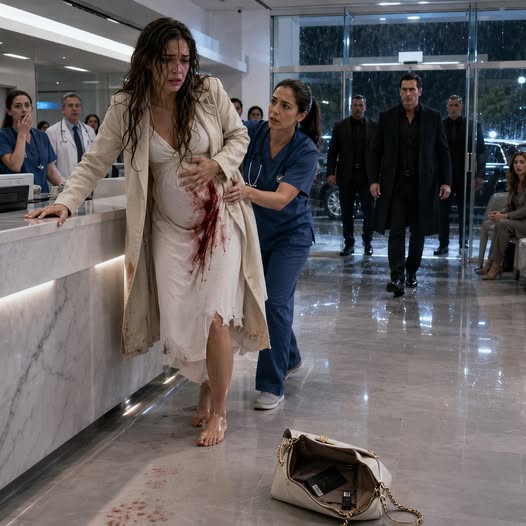
That was the first thing I managed to say when I stumbled into the emergency room, covered in blood, barefoot, one hand protecting my seven-month pregnant belly.
That night, São Paulo felt like it was collapsing.
Rain slammed against the windows of Hospital Santa Clara, near Paulista Avenue, as if trying to break inside. Cars splashed water onto the sidewalks, sirens cut through the night, and inside the ER, everyone looked too tired to be shocked by anything.
Until I arrived.
It was 11:42 p.m.
The automatic doors slid open and I walked in staggering, my white dress clinging to my body, wet hair stuck to my face, a dark stain spreading across my chest.
Not rain.
My blood.
A child stopped crying in his father’s arms. An older man with a bandaged hand stared. The receptionist froze mid-motion. For a few seconds, no one moved, like they had just seen something that wasn’t supposed to exist.
I tried to reach the counter, but my legs gave out.
—Help… my baby…
The nurse who ran toward me was named Camila. I didn’t know that yet. All I saw was a blue uniform rushing in, her expression shifting from exhaustion to horror.
—Trauma 1! Now! Pregnant patient, bleeding!
I fell into her arms before hitting the floor.
After that, everything broke into fragments.
Bright lights.
Gurney wheels.
Fast voices.
Scissors cutting fabric.
Hands checking my pulse.
Oxygen mask on my face.
—Pressure dropping!
—Call OB now!
—Blood bank, urgent!
The pain arrived late, like my body only remembered it when I finally stopped running from it. It came from my belly to my back, burning, tearing, stealing what little air I had left.
When they opened my coat, the silence changed.
They saw the bruises.
On my arms.
On my wrists.
On the side of my belly.
Finger marks. Force marks. Signs that didn’t match a fall, an accident, or a scare.
Someone had done this to me.
And everyone in that room understood without me needing to explain.
—My baby… —I whispered.
Camila leaned over me.
—We’re going to take care of both of you. Stay with me.
I tried to answer, but darkness crept in at the edges.
Then a sound filled the room.
Thump-thump-thump-thump.
His heartbeat.
Fast. Terrified. Alive.
My son was still there.
Inside me, fighting with me.
While the doctors tried to save us, someone searched my wet bag for ID. My phone was shattered, screen cracked. No emergency contact marked with a heart. No “my love.” No “Renato.”
Only my identity card.
Helena Vasconcelos Falcão.
Wife of Renato Falcão, a famous prosecutor, constantly on television talking about justice, family, and morality. The man who stood beside me smiling at charity events like a perfect husband. The man people said might become a minister.
But his wife was not supposed to arrive barefoot, bleeding, and terrified in the middle of the night.
The staff kept searching until they found a black card, no logo, no address, no title.
Just a name written in small letters:
Dante.
On the back, a handwritten line:
“If one day you have nowhere left to run, call me.”
Camila looked at me on the gurney. Then at the card. Then at the marks on my wrists.
And she made a decision that changed everything.
She called.
He answered on the first ring.
—Talk.
His voice was low, cold, dangerous.
—This is Santa Clara Hospital. Helena Falcão was admitted in critical condition.
Silence.
Not confusion.
The silence of someone who, in one second, locked an entire storm inside his chest.
—Is she conscious?
—No.
—And the baby?
Camila swallowed hard.
—Alive.
Another pause.
—Is Renato Falcão there?
—No, sir.
His voice dropped even lower.
—Don’t call him first.
—But protocol…
—I’ll be there in eight minutes.
He hung up.
And eight minutes later, three black SUVs pulled into the emergency entrance like the entire street had been told to clear a path.
Men in dark suits stepped out calmly. No running. No shouting. No asking permission.
A security guard reached for his radio, but didn’t press the button.
Then Dante Albuquerque walked in.
Owner of security companies, port warehouses in Santos, nightclubs, and rumors no journalist dared to fully investigate. A man politicians avoided looking at directly. A man criminals pretended not to know. A man I swore I would never call again.
The hospital administrator tried to stop him.
—Sir, only family—
Dante grabbed him by the collar and lifted him slightly off the ground.
The entire ER froze.
—Tonight —he said quietly— I am the only family she has.
And nobody could believe what was about to happen.
PART 2
Dante walked into Trauma 1 and stopped beside my gurney.
I was pale, hooked to monitors, my belly covered with a thermal blanket. My feet, now cleaned, still had small cuts—silent proof I had run without looking back.
He didn’t lose control.
Men like Dante don’t collapse in front of doctors or cameras.
But Camila saw his jaw tighten. Saw his hand slowly clench. Saw his eyes move over my wrists, my belly, the fetal monitor.
—Who did this? —he asked.
The doctor exhaled.
—Right now our priority is stabilizing her.
—I asked who did this.
—She came in alone. We don’t know yet.
Dante stood still.
And that stillness was worse than anger.
Camila handed him the black card.
—We found this in her bag.
He stared at it like it was an old wound reopening. Ran his finger over the handwritten line on the back and closed his eyes for half a second.
When he opened them, he looked like a different man.
—Did you call Renato?
—Not yet.
—Good.
The doctor frowned.
—Sir, Renato Falcão is her husband. He must be notified.
Dante turned slowly.
The doctor stopped speaking.
At that moment, my hand moved slightly under the blanket.
Camila leaned in.
—Helena? Can you hear me?
I opened my eyes just a little. Everything was light, shadow, pain. But I recognized the voice before the face.
—Dante… —I whispered.
The room heard it.
The doctor heard it.
Camila heard it.
The men in suits at the door heard it.
The pregnant wife of São Paulo’s most respected prosecutor knew the first name of the city’s most feared man.
Dante leaned closer.
—I’m here.
My fingers reached for his. He held my hand carefully, as if I might break.
—Don’t… Renato…
The words barely came out.
But they were enough.
Don’t call my husband.
Don’t let him come near.
Dante looked around the room.
—Nobody calls Renato Falcão.
Camila returned with a transparent evidence bag containing my belongings. Inside: my broken phone, my ID, a small key, lipstick without a cap—and something sewn into the lining of my bag.
A black USB drive.
With a dried drop of blood on it.
—This was hidden —Camila said. —We didn’t know if it mattered.
For the first time, Dante looked shaken.
—Who else saw it?
—Just me and triage. No one else.
He took the USB like it weighed more than a weapon.
I tried to speak.
—Proof…
He leaned in.
—What?
—Renato… proof…
His grip tightened.
—I’ve got you.
A tear slipped down my face. Pain, fear, relief—I didn’t know anymore.
Then the nursing phone rang.
A nurse looked at the screen and went pale.
—It’s Dr. Renato Falcão.
The air disappeared from the room.
Outside, the perfect husband was calling the hospital where his bleeding wife had just arrived.
And Dante Albuquerque was standing at my bedside holding the evidence that could destroy a prosecutor’s career.
—Don’t answer —Dante said.
The phone rang again.
Once.
Twice.
Three times.
Then the fetal monitor screamed.
—Fetal heart rate dropping! —Camila shouted.
The doctor rushed.
—OR now!
Dante released my hand only because they had to move me. Before the gurney rolled away, he leaned in.
—I won’t let him touch you again.
The phone stopped.
And seconds later, it started again.
Renato Falcão never accepted being ignored.
In that corridor, between monitor alarms and rain hitting the glass, everyone understood the truth hadn’t arrived yet.
But it was already knocking at the door.
PART 3
When I woke up, the world smelled like medicine, alcohol, and milk.
For a few seconds, I thought I was still running.
My body curled instinctively before my mind remembered where I was. Then the pain came—deep, heavy, cutting through my belly.
—Easy, Helena.
Camila’s voice was close.
I opened my eyes slowly.
The room was bright. The rain had stopped. São Paulo outside looked gray, wet, indifferent.
My hand went straight to my stomach.
It wasn’t the same.
Panic rose in my throat.
—My baby…
Camila held my fingers.
—He’s alive.
I cried before I understood.
—He’s in the neonatal ICU, but he’s alive. He was born small, scared—but he was born fighting.
I closed my eyes and cried like my body had finally been allowed to break.
—Dante…?
—He’s outside. Hasn’t left since yesterday.
I turned my head.
Dante stood in the hallway, visible through the glass. No jacket, sleeves rolled up, exhausted face. He wasn’t looking at his men. He was looking at me like he had spent the night holding the world back so it wouldn’t swallow me.
Camila left.
He came in.
For a moment, neither of us spoke.
Years stood between us.
Years of silence.
Years since I chose Renato—the “right path,” the “respectable man,” the “safe future.” Years since Dante handed me that black card and told me I didn’t have to survive alone.
I kept it.
Never used it.
Until the night I thought I was going to die.
—The baby? —he asked.
—Alive.
He exhaled like that word loosened something inside him.
—And the USB?
He took out a sealed envelope.
—Safe.
I looked at it and felt fear return.
—Does Renato know?
—He knows you’re alive. He knows I’m here. He doesn’t know how much you brought out.
I turned away, ashamed.
—I should’ve spoken sooner.
—You should have —he said.
It hurt because it was true.
But there was no judgment in his voice. Only exhaustion.
—What’s on it, Helena?
I stayed silent for a few seconds.
Then I told him.
I told him Renato wasn’t just a respected prosecutor. He used his position to sell protection, bury investigations, destroy enemies, and appear clean on television. I told him I recorded conversations, meetings, documents. I hid evidence for months.
I told him I thought the pregnancy would change him.
It didn’t.
It made him worse.
The control.
The isolation.
The fear.
And the night he found my bag open.
—You recorded what? —he asked.
I whispered:
—Everything.
Dante was silent.
Then:
—You didn’t destroy anyone.
A knock interrupted.
The door opened.
Renato Falcão walked in.
Perfect suit. Controlled expression. Concerned mask.
Behind him, an assistant and two police officers.
He smiled when he saw me.
—My love, thank God.
My entire body went cold.
Dante stepped in front of me.
Renato looked at him and smiled thinly.
—Dante Albuquerque. Of course.
—Don’t come closer.
—You’re threatening a prosecutor in a hospital?
—I’m protecting a woman you almost killed.
For a split second, something cracked in Renato’s face.
Then the mask returned.
—Helena is confused. She fell. She lost blood. She’s medicated. I already arranged for a transfer to a private hospital.
—I’m not going with you —I said.
My voice was weak, but real.
Renato looked at me like I had broken a rule.
—Don’t make this difficult.
Camila entered with a folder.
Behind her, a woman in a dark blazer.
Detective Patrícia Nogueira.
Renato lost color.
—What is this?
Dante didn’t answer.
I did.
—The part you never thought would reach you.
Patrícia lifted the USB in an evidence bag.
—Mr. Renato Falcão, we are opening a formal investigation for corruption, coercion, obstruction of justice, and domestic violence against Helena Vasconcelos Falcão.
—This is ridiculous.
—We also have medical reports, photographs, audio recordings, and your arrival records at the hospital.
Renato looked at me.
No love.
No concern.
Only anger.
—You destroyed my life.
I held the sheet tightly.
—No. I saved mine.
Outside the glass, the perfect husband no longer looked perfect.
He looked exposed.
PART 4
Miguel was born 21 days later.
Small. Fragile. Alive.
I sat beside his incubator every day, my hand against the glass, promising him he would never confuse fear with love.
Dante didn’t become a hero.
Real life doesn’t work that way.
He was still a man full of shadows.
But that night, when everyone respectable was afraid to act, he was the one who protected the evidence, called the authorities, and stood at the door so Renato couldn’t enter.
Months later, I signed the divorce papers.
My hands didn’t shake.
When I left the courthouse, reporters were waiting.
One asked:
—Helena, what would you say to women afraid to report powerful men?
I looked at Miguel.
Then at the camera.
—I would say powerful men fall too. And no beautiful house is worth a woman’s silence.
That day, thousands commented.
Some called me brave.
Some asked why I waited so long.
But only someone who has lived inside a glass prison with a respectable name on the door understands:
Leaving doesn’t start with your feet.
It starts the moment you realize survival itself is already a form of screaming.
That night, I entered the hospital thinking I had lost everything.
But it was there—covered in blood, barefoot, barely able to speak—that I finally stopped asking permission to live.