Iran Just Walked Into Trump’s Perfect TRAP, Then Everything COLLAPSED!!!
Iran’s Hormuz Gambit and Trump’s Strategic Countermove: A High-Stakes Energy Confrontation Reshapes Global Power Dynamics
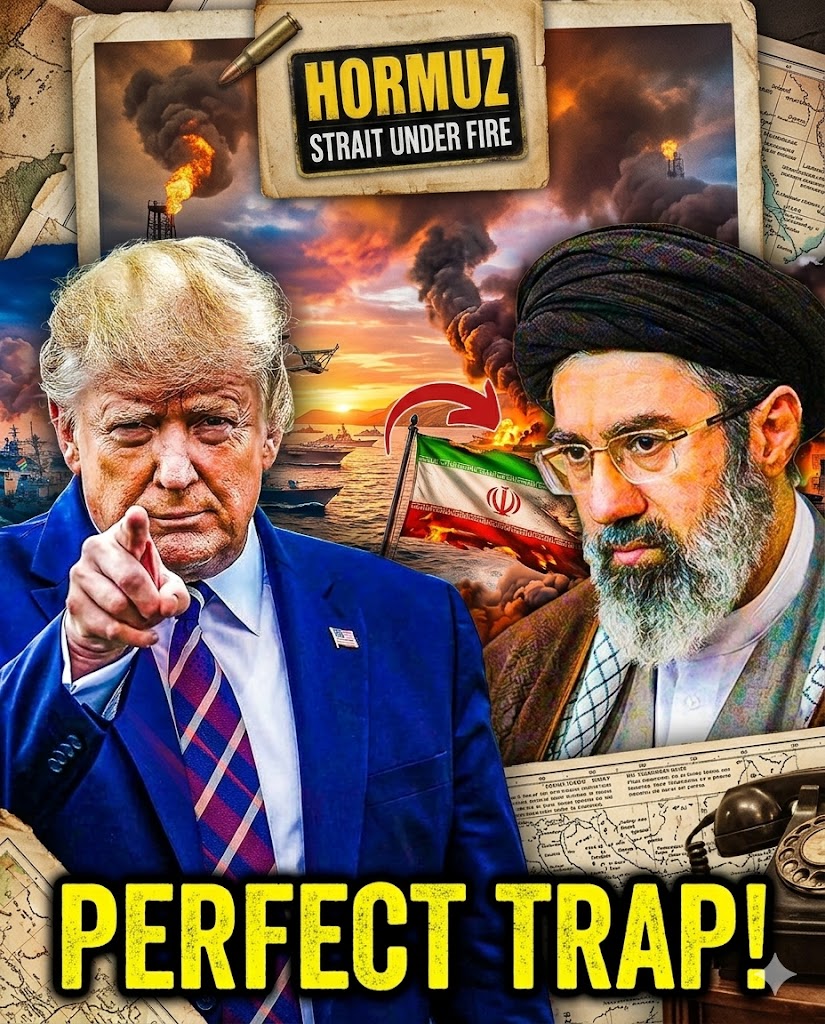
In the volatile waters of the Strait of Hormuz—through which nearly one-fifth of the world’s oil supply flows—recent events have triggered a wave of geopolitical claims, counterclaims, and sharply divided interpretations about who now holds the upper hand in one of the world’s most critical energy corridors.
Supporters of former President Donald Trump describe a decisive strategic breakthrough: Iran, they argue, attempted to leverage its long-standing threat to disrupt the Strait of Hormuz as a geopolitical weapon, only to find itself economically and militarily cornered by a coordinated U.S.-led response. Critics, however, warn that such narratives oversimplify a deeply complex and still-unfolding regional confrontation.
At the center of the debate is a rapidly evolving confrontation that has played out over a compressed 60-day military and diplomatic window—one that has included drone strikes, naval operations, economic pressure campaigns, and high-level negotiations involving the United States, Iran, and multiple regional powers.
While official details remain fluid and often disputed, the broader contours of the episode reveal a striking shift in how energy security, military deterrence, and geopolitical leverage intersect in the modern Middle East.
A chokepoint that defines global energy security
The Strait of Hormuz has long been considered one of the most strategically sensitive waterways in the world. Located between Iran and Oman, the narrow passage serves as the primary export route for crude oil and liquefied natural gas from Gulf producers including Saudi Arabia, Iraq, Kuwait, and the United Arab Emirates.
For decades, Iran has treated its geographic position along the strait as a form of strategic leverage. Iranian military doctrine has frequently emphasized the ability to disrupt maritime traffic through missile systems, fast-attack boats, naval mines, and drone operations.
The underlying assumption has been simple: any significant disruption to the Strait of Hormuz would trigger immediate global economic consequences, particularly in energy markets.
That assumption has historically given Tehran disproportionate influence in regional negotiations, even as it faced sanctions and military pressure from Western governments.
But recent developments, according to supporters of the Trump administration’s approach, suggest that this leverage may no longer function as effectively as it once did.
Iran’s escalation and the U.S. response
In the latest cycle of tensions, Iranian forces reportedly intensified military signaling in and around the Strait of Hormuz, including the deployment of drones and increased naval activity. These actions came amid broader regional instability involving Israel, Hezbollah in Lebanon, and ongoing diplomatic negotiations over Iran’s nuclear program.
According to U.S. military officials, Iranian drones launched toward commercial shipping lanes were intercepted by American and allied forces operating in the region. U.S. Central Command stated that all incoming systems were neutralized and that maritime traffic continued uninterrupted.
The operational response involved a multi-layered defense architecture combining air patrols, naval intercept capabilities, electronic warfare systems, and emerging counter-drone technologies.
Among the platforms reportedly involved were U.S. fighter aircraft, naval assets, and advanced counter-unmanned aerial systems designed specifically to address the proliferation of low-cost drone warfare.
Defense analysts note that modern U.S. strategy in the Gulf has increasingly focused on layered deterrence—ensuring that no single type of attack system can overwhelm defenses.
A narrative of strategic reversal
Supporters of Trump’s foreign policy approach argue that Iran’s attempt to assert leverage over the Strait of Hormuz ultimately backfired, triggering a coordinated U.S. response that not only neutralized military threats but also imposed significant economic pressure on Tehran.
They describe a so-called “counter-blockade” strategy in which U.S. naval forces ensured continued global energy flow while simultaneously restricting Iran’s own ability to export oil.
In this framing, Iran’s decision to threaten or disrupt maritime traffic became self-defeating, as it allegedly accelerated international coordination against its economic interests.
Proponents argue that this dynamic forced Tehran into a position where continued escalation would have resulted in worsening economic conditions, while de-escalation required acceptance of negotiated constraints.
Critics of this interpretation, however, caution that such assessments often rely on selective data and post hoc strategic narratives that may not fully reflect the operational complexity of the situation.
The economics of energy pressure
At the heart of the confrontation is a fundamental economic reality: Iran’s government relies heavily on oil exports for revenue, while global markets depend on uninterrupted energy flows through the Gulf.
When tensions rise in the Strait of Hormuz, oil prices typically react quickly, reflecting the risk premium associated with potential disruption. During the latest episode, prices reportedly fluctuated before stabilizing following diplomatic announcements and indications that shipping lanes would remain open.
According to proponents of the U.S. strategy, this stabilization reflects successful deterrence and the effectiveness of maintaining open maritime corridors despite Iranian signaling.
They argue that Iran’s own economic position became increasingly strained under the pressure of sanctions, asset freezes, and reduced export capacity during earlier phases of the conflict.
However, energy analysts emphasize that global oil markets are influenced by multiple factors simultaneously, including production decisions by OPEC members, global demand trends, and broader macroeconomic conditions.
As a result, attributing price movements solely to military developments in the Strait of Hormuz may oversimplify a far more complex system.
Military doctrine and asymmetric strategy
Iran’s approach to the Strait of Hormuz has long been rooted in asymmetric warfare doctrine—leveraging relatively low-cost, high-impact systems such as drones and fast-attack boats to offset conventional military disadvantages.
The Revolutionary Guard Corps (IRGC) has developed a strategy centered on denial rather than control: if Iran cannot dominate the waterway outright, it can make it sufficiently risky to deter adversaries.
Supporters of the Trump-aligned interpretation argue that recent U.S. countermeasures have significantly reduced the effectiveness of this doctrine.
They point to integrated air and naval systems, including advanced missile defense platforms, electronic warfare capabilities, and directed-energy weapons under development or deployment, as evidence that the cost asymmetry has shifted.
In particular, they highlight the growing use of low-cost intercept systems—such as laser-guided rockets and short-range air defense guns—as a way to counter Iran’s relatively inexpensive drone arsenal.
This shift, they argue, undermines Iran’s ability to impose disproportionate costs on adversaries.
The strategic role of energy independence
A central theme in pro-Trump analysis of the situation is the assertion that the United States has fundamentally altered global energy geopolitics by expanding domestic production and export capacity.
They argue that the United States has transitioned into a leading global exporter of oil and gas, reducing its vulnerability to disruptions in the Middle East and increasing its strategic flexibility.
From this perspective, Iran’s traditional leverage over global energy markets is diminished, as alternative supply routes and producers can offset disruptions more effectively than in previous decades.
Energy economists, however, note that while U.S. production has increased significantly, global markets remain deeply interconnected, and disruptions in key chokepoints like the Strait of Hormuz can still have immediate and widespread price impacts.
China, global trade, and indirect pressure
Another dimension of the conflict involves China, which remains one of the largest importers of crude oil passing through the Strait of Hormuz.
Analysts note that any sustained disruption to the waterway would have direct consequences for Chinese energy security, creating indirect pressure on Tehran through one of its key economic partners.
This dynamic has led some observers to argue that China’s interests in maintaining stable energy flows align, in practice if not explicitly, with broader international efforts to keep the strait open.
In this context, Iran’s ability to use the strait as a geopolitical tool is constrained not only by Western military presence but also by the economic interests of non-Western global powers.
A contested interpretation of outcomes
Despite claims of decisive strategic success, the situation remains highly contested in academic and policy circles.
Some analysts argue that Iran retains significant regional influence through proxy networks, missile capabilities, and asymmetric operations across the Middle East, including in Lebanon, Iraq, Yemen, and Syria.
Others emphasize that while Iran may have suffered operational setbacks, its broader strategic position has not been fundamentally altered.
The divergence in interpretation reflects a broader challenge in assessing modern hybrid conflicts, where military action, economic pressure, and information warfare operate simultaneously.
Conclusion: a shifting but unresolved balance
What has emerged from the recent confrontation in the Strait of Hormuz is not a clear resolution, but a shifting balance of pressure between competing strategic actors.
Supporters of the Trump-aligned strategy view the outcome as a demonstration of effective deterrence: Iran’s most powerful leverage point, they argue, was neutralized through a combination of military readiness, economic resilience, and coordinated diplomacy.
Critics counter that the situation remains unstable, with unresolved nuclear issues, regional proxy conflicts, and fragile ceasefire arrangements still capable of reigniting broader escalation.
What is clear, however, is that the Strait of Hormuz remains at the center of global strategic attention—and that its role as both a physical chokepoint and a geopolitical pressure valve is as important as ever.
Whether the current moment represents a lasting strategic shift or a temporary pause in a longer cycle of confrontation remains an open question.
But for now, the flow of oil continues—and so does the contest over who ultimately controls the balance of power in one of the world’s most consequential waterways.