U.S. Military Is About To UNLEASH Reaper Drones On Iran’s Fast Boats
U.S. Military Is About To UNLEASH Reaper Drones On Iran’s Fast Boats
Operation Freedom Plus: How U.S. Reaper Drones Could Crush Iran’s “Mosquito Fleet” in the Strait of Hormuz
The Strait of Hormuz has once again become the center of global attention. For decades, military strategists understood one unshakable reality: whoever controls this narrow maritime corridor holds enormous influence over the world economy. Nearly a quarter of the world’s seaborne oil shipments pass through the strait, making it one of the most strategically vital waterways on Earth. In May 2026, that fragile balance appears closer to collapse than at any time in modern history.
The latest escalation between the United States and Iran has transformed the Persian Gulf into a high-stakes military chessboard where drones, missile boats, aircraft carriers, and economic pressure are all converging toward a potentially explosive confrontation. At the center of this looming conflict is a weapon system that symbolizes modern American warfare: the MQ-9 Reaper drone.
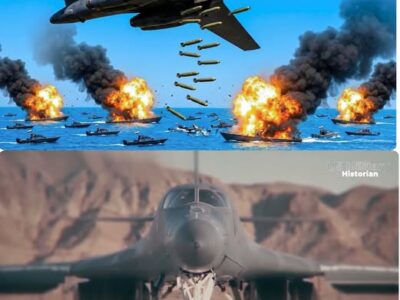
What makes the current situation especially dangerous is not merely the presence of advanced military technology. It is the collapse of diplomacy at the exact moment both sides are positioning themselves for a much larger confrontation. President Donald Trump’s public rejection of Iran’s latest peace proposal marked a turning point. According to reports, Trump dismissed the proposal as “garbage” before publicly sharing imagery of MQ-9 Reaper drones destroying Iranian fast attack boats. That sequence of events was interpreted around the world as more than political theater. It was seen as strategic signaling.
The message was unmistakable: the United States is preparing for the possibility of renewed military operations in the Strait of Hormuz.
The End of the Diplomatic Window
Since the beginning of Operation Epic Fury on February 28th, 2026, the conflict has steadily escalated despite repeated international attempts to negotiate a ceasefire. Pakistan, Oman, China, and several European governments all attempted to mediate between Washington and Tehran. Temporary pauses in combat created brief hopes for diplomacy, but none of those efforts produced a breakthrough.
Iran’s latest proposal reportedly demanded sweeping concessions from the United States. Among its most controversial demands were:
Full sovereignty over the Strait of Hormuz
Immediate removal of American sanctions
An end to the naval blockade
War reparations from Washington
Delayed discussions regarding Iran’s nuclear program
For American officials, these demands were seen as completely detached from the military and economic realities Iran currently faces. The U.S. blockade has severely disrupted Iranian oil exports, costing Tehran hundreds of millions of dollars per day. Storage facilities are nearing capacity, export routes remain constrained, and key infrastructure has already suffered major damage.
In Washington’s eyes, the proposal appeared less like genuine diplomacy and more like a political performance aimed at Iran’s domestic audience, particularly the Islamic Revolutionary Guard Corps (IRGC).
Trump’s rejection effectively slammed the door on the current diplomatic phase of the conflict.
Iran’s “Mosquito Fleet” Strategy
To understand why the United States is now focusing so heavily on MQ-9 Reaper drones and attack helicopters, it is necessary to understand Iran’s naval doctrine.
Iran knows it cannot defeat the U.S. Navy in a conventional naval war. The technological gap is simply too enormous. American aircraft carriers, destroyers, submarines, stealth aircraft, and surveillance systems vastly outperform Iran’s traditional naval assets.
Instead, Iran built an asymmetric strategy.
That strategy centers around what military analysts often call the “Mosquito Fleet” doctrine.
Rather than relying on large warships, Iran developed hundreds of small, fast attack boats designed to overwhelm enemy defenses through numbers, speed, and geographic advantage. These boats are lightweight, difficult to track in crowded coastal waters, and capable of carrying anti-ship missiles, rockets, machine guns, drones, and even suicide explosive payloads.
The doctrine emerged directly from the trauma of Operation Praying Mantis in 1988, when the United States Navy destroyed much of Iran’s conventional naval force in a single day. Iran’s military leadership concluded that fighting America symmetrically was suicidal. Instead, they embraced swarm warfare.
The Strait of Hormuz is ideal terrain for this approach.
At its narrowest point, the strait is only around 33 kilometers wide. It contains islands, inlets, shallow waters, and heavy commercial shipping traffic. These conditions create radar clutter and shorten engagement distances. Iran believes these factors partially neutralize America’s long-range technological superiority.
The IRGC Navy reportedly maintains between 500 and 1,000 fast attack craft dispersed across southern Iran’s coastline. Many are hidden inside tunnels, caves, and concealed coastal facilities.
In theory, if hundreds of these boats attack simultaneously, they could saturate defensive systems and create enough chaos to damage commercial shipping or even threaten major naval vessels.
That is the theory.
But modern American warfare has evolved specifically to counter precisely this kind of threat.
Why the MQ-9 Reaper Changes Everything
The MQ-9 Reaper drone is not simply a surveillance platform. It is one of the most effective hunter-killer systems ever developed for asymmetric warfare.
Originally designed for counterterrorism operations, the Reaper has evolved into a highly sophisticated multi-role combat drone capable of surveillance, reconnaissance, precision strikes, and target coordination.
Against Iran’s fast attack boats, the Reaper offers several critical advantages.
First, it provides persistent surveillance. Unlike fighter jets that must cycle in and out of combat zones, MQ-9s can remain airborne for extended periods, continuously monitoring Iranian coastal activity.
Second, the Reaper can detect and track small maritime targets in crowded environments. Fast attack boats attempting to emerge from tunnels, hidden coves, or island cover can be identified long before they reach open water.
Third, the drone is armed.
Hellfire missiles mounted on MQ-9s are extremely effective against lightly armored boats. One particular variant, the AGM-114R9X, sometimes nicknamed the “Flying Ginsu,” replaces an explosive warhead with extending blades designed for precision strikes with reduced collateral damage.
This is especially important in congested shipping lanes where large explosions could threaten civilian vessels.
Most importantly, the MQ-9 combines surveillance and strike capability into a single platform. The drone does not need to hand off targets to another aircraft. It can identify, track, and destroy boats within minutes.
That dramatically shortens the kill chain.
The American Kill Chain
The U.S. military’s strategy in the Strait of Hormuz relies on layered coordination between multiple systems operating simultaneously.
At the top of the surveillance network are E-2D Hawkeye aircraft operating from aircraft carriers. These airborne radar platforms monitor the entire battlespace, tracking movement patterns and coordinating information across naval and air assets.
Destroyers equipped with the Aegis Combat System receive the same data in real time.
MQ-9 Reapers then provide lower-altitude surveillance focused specifically on coastal clutter zones where Iranian boats are most likely to gather.
If engagement becomes necessary, multiple strike platforms enter the equation:
MQ-9 Reapers launch Hellfire missiles
AH-64 Apache helicopters conduct close-range attacks
MH-60 Seahawk helicopters support naval engagements
F-15E Strike Eagles perform sector-based strike operations
F-35 stealth fighters provide sensor fusion and suppression capabilities
EA-18G Growlers disrupt Iranian radar and communications
The entire architecture is built around preventing swarm attacks from ever reaching saturation levels.
American planners understand that the danger of Iran’s mosquito fleet lies in numbers. If hundreds of boats attack simultaneously, even advanced defensive systems can become overwhelmed.
The U.S. response is to divide the battlefield into sectors.
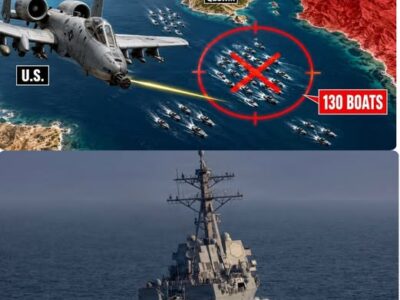
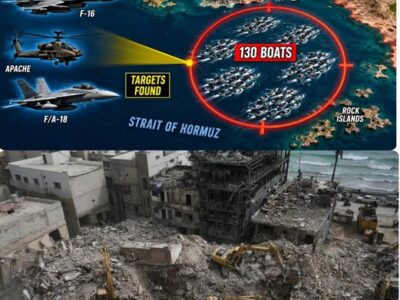
Instead of facing 100 boats as a single swarm, American forces divide them into smaller target groups manageable by assigned aircraft and ships. What appears to be a saturation problem becomes a series of smaller engagements.
This is why American commanders describe operations with words like “clinical.”
The goal is not dramatic naval combat. It is systematic elimination.
The May 4th Engagement
One incident in particular demonstrated the effectiveness of this strategy.
On May 4th, U.S. forces reportedly destroyed six Iranian fast attack boats in approximately 12 minutes. According to CENTCOM statements, the operation involved attack helicopters and coordinated aerial surveillance.
The significance of that engagement was not the number of boats destroyed.
It was the speed.
Twelve minutes.
For American military planners, that encounter validated the operational model now being prepared on a much larger scale.
For Iran, it exposed a nightmare scenario.
The mosquito fleet depends on mobility, surprise, and concentrated attacks. But if American drones and helicopters can destroy boats before swarms fully form, the doctrine collapses.
And unlike previous eras of warfare, Iran now operates under near-total American air dominance.
Its air force has suffered extensive damage since the beginning of Operation Epic Fury. Iranian fast attack boats effectively have no air cover.
That leaves them exposed.
The UAE Enters the Conflict
One of the most significant developments in May 2026 was the revelation that the United Arab Emirates has become an active combatant.
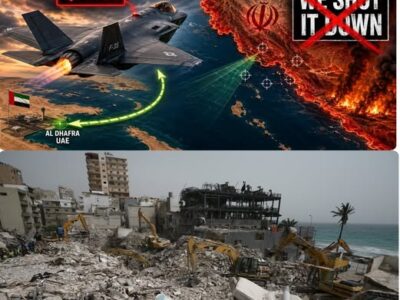
According to reports, the UAE secretly conducted airstrikes against Iran’s Lavan Island refinery after Iranian attacks targeted Fujairah’s oil infrastructure.
This changes the regional equation dramatically.
Until now, Iran framed the conflict primarily as a confrontation with the United States and Israel. The entry of a Gulf Arab state complicates that narrative.
The UAE’s involvement also opens a new operational front.
Iran must now divide its attention between:
American naval power
Israeli military operations
Gulf state retaliation
Economic collapse under sanctions and blockade
For Tehran, this is a dangerous expansion of the battlefield.
France and the Expanding Coalition
Another major signal came with the arrival of a French carrier strike group in the region.
France’s deployment is strategically important for several reasons.
First, it demonstrates growing European concern over freedom of navigation in the Strait of Hormuz.
Second, it signals that NATO’s most militarily capable European member is positioning itself alongside American operations.
Third, it increases diplomatic pressure on China and Russia, both of whom have attempted to balance support for Iran against their broader global interests.
The coalition now opposing Iranian disruption in the Gulf includes:
The United States
Israel
The UAE
France
This expanding alignment further isolates Tehran internationally.
The Economic Pressure Cooker
Military pressure is only one side of the crisis.
The economic dimension may ultimately prove even more devastating for Iran.
The Strait of Hormuz blockade has severely disrupted global shipping. Thousands of sailors and commercial vessels remain stranded or rerouted. Energy prices have surged worldwide.
For Iran itself, the consequences are severe:
Oil exports have collapsed
Storage facilities are filling rapidly
Infrastructure is increasingly vulnerable
Revenue losses are mounting daily
Domestic financial strain is intensifying
Some estimates place Iran’s economic losses at roughly $500 million per day under the current blockade conditions.
This creates a dangerous strategic dilemma for Tehran.
Backing down risks internal political consequences for the IRGC leadership. Escalating militarily risks catastrophic confrontation with overwhelming coalition firepower.
Project Freedom Plus
Perhaps the most ominous phrase emerging from Washington is “Project Freedom Plus.”
While official details remain classified, the implication is clear.
The original Project Freedom focused on protecting commercial navigation and escorting shipping traffic through contested waters.
“Plus” suggests expanded rules of engagement.
It likely includes:
Preemptive strikes against Iranian fast attack boats
Expanded drone operations
Direct targeting of coastal launch sites
Wider suppression of Iranian naval infrastructure
More aggressive maritime interception operations
The public release of MQ-9 strike footage appears intended to psychologically prepare both domestic and international audiences for this next phase.
The China Variable
One remaining wildcard is China.
Beijing has attempted to position itself as a mediator while also maintaining strategic ties with Iran. However, China’s economy depends heavily on stable energy flows through the Gulf.
That creates competing interests.
China wants:
Continued access to Iranian energy
Stability in global shipping lanes
Avoidance of major regional war
Preservation of broader U.S.-China diplomatic engagement
The upcoming U.S.-China summit may therefore become pivotal.
If Beijing pressures Tehran toward genuine concessions, diplomacy could survive.
If not, military escalation becomes increasingly likely.
The Strategic Reality
As of May 2026, the conflict appears to be approaching a decisive phase.
Iran still possesses dangerous capabilities. Its missile arsenal remains significant. Its drone operations continue. Its geography still provides strategic leverage.
But several assumptions underlying Iran’s strategy are eroding rapidly.
The mosquito fleet was designed for an era before persistent drone surveillance dominated the battlefield.
The tunnel systems and coastal hiding spots that once provided concealment are now increasingly vulnerable to advanced ISR networks.
The IRGC’s asymmetric doctrine remains dangerous, but modern American military architecture was specifically built to dismantle exactly this kind of threat.
That does not mean victory would come without cost.
Any major conflict in the Strait of Hormuz would likely trigger:
Massive disruptions to global energy markets
Increased shipping crises
Potential missile attacks across the Gulf
Expanded regional instability
Civilian economic suffering worldwide
The stakes are enormous.
Conclusion
The image President Trump posted of MQ-9 Reaper drones destroying Iranian fast attack boats may ultimately be remembered as more than political messaging.
It may prove to have been the public signal that the next stage of the conflict had already begun.
Iran’s mosquito fleet represents decades of asymmetric military planning built around exploiting the geography of the Strait of Hormuz. But warfare evolves. Technologies change. Strategies that once seemed revolutionary can suddenly become obsolete when confronted by new systems.
The MQ-9 Reaper embodies that evolution.
Persistent surveillance, precision targeting, real-time intelligence sharing, and rapid strike capability have fundamentally changed the balance between swarm tactics and defensive power.
Whether diplomacy can still prevent a larger war remains uncertain.
But one reality is increasingly clear: the Strait of Hormuz is no longer simply a shipping lane. It has become the proving ground for the next generation of drone-centered maritime warfare.