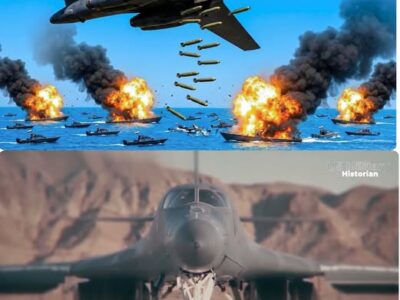
Iran Just Showed The U.S. Military The EXACT Location Of Their Fast Attack Boats
Iran Just Showed The U.S. Military The EXACT Location Of Their Fast Attack Boats
Iran’s 130-Boat Gamble: Why the Strait of Hormuz Could Become the Most Dangerous Naval Flashpoint in the World
The release of a single satellite image may have revealed more than Iran intended.
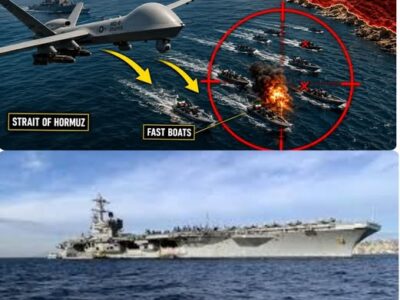
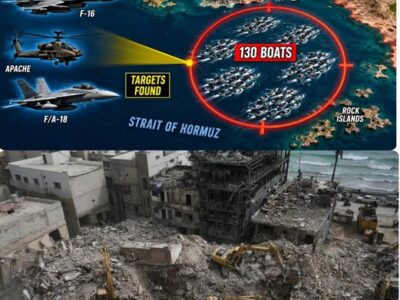
In what appears to be a deliberate show of force, Iranian state-linked channels circulated overhead imagery showing approximately 130 Islamic Revolutionary Guard Corps (IRGC) fast attack boats deployed in two large coordinated formations inside the Strait of Hormuz. The message was unmistakable. Iran wanted Washington, Gulf states, global shipping companies, and its own domestic audience to see that the IRGC still possessed the ability to mass naval forces inside one of the world’s most strategically important waterways.
But the image may also have exposed something else entirely.
What Tehran presented as a symbol of strength could simultaneously represent one of the largest concentrated target formations ever publicly revealed in modern asymmetric naval warfare. In attempting to project deterrence, Iran may have unintentionally demonstrated how vulnerable its fast attack doctrine becomes when confronted by layered American airpower, naval firepower, and integrated Gulf defense systems.
The implications go far beyond military hardware.
This is not simply a story about speedboats in the Persian Gulf. It is about deterrence, propaganda, regional escalation, psychological warfare, and the dangerous possibility that the Strait of Hormuz is moving toward a direct military confrontation unlike anything seen in decades.
Why the Satellite Image Matters
Military organizations do not accidentally publish high-resolution imagery of operational deployments.
The decision to release satellite images of 130 fast attack boats operating in coordinated formations was almost certainly intentional. The visual itself was crafted as strategic communication.
Iran’s leadership understands that modern warfare is not fought only with missiles and aircraft. It is also fought through narratives, perception management, and information operations. Images can shape public psychology as effectively as military maneuvers.
The satellite photo appears designed for several audiences simultaneously.
1. The Iranian Domestic Audience
After months of sanctions, military pressure, economic instability, and restricted information flows, Iran’s leadership likely needed to project resilience to its own population.
State media messaging in authoritarian systems often focuses on symbolism. The image of 130 IRGC speedboats assembled in formation communicates several ideas at once:
The IRGC remains operational.
Iran still controls strategic waters.
Foreign pressure has not crippled military capabilities.
The regime retains the ability to challenge the United States.
For domestic audiences isolated from independent reporting, visuals like these become political theater designed to reinforce national unity and institutional survival.
2. Gulf States and Shipping Operators
The Strait of Hormuz remains one of the most strategically critical maritime chokepoints on Earth.
A massive percentage of global oil exports passes through this narrow waterway. Any military instability immediately affects shipping insurance, energy prices, financial markets, and global trade confidence.
By showcasing large coordinated naval formations, Iran is reminding Gulf monarchies and international shipping companies that Tehran retains the ability to disrupt maritime traffic if conflict escalates further.
This is classic coercive signaling.
Iran’s strategy has long relied on the idea that even if it cannot defeat the United States conventionally, it can impose unacceptable economic disruption on the global system.
3. Washington
The image also serves as diplomatic leverage.
Iran appears to be communicating that any future military campaign against Tehran would not remain confined to airstrikes or sanctions. Instead, the conflict could spill directly into maritime warfare, threatening global oil supply chains and forcing the United States into costly naval operations.
The message is essentially this:
“If negotiations fail, this is what awaits.”
But that message carries a dangerous contradiction.
Because concentrated formations of small fast attack craft may look intimidating politically while simultaneously becoming highly vulnerable militarily.
The Evolution of Iran’s Fast Attack Doctrine
Iran’s naval strategy has never depended on matching the United States ship-for-ship.
The Iranian Navy and the IRGC Navy developed entirely different philosophies after observing America’s overwhelming technological superiority during the late twentieth century. Tehran understood it could not compete through aircraft carriers, destroyers, or blue-water naval fleets.
Instead, Iran focused on asymmetric warfare.
This doctrine relies on several principles:
Swarm attacks
Speed
Decentralization
Saturation tactics
Coastal missile integration
Mines and submarines
Psychological intimidation
The idea is relatively simple.
A large number of cheap, fast-moving boats armed with missiles, rockets, machine guns, or explosives could potentially overwhelm larger naval vessels by attacking from multiple directions simultaneously.
Instead of trying to destroy a U.S. carrier battle group directly, Iran’s goal would be to create chaos, force defensive reactions, disrupt shipping, and increase the cost of military intervention.
Historically, this doctrine made strategic sense.
The geography of the Strait of Hormuz favors smaller craft. Narrow waterways reduce maneuverability for large warships while creating opportunities for ambushes, rapid dispersal, and coastal support operations.
But military technology has evolved dramatically.
And that evolution may now be undermining the core assumptions behind Iran’s swarm strategy.
Why Concentrated Boat Formations Could Become a Liability
The biggest issue with the satellite image is not what it shows — it is how densely packed the formations appear.
Swarm doctrine works best when attackers are dispersed, unpredictable, and difficult to track. Concentrating large numbers of boats into visible formations creates the opposite effect.
It simplifies targeting.
Modern American military doctrine revolves around layered kill chains — integrated systems combining satellites, drones, aircraft, radar, helicopters, electronic warfare, naval guns, and precision-guided munitions into a unified targeting network.
In practical terms, concentrated fast attack formations may become ideal targets.
The moment those boats mass together in open water, they potentially expose themselves to multiple overlapping engagement systems simultaneously.
That changes the tactical equation dramatically.
The A-10 Warthog Factor
One of the most dangerous threats to fast attack boats comes from an aircraft many people associate primarily with land warfare: the A-10 Thunderbolt II.
Nicknamed the “Warthog,” the A-10 was designed specifically for close air support and armored vehicle destruction. Its defining weapon is the GAU-8 Avenger cannon — a massive 30mm rotary cannon capable of firing thousands of rounds per minute.
Against lightly armored boats, the effect would be devastating.
Fast attack craft are not built to absorb heavy kinetic firepower. Most rely on speed and maneuverability rather than armor protection. A concentrated burst from an A-10 could disable engines, ignite fuel systems, detonate onboard munitions, or destroy hull integrity within seconds.
The key issue here is density.
If 130 boats are grouped into tight formations, A-10 attack runs become far more efficient. Pilots no longer need to search for dispersed targets hidden along coastlines or separated across wide maritime areas.
Instead, they confront a concentrated target-rich environment.
From a tactical perspective, this favors the attacker.
Apache Helicopters and Persistent Tracking
The AH-64 Apache introduces another layer of danger for Iranian fast attack fleets.
Unlike fixed-wing aircraft conducting high-speed passes, attack helicopters can loiter, track, and engage targets continuously at lower altitudes.
This matters enormously in maritime engagements.
Fast attack boats rely heavily on maneuverability and sudden directional changes. Helicopters equipped with advanced targeting systems can monitor those movements in real time while coordinating with aircraft and naval assets.
The Apache’s sensors, precision-guided weapons, and sustained battlefield presence make it particularly dangerous against boats attempting to scatter after initial attacks.
And that is exactly what surviving boats would likely attempt to do.
Once formations begin taking losses, commanders face a brutal dilemma:
Stay concentrated and absorb repeated strikes
Break formation and become individually isolated targets
Neither option is favorable.
The Return of Naval Gunfire
Modern military discussions often focus heavily on missiles and drones, but naval gun systems remain extraordinarily lethal against small surface craft.
The Arleigh Burke-class destroyers deployed by the United States Navy carry 5-inch naval guns capable of delivering high-explosive projectiles over significant distances.
Against fast attack boats, these weapons would be overwhelming.
Unlike armored warships, small attack craft possess minimal structural resilience. A direct hit from a large-caliber naval shell would almost certainly destroy the target instantly.
What makes this especially dangerous for Iran’s formations is sustained fire capability.
Destroyers can continuously deliver rapid salvos while simultaneously coordinating missile defense, radar tracking, and electronic warfare operations. Combined with aircraft support, this creates overlapping layers of engagement that become extremely difficult for swarm tactics to penetrate.
The F-15E and Precision Economics
Another critical factor is the changing economics of modern warfare.
Historically, one challenge facing advanced militaries involved cost asymmetry. Expensive missiles were often required to destroy cheap targets.
That equation is changing.
The integration of systems like APKWS laser-guided rockets onto aircraft such as the F-15E Strike Eagle dramatically lowers engagement costs while maintaining precision.
This matters because Iran’s doctrine depends partly on overwhelming defenders through numbers.
But if American aircraft can destroy individual boats cheaply and efficiently, the financial advantage of swarm tactics diminishes significantly.
Iran may deploy dozens or hundreds of boats, but if those boats can be systematically destroyed with relatively low-cost precision weapons, the strategic balance changes.
General Salami and Command Integration
One of the more intriguing elements surrounding these developments is the emergence of reports about a “shadow” General Salami figure allegedly coordinating between the IRGC and Iran’s conventional military forces.
Whether fully accurate or partly exaggerated, the underlying issue is important: command integration.
Historically, the IRGC and Iran’s regular military (the Artesh) operated as parallel institutions with different cultures, structures, and priorities.
The IRGC emphasizes ideological commitment and asymmetric warfare.
The Artesh traditionally focuses more on conventional military professionalism.
Coordinating these two institutions effectively during wartime presents enormous challenges.
Yet if Iran is attempting to integrate coastal missile systems, submarines, drone operations, and swarm attacks into a unified combined-arms structure, the threat becomes more sophisticated than isolated harassment missions.
This is the scenario American planners likely take most seriously.
Not individual boats alone — but synchronized multi-domain operations involving:
Fast attack craft
Coastal missile batteries
Drones
Submarines
Electronic warfare
Air defense systems
That kind of integrated pressure creates operational complexity even for advanced militaries.
The Strait of Hormuz: Geography That Shapes Strategy
The geography of the Strait of Hormuz explains why tensions there matter globally.
At its narrowest navigable point, the strait is only about 21 miles wide. Massive oil tankers, commercial cargo vessels, naval ships, and energy infrastructure all converge inside this confined maritime corridor.
Any disruption immediately affects:
Oil prices
Shipping insurance
Global inflation
Financial markets
Energy security
This gives Iran leverage disproportionate to its conventional naval strength.
Even temporary disruptions could trigger major global economic consequences.