“🇺🇸🇺🇸🇺🇸FBI: SENTENCED — Chicago’s Most Powerful Alderman Ran City Hall for 54 Years “
The Finance King of Chicago: The 54-Year Reign and Fall of Ed Burke
The Shadow of City Hall: Half a Century of Absolute Power
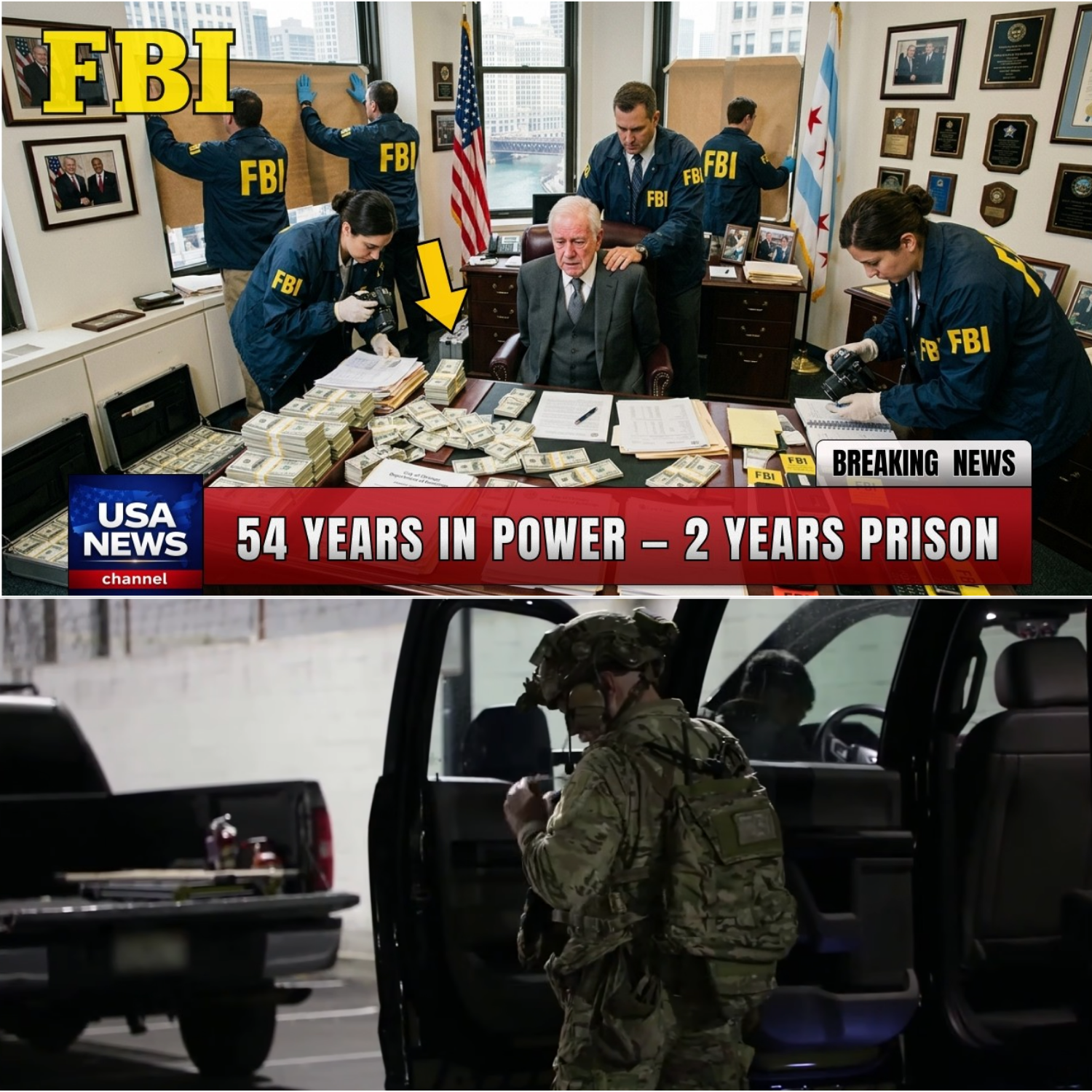
On the morning of November 29, 2018, the political foundations of Chicago didn’t just shake; they fractured. Federal agents entered the City Hall office of Alderman Edward M. Burke and performed a maneuver rarely seen in the light of day: they papered over every window and door from the inside, effectively creating a black site in the heart of the city’s government. For the people of Chicago, this was the beginning of the end for a man who had been a constant in their lives since 1969. Ed Burke wasn’t just an alderman; he was the Chairman of the Finance Committee, a position so formidable that he functioned as the city’s gatekeeper for over five decades.
Burke’s power was legendary. In a city notorious for “machine politics,” he was the ultimate machinist. He had survived scandals that toppled mayors, investigations that emptied entire city departments, and the shifting tides of ten different presidential administrations. His longevity was built on a dual foundation: a vast personal intelligence network of allies placed in city jobs and a private law firm that specialized in property taxes. To understand the gravity of his fall, one must realize that for many Chicagoans, Ed Burke was the only political reality they had ever known. He was a man who could stall a mayor’s entire legislative agenda with a single phone call, making him, in many ways, more powerful than the occupants of the fifth floor.
The Tollbooth Strategy: Monetizing the Public Trust
The federal prosecution eventually distilled fifty-four years of political maneuvering into a single, devastatingly effective mechanism: the “tollbooth” scheme. As the head of the Finance Committee, Burke controlled the bureaucratic oxygen that developers needed to survive. If a developer wanted a permit, tax increment financing (TIF), or even just a simple zoning change, they eventually discovered that the most efficient path through the red tape led directly to Burke’s private law firm, Klafter & Burke.
The FBI focused on three primary instances that illustrated this corruption with surgical clarity. The most high-profile involved the Old Main Post Office, a massive redevelopment project in downtown Chicago. Evidence at trial showed Burke corruptly soliciting property tax business from the developers, using his public office as a lever to enrich his private practice. Perhaps the most “Chicago” detail of the trial involved a southwest side Burger King. When a franchise owner needed a permit for a remodeling project, Burke’s office sat on the paperwork. Burke then solicited the owner for law firm business; when the owner refused, Burke actively blocked the permit. This wasn’t high-level statecraft—it was a sophisticated shakedown of a fast-food restaurant.
The Wire: When the Machine Turned on Itself
The collapse of the Burke empire was made possible by an act of betrayal that few saw coming. Danny Solis, an alderman and a longtime colleague of Burke’s, was confronted by the FBI with evidence of his own wrongdoing in 2016. Faced with the prospect of federal prison, Solis made a deal that would change Chicago history: he agreed to wear a wire. For two years, Solis moved through the corridors of power as a human recording device, capturing the unguarded words of a man who believed he was untouchable.
During the six-week trial in late 2023, these recordings were played for a jury. They heard Ed Burke’s own voice, speaking with the casual confidence of someone for whom corruption had become routine. The audio removed all ambiguity about the “quid pro quo” arrangements Burke was orchestrating. While Solis walked free under a cooperation agreement—never facing a single charge for his own decades of conduct—his recordings provided the evidentiary thread that finally pulled Burke’s 54-year career into a federal courtroom. It was the ultimate irony: the machine didn’t fail from the outside; it was dismantled by one of its own gears.
The Verdict: Thirteen Counts of Institutional Erosion
On December 21, 2023, the jury returned a verdict that echoed through every precinct in the city. Ed Burke was found guilty on thirteen federal counts, including racketeering, bribery, and attempted extortion. He was 80 years old. The trial had provided a complete picture of what federal prosecutors called “institutionalized corruption,” where the public’s business was inextricably tied to a private official’s profit.
Burke’s defense was built on the image of the “old school” public servant. They argued that his law practice and public office were rigorously separate and that the FBI had relied on a corrupt informant (Solis) to manufacture a case. However, the unanimous jury found the documentary evidence and the recorded conversations impossible to ignore. After half a century of surviving every “political storm,” Burke was finally a convicted felon. The man who had presided over the city’s finances was now ordered to pay $65,000 in restitution to a Burger King owner and a massive $2 million fine to the government.
Two Years and Two Hundred Letters: The Final Act
The sentencing of Ed Burke on June 24, 2024, was a study in contradictions. On one hand, the judge received over 200 letters of support from ordinary Chicagoans—families Burke had helped at funerals, neighbors he had served in small but meaningful ways. The judge, Virginia Kendall, noted that she had never seen such an outpouring of support for a defendant. On the other hand, the crimes were an “erosion of faith” in the very concept of government. Prosecutors sought a harsh sentence, pointing to the decades of power Burke had wielded.
Ultimately, the judge sentenced Burke to two years in federal prison. To many, this felt like a light punishment for thirteen federal counts of racketeering and extortion, especially compared to the 32-month sentence given to the developer Charles Cui, who was convicted alongside him. The judge factored in Burke’s age and his history of public service, but the “two-year sentence” became a point of intense public debate. In September 2024, the former chairman of the Finance Committee became inmate 53658-424 at a low-security facility in Thompson, Illinois.
The Unresolved Math: Two Years for Fifty-Four
The legal saga of Ed Burke ended with a surprising final chapter. After serving less than half of his two-year sentence, Burke was transferred to a halfway house in June 2025. As of the latest records, a commutation petition remains pending with the Department of Justice, a move that could erase the remainder of his sentence entirely. For a city that watched the FBI build a case for seven years, the result is a complicated mathematical equation: two years of prison for the last two years of recorded conduct, set against fifty-two years of unindicted political life.
The law reached Ed Burke, but it did so through a process of compromise. Danny Solis, the man who provided the evidence, will never wear a prison uniform. The 200 letters sent to the judge remind us that even the most corrupt “bosses” are often beloved by those they choose to help. Burke’s office is empty, his law firm’s influence is shattered, but the “Chicago Machine” he helped build remains a part of the city’s DNA. Whether the verdict represents a final victory for justice or merely a symbolic gesture against an eighty-year-old man is a question that continues to be discussed in every coffee shop and ward office in Chicago. The “Finance King” has fallen, but the silence in his old office is filled with the echoes of a half-century of secrets.