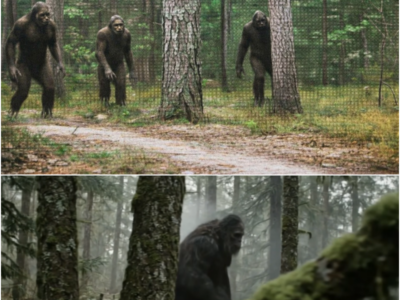
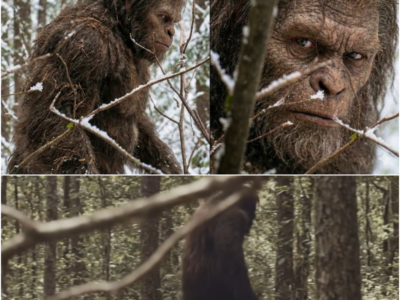
Face to Face With a Sasquatch | Without It Knowing
The rain in the Olympic Peninsula doesn’t just fall; it colonizes. It soaks into the hemlock needles, turns the glacial silt into a slurry of grey chocolate, and muffles the world until the only thing you can hear is the rhythmic thrum of your own heart.
William Carter knew that silence. He had lived in it for forty years, long after the echoes of his two combat tours had faded into the background noise of a life spent in the timber. He wasn’t a “believer.” He was a hunter, a man of maps and calibers, a man who viewed the wilderness as a series of biological systems. To him, the forest was a ledger of tracks, scat, and bedding sites.
But then came the SD card from the creek crossing.
The Ghost on the Game Trail
It started with a sense of structural wrongness. About six months ago, Will noticed the property felt… occupied. Not by a trespasser—he knew what a man in a flannel shirt sounded like—but by something with a different mass. His two hounds, normally fearless defenders of the porch, began to skulk. They wouldn’t go past the old cedar stump near the north boundary. They would stand, hackles raised, staring into the dark geometry of the Douglas firs, emitting a low, vibrating whine that felt like a warning from a past life.
Will did what any modern woodsman does: he doubled down on technology. He had dozens of trail cameras—Bushnells and Browning Strike Forces—scattered across his acreage.
“Probably a rogue grizzly or a big cougar,” he told himself, though he knew grizzlies didn’t snap branches eight feet off the ground with the clean, splintering torque of a primate’s hand.
When he pulled the card from Camera 04—a low-angle mount aimed at a game trail near a moss-slicked creek—he expected to see a buck. Instead, he saw the First Clip.
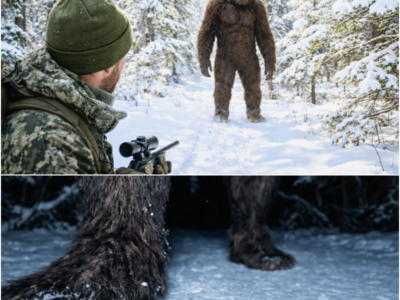
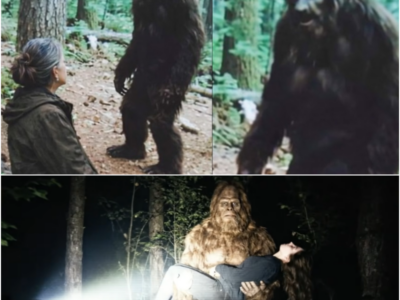
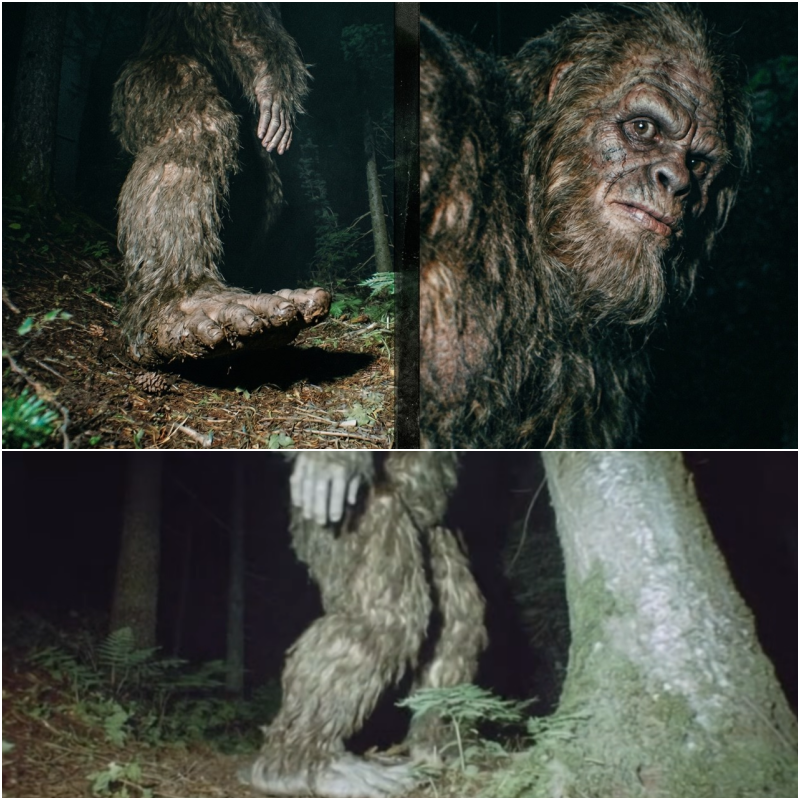
It was ten seconds of impossible physics. The camera, mounted just two feet off the ground, captured a foot. It wasn’t a bear’s paw; there were no claw marks dragging in the silt. It was a foot that looked like a piece of living leather, easily sixteen inches long, with toes spread wide to distribute a weight that made the earth visibly compress.
As the creature moved, Will watched the fur on the calf. This was the detail that broke him. In Hollywood, fur is a suit; it bunches at the joints. Here, the fur flowed. It shifted over ripples of muscle and bone that shifted independently. It was an anatomy lesson in something that shouldn’t exist.
Then, there was the Second Clip. Same spot, three nights later.
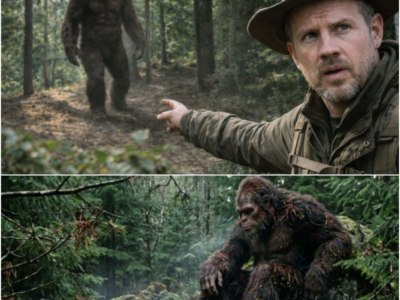
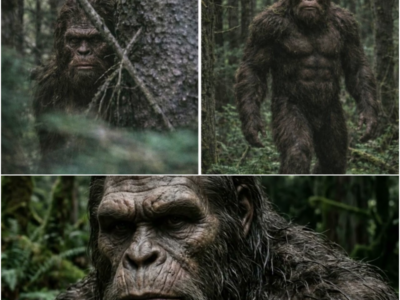
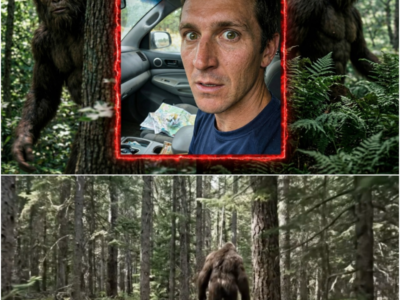
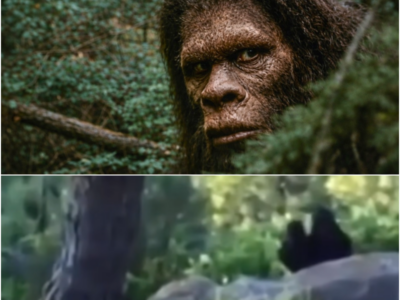
This time, the creature leaned into the frame. For three frames—less than half a second of digital time—the infrared flash illuminated a face. It wasn’t the “monkey man” of the tabloids. It was ancient. The brow was a heavy shelf of bone, the eyes deep-set and reflective like a predator’s, yet possessing a terrifying, weary intelligence. It looked less like an animal and more like a man who had been left out in the rain for ten thousand years.
The Corridor
“I’m not going to the news, Will,” the property owner, a man named Elias who had spent thirty years as a high-stakes civil engineer, had told him. “I have a reputation. I have a life. If I put my name on this, I’m the ‘Bigfoot Guy’ until the day I die. You take it. You have the platform. Just… keep me out of it.”
Will had spent six weeks staring at those ten seconds. He had consulted with trackers and biologists under the guise of “hypothetical” questions. Finally, he had sent a message back to Elias: Move the cameras. We need to see where it’s going, not just where it’s been.
They devised a “corridor strategy.” They identified a natural funnel between a steep basalt ridge and a swampy lowland—the kind of path a large animal would use to stay hidden while moving between feeding grounds. They deployed ten high-definition cameras, spaced exactly fifty yards apart, covering a quarter-mile of the densest old-growth on the peninsula.
Then, they waited.
Twenty-one days passed. The rain continued. The dogs stopped barking entirely; they simply stayed under the porch, shivering. On the twenty-second day, Elias called.
“I have the cards. Get over here. Now.”
The Anatomy of a Shadow
Will sat in Elias’s study, the glow of a 30-inch monitor the only light in the room. Outside, the Washington wind was howling through the firs, but inside, the silence was absolute.
“Camera One,” Elias whispered, clicking the mouse.
The footage began. It was 3:14 AM. A massive shape moved through the frame, but it didn’t walk like the first time. It was moving with a purpose—a heavy, swinging gait. As it passed Camera One, it did something that made Will’s blood turn to ice.
The creature didn’t look at the camera, but it reached out a hand—a hand with a thumb and four fingers, covered in fine, dark hair—and lightly brushed a branch that was obscuring the lens. It didn’t break the branch. It tucked it. It was clearing its path.
“Camera Two,” Elias said.
Fifty yards away, the creature appeared four seconds later. The speed was incredible. For a biped of that size to cover that terrain in that time, it was moving at a near-run, yet it was silent. There was no snapping of twigs, no heavy thud. It moved like a shadow given weight.
But it was Camera Five where the story changed from a sighting to a nightmare.
Camera Five was positioned at a slight elevation, looking down into a small clearing where a fallen cedar created a natural bridge across a ravine. In the frame, the Sasquatch stopped.
It didn’t just stop; it froze. Its head turned—a slow, owl-like rotation. The infrared light caught the muscles of its neck, cords of tension that looked like braided steel. It wasn’t looking at the camera. It was looking back the way it had come.
Then, it let out a sound.
The trail camera’s microphone was cheap, designed for the grunt of a deer or the howl of a coyote. This sound blew out the audio levels. It was a rhythmic, multi-tonal vocalization—a series of “whops” followed by a long, descending moan that seemed to vibrate the very air in the recording.
“Listen,” Will whispered.
From the distance, recorded faintly on the mic, came an answer. Not one. Two.
“There’s a family,” Elias said, his voice trembling. “They aren’t just passing through. They’re patrolling.”
The Sentinel
The footage from Cameras Six through Nine showed the same creature moving deeper into the ravine, but Camera Ten—the final sentinel at the edge of the property—captured the moment that changed Will Carter forever.
The Sasquatch reached the final camera. It was 3:42 AM. Instead of passing by, it stopped directly in front of the lens. It stood so close that the infrared flash washed out the image into a ghostly white.
Then, it sat down.
For six minutes, the creature sat with its back to the camera. Will and Elias watched the rise and fall of its massive shoulders as it breathed. They watched the way the hair on its back parted to reveal skin that was scarred—long, jagged white lines that looked like the marks of a brush with a boat propeller or perhaps the claws of a very large bear.
Suddenly, the creature turned. It didn’t look at the camera lens; it looked past it, toward the house where Elias was sleeping at that very moment.
Its expression wasn’t one of animal curiosity. It was one of recognition. It knew the camera was there. It had always known. It had simply chosen to ignore it until now.
The creature reached out, and for a terrifying second, Will thought it was going to smash the device. Instead, it picked up a small stone from the ground. It held the stone up to the camera, as if showing a prize, and then placed it carefully on top of the camera housing.
Then, it stood up and vanished into the treeline.
The Weight of the Secret
When the final clip ended, the room stayed dark for a long time.
“It left a gift,” Elias said, his voice barely a breath. “Or a warning.”
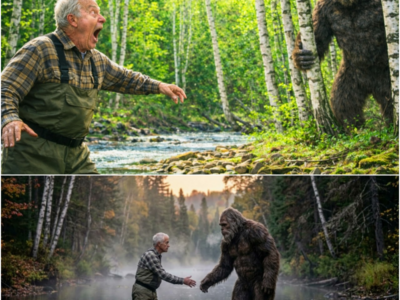
“It’s a boundary marker,” Will replied. He thought back to the stories of the Stalo and the Cherokee, of the ‘Middle People’ who lived between the worlds of man and beast. “It’s telling you that it knows you’re watching. It’s acknowledging the contract.”
Elias looked at the stack of SD cards. “What do we do with this, Will? If I release this… the world comes here. Scientists, hunters, tourists, kooks. They’ll bring helicopters and thermal Scopes. They’ll tear this forest apart looking for them.”
Will looked at the screen, at the frozen image of that ancient, scarred face. He saw the intelligence there—a creature that had survived the ice age, the arrival of the settlers, the loggers, and the sprawl of the modern world, all by being a master of the unseen.
“If we show the world,” Will said, “we kill them. Maybe not with bullets, but with the end of their silence. We turn them into a ‘discovery’ instead of a neighbor.”
Elias nodded. He took the SD cards, walked over to his fireplace, and held them over the cold ash. “But people need to know. They need to know the world is still big. They need to know we haven’t conquered everything.”
“Then tell them the story,” Will said. “But don’t give them the map.”
The Silence Returns
Will Carter drove home that night through a downpour that felt like a wall of water. He thought about his time overseas, the things he’d seen in the desert—the way men behaved when they thought no one was watching. He thought about the 50 million trail cameras currently pointed at the woods of North America.
How many of them had captured a foot? A hand? A pair of eyes that didn’t belong to a deer?
He knew the answer. The footage was out there, sitting in drawers, tucked away by people who were too afraid of being laughed at, or too protective of the thing they had found. The forest wasn’t empty; it was just very, very good at keeping its secrets.
A week later, Will sat down in front of his own microphone. He didn’t have a script. He just had the memory of that creature sitting in the rain, placing a stone on a camera.
“My name is William Carter,” he began, the recording light flickering red in the dark room. “And I’m going to tell you about what’s living in the Olympic Peninsula. I’m not going to show you a map. I’m not going to give you coordinates. But I’m going to tell you why you should never look at a forest the same way again.”
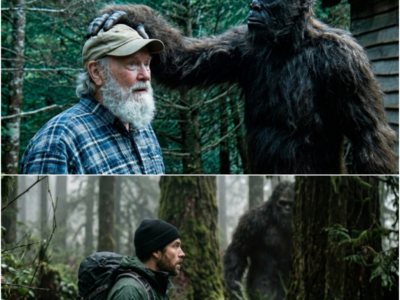
As he spoke, he looked out his window. At the edge of his property, where the light of the porch faded into the absolute black of the timber, he saw a movement. Just a shift in the shadows. A branch bending eight feet off the ground, then snapping back into place.
He didn’t grab his rifle. He didn’t grab his camera.
He simply nodded into the dark.
“The traditions say they prefer to stay hidden,” Will told his audience. “And after what I’ve seen, I think that’s the greatest gift they ever gave us. Because as long as they are hidden, the world is still a place of mystery. As long as they are out there, walking their trails under the cover of the rain, we aren’t the masters of the earth. We’re just guests.”
He hit ‘Stop’ on the recording. Outside, the rain continued to fall, washing away the tracks, filling the deep impressions in the mud, and returning the Olympic Peninsula to the silence it had earned over ten thousand years.
Somewhere in the deep woods, a stone sat on top of a camera, a small monument to a boundary that remained uncrossed. Will went to bed, and for the first time in months, his dogs slept soundly at the foot of the stairs, no longer afraid of what was watching from the trees.
The secret was safe. For now.