Mysterious Disappearances in National Parks… Nobody Knows Why
The timber in the Gifford Pinchot National Forest doesn’t just grow; it looms. It’s a vertical labyrinth of Douglas fir and Western hemlock that swallows light by three in the afternoon, leaving the forest floor in a permanent, moss-slicked twilight.
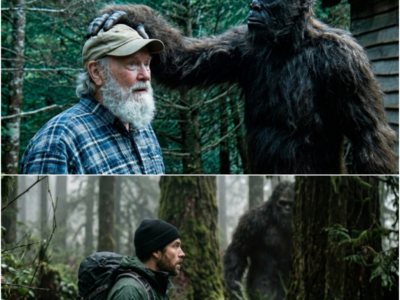
Elias Thorne didn’t believe in monsters. Twenty years as a seasonal Ranger for the Forest Service had beaten the romance out of the woods. To him, the wilderness was a series of data points: fuel moisture levels, snowpack depth, and the predictable stupidity of hikers who thought a cell phone battery was a substitute for a compass.
But on a Tuesday in late September, the data points stopped making sense.
He was stationed near the Dark Divide, a rugged roadless area, investigating a “Point Last Seen” report. A backpacker named Marcus Vane—a triathlete with high-end gear—had vanished. His hiking partner claimed Marcus had stepped five feet off the trail to adjust a boot lace. When the partner turned back ten seconds later, Marcus was gone. No shout, no crashing through the brush, just an empty space where a 200-pound man had been standing.
By day three of the search, the “Missing 411” checklist was already filling itself out.
First, the weather. The forecast had called for a clear, high-pressure system, but within two hours of Marcus vanishing, a freak localized cell had dumped four inches of freezing rain, grounding the Hueys and scrubbing any potential scent.
Second, the dogs. Elias watched the K9 handler, a veteran named Sarah, struggle with her prize bloodhound. The dog didn’t lose the scent; it refused to take it. It sat back on its haunches, whining with a low, vibrating dread, its hackles standing up like a row of needles.
“He won’t go toward the boulder field,” Sarah whispered, her face pale. “He acts like the air over there is dead.”
Elias looked toward the “Devil’s Washbasin,” a massive field of granite boulders slick with rain. “Then we go in on foot.”
The silence in the washbasin was heavy, the kind of silence that feels like pressure against your eardrums. Elias moved with a practiced gait, his eyes scanning for “color out of place”—the neon orange of a pack or the blue of a jacket.
He found it near the center of the granite field, but it wasn’t a person.
It was Marcus’s boots. They were set neatly side-by-side on a flat slab of rock. They weren’t scuffed. The laces were still tied. There was no blood, no sign of a struggle. Just the boots, and fifty yards away, Marcus’s Gore-Tex jacket, folded as if for a retail display.
“Paradoxical undressing,” Elias muttered, trying to force the facts into a box he understood. Hypothermia victims often feel hot as their systems fail and strip their clothes. But it hadn’t been cold enough for long enough, and a hypothermic hiker doesn’t fold their clothes with military precision.
Then Elias smelled it.
It wasn’t the scent of a bear—that greasy, garbage-can musk. This was different. It was old. It smelled like wet earth, stagnant swamp water, and something metallic, like a penny on your tongue. It was a scent that triggered an ancient, lizard-brain response: Hide.
He looked up. The boulder field was surrounded by a rim of high ridges. On the eastern ridge, the silhouettes of the trees seemed to shift.
He pulled his binoculars. The magnification brought the treeline into sharp focus. For a second, he saw nothing but gray bark and green needles. Then, a “tree” moved.
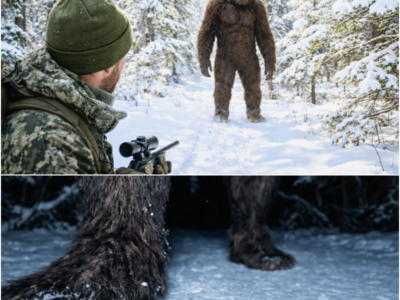
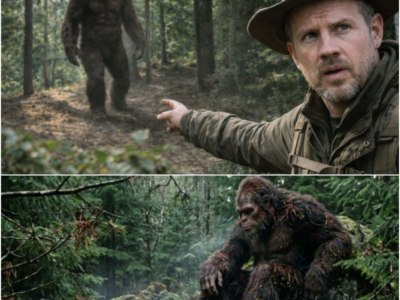
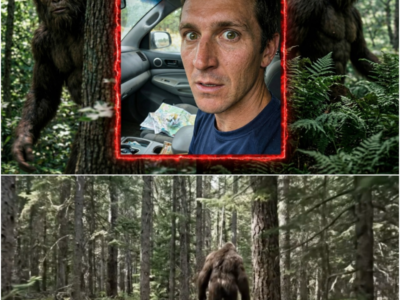
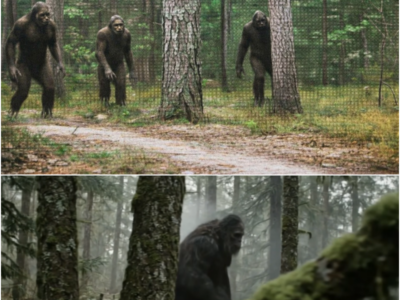
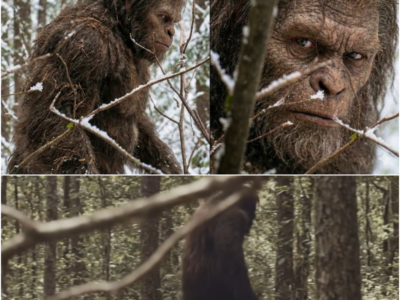
It was tall—nine feet at least—and its hair wasn’t the chocolate brown of a grizzly or the black of a forest bear. It was the color of woodsmoke and dried mud, perfectly matched to the granite. It didn’t have a neck; its massive, conical head sat directly on shoulders that were wide enough to block out the horizon.
It wasn’t walking. It was gliding. It moved with a fluid, terrifying grace that no bipedal animal should possess, stepping over waist-high deadfall as if it were a sidewalk curb.
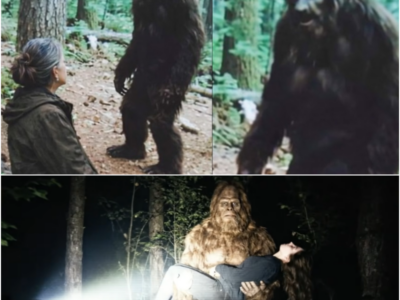
Most importantly, it was carrying something. A bundle of blue fabric.
“Marcus,” Elias breathed.
The creature stopped. It didn’t turn its head; it turned its entire torso. Even through the binoculars, Elias felt the impact of its gaze. The eyes weren’t glowing or demonic; they were deep-set, intelligent, and amber. It looked at Elias not as a monster looks at prey, but as a homeowner looks at an intruder.
Then, the creature did something that defied every law of biology Elias knew. It opened its mouth and emitted a sound—not a roar, but a series of high-pitched, rhythmic whistles followed by a deep, infrasonic thrum that Elias felt in his chest more than he heard in his ears.
The world seemed to tilt. The light around the boulder field warped, the edges of his vision blurring like a heat haze. When his eyes cleared a heartbeat later, the ridge was empty.
Elias didn’t report the sighting. He knew the protocol for “anomalous biological encounters”—which was to say, there wasn’t one, other than a psych eval and a desk job.
Instead, he went back out that night, alone.
He navigated by a red-lens headlamp, bypassing the official search perimeter. He returned to the spot where the boots had been found. He sat on a rock, turned off his light, and waited.
“I know the rules,” Elias said into the dark. “You take the young, the old, and the ones who step off the line. You move through the granite because it doesn’t hold a print. You bring the storm to hide the tracks.”
The forest didn’t answer.
“But Marcus has a daughter,” Elias continued. “She’s four. She doesn’t know about the rules. She just knows her dad didn’t come home from the big trees.”
A twig snapped. Not behind him, but above him.
Elias looked up. High in the canopy of a massive hemlock, two amber circles reflected the faint starlight.
The creature descended. It didn’t climb down like a man or a bear; it flowed down the trunk, its massive hands and feet gripping the bark with effortless strength. It landed five feet from Elias. The weight of it hit the ground with a dull thud that Elias felt through his boots.
Close up, the sheer mass of the thing was paralyzing. It was a wall of muscle and matted fur. It radiated heat like a furnace.
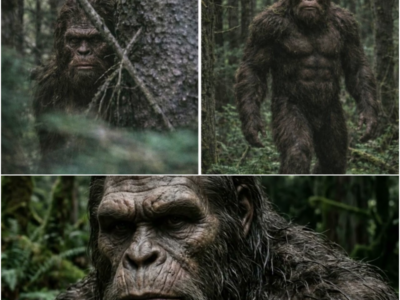
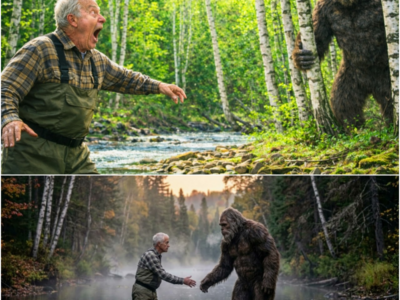
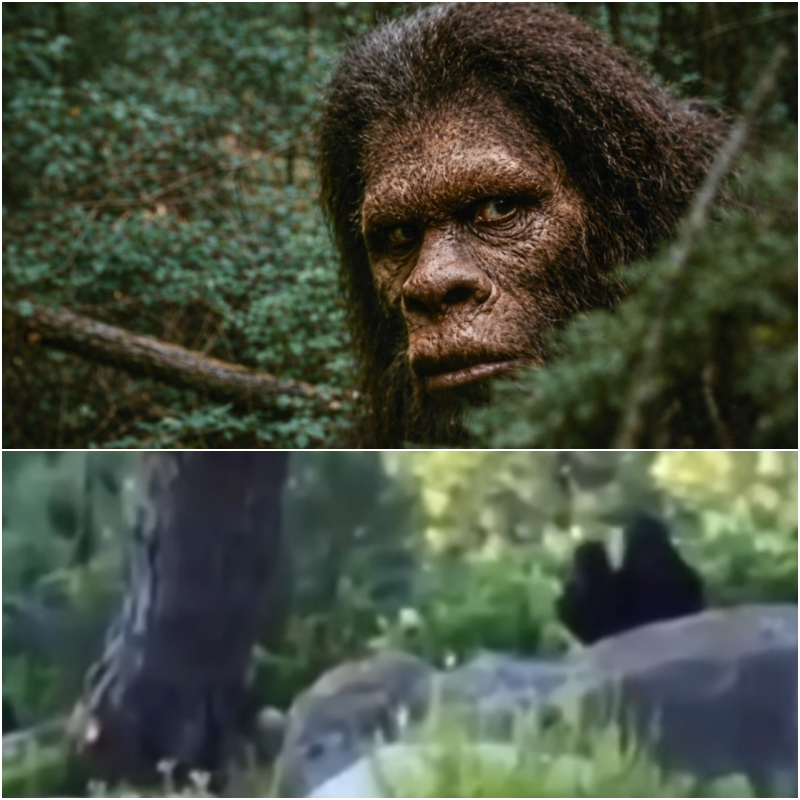
The creature leaned in. Its face was a haunting mix of human and ape—a high brow, a flat nose, and a thin, expressive mouth. It smelled of the very beginning of the world. It didn’t growl. It made a soft, clicking sound in its throat, a mimicry of the local ravens.
It reached out a hand. The fingers were long, the skin on the palms thick and black like weathered leather. In its grasp was a small, silver carabiner—Marcus’s.
The creature placed the carabiner on the rock between them. Then, it pointed a massive finger toward the north, toward a deep, inaccessible canyon known as The Box.
It spoke. It wasn’t English, but the cadence was unmistakable. It was a warning. He is there. He is not for you. Do not come back.
Then, with a burst of speed that made the air whistle, the creature turned and leaped. It cleared fifteen feet in a single bound, vanishing into the darkness of the timber before Elias could even draw a breath.
The next morning, Elias led the search team to the mouth of The Box canyon.
“How do you know he’s down there?” Sarah asked, her hand still firm on the collar of her nervous bloodhound. “We searched the rim yesterday. Nothing.”
“I have a feeling,” Elias said, his voice flat. “The terrain funnels toward the water. If he was disoriented, he’d follow the gravity.”
It was a lie, but it was a “normal” lie.
They found Marcus four hours later. He was huddled under a rock overhang, three miles from the point he’d vanished. He was alive, but barely. He was in a state of profound catatonia, his eyes wide and tracking things no one else could see.
Like the cases in the logs, Marcus’s condition made no sense. He had been missing for four days in a freezing deluge, yet his skin showed no signs of frostbite. His feet were bare, yet there wasn’t a single scratch or blister on his soles, despite the miles of jagged volcanic rock between the boulder field and the canyon. His clothes were gone, but he was warm to the touch.
As the paramedics loaded Marcus into the basket for the long haul out, Sarah walked over to Elias. She was holding her dog’s leash, but she was looking at the ground.
“Elias,” she whispered.
“Yeah?”
“The dog. He found Marcus’s scent about fifty yards back.”
“That’s good, Sarah. That’s why we bring him.”
“No,” she said, her voice trembling. “The scent didn’t lead to the cave. It started there. Like Marcus was dropped from the sky. And Elias…”
She pointed to a soft patch of mud near the cave entrance.
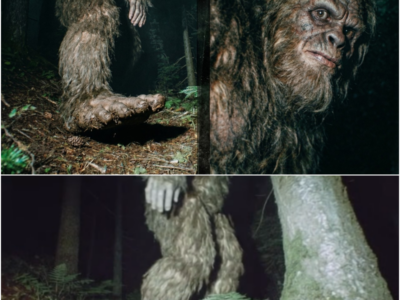
There was a print. It wasn’t a human boot, and it wasn’t a bear’s paw. It was sixteen inches long, with a distinct mid-tarsal break—a joint in the middle of the foot that doesn’t exist in modern humans. The toes were splayed, deep and heavy.
But beside the giant print, there was a second mark.
A small, perfect circle pressed into the mud. Elias reached into his pocket and felt the silver carabiner he’d picked up from the rock the night before. The mark in the mud was the exact shape of the carabiner’s locking gate.
The creature hadn’t just left Marcus there. It had left a signature.
Elias Thorne retired a month later.
He moved to a small town in eastern Washington, far from the towering timbers of the Cascades. He told people he was tired of the rain, but the truth was in his dreams.
Every night, he saw the amber eyes. Every night, he heard the rhythmic whistling that seemed to thin the fabric of reality.
He realized then what the Rangers who called the investigators privately already knew. The National Parks aren’t just preserved land; they are partitioned realities. We built the trails and the visitor centers to convince ourselves we own the place, but we are only guests.
There are rules in the deep woods. Rules about water, rules about granite, and rules about the things that live in the spaces between the trees.
Sometimes, they are curious. Sometimes, they are predatory. And occasionally, for reasons known only to a mind that has survived a million winters, they are merciful.
Elias never spoke of the creature again. But whenever he saw a headline about a “mysterious disappearance”—a child gone in seconds, a hiker found miles uphill in a place they couldn’t have reached—he didn’t look for a logical explanation.
He simply closed his eyes and remembered the smell of wet earth and copper, and the sight of a shadow that moved better than a man, gliding through the trees, watching us walk our narrow trails, waiting for the next person to step off the line.
Because the wilderness isn’t empty. It’s just waiting for the light to fade.