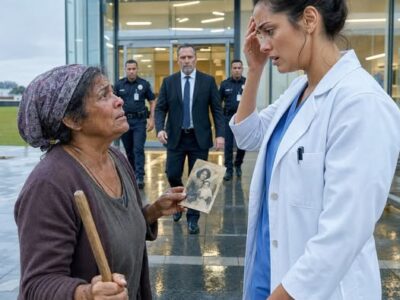
My children abandoned their father’s funeral because they believed he had died in 124 million pesos of debt. But when I found his secret letter and opened the blue Ford, I discovered a truth that made them return on their knees.
My children abandoned their father’s funeral because they believed he had died in 124 million pesos of debt. But when I found his secret letter and opened the blue Ford, I discovered a truth that made them return on their knees.
PART 1
—We’re not going to a bankrupt man’s funeral, Mom.
Mercedes Salgado heard that sentence on the phone the night before her husband’s burial and felt something inside her break without making a sound.
On the other end of the line was Darío, her eldest son. His voice didn’t sound sad, confused, or even tired. It sounded irritated, as if his father’s death were just an inconvenient appointment on his schedule.
—Darío… he’s your father —Mercedes said, gripping the phone with a trembling hand—. Tomorrow we’re saying goodbye to him.
—Goodbye to what? —interrupted Bruno, the younger one, with the same coldness he had learned in business meetings—. Dad left a debt of 124 million pesos. Do you want us to show up there so everyone can see the faces of the sons of a failure?
Mercedes closed her eyes.
Roberto Salgado had founded a transport company in Querétaro 30 years earlier, with two used trucks and a rented office next to a gas station. He worked at dawn, slept in warehouses, carried boxes with his own hands. But in recent years, rumors had turned into poison: lawsuits, unpaid loans, angry suppliers, pressured banks.
Roberto always gave the same answer:
—Everything is under control, Meche.
And now he was dead.
A stroke took him on a Tuesday afternoon, sitting in his office, a cup of coffee untouched beside him and a blue folder under his hand.
The next day, the funeral chapel in Mexico City was nearly empty. Mercedes sat in the front row, dressed in black, holding her mother-in-law’s rosary. Roberto’s coffin shone under a cold white light.
There were no wreaths from Darío.
No flowers from Bruno.
No grandchildren.
Only Father Ignacio, two former employees, and Martina, the woman who had worked in the house for 18 years.
—He was a good man —Martina whispered, crying.
Mercedes couldn’t answer. She kept staring at the door, waiting for her sons to walk in at the last minute—ashamed, regretful, red-eyed.
But the door never opened.
When the ceremony ended, Mercedes walked alone behind the coffin. Each step felt heavier than grief—it felt like humiliation.
One week later, while cleaning Roberto’s office, she found a letter hidden inside an old accounting book. The envelope had her name written in his firm handwriting:
For Mercedes. Read without our children.
Her heart tightened.
She opened it.
Meche,
If you are reading this, it means the boys have already chosen who they want to be. Do not confront them yet. Do not beg. Do not explain.
Go to warehouse B17, in the old industrial park in Tlalnepantla. Look for the blue Ford. Open the trunk. The key is where it has always been.
And please: do not bring Darío or Bruno.
Trust me one last time.
Roberto.
Mercedes read the letter three times.
The blue Ford.
An old 1998 sedan Roberto had refused to sell for years. Darío mocked it. Bruno said it smelled like failure. Roberto always smiled and said:
—Some things are not for sale.
The next morning, Mercedes drove to Tlalnepantla. Warehouse B17 was at the end of a gray corridor, behind a dusty metal door.
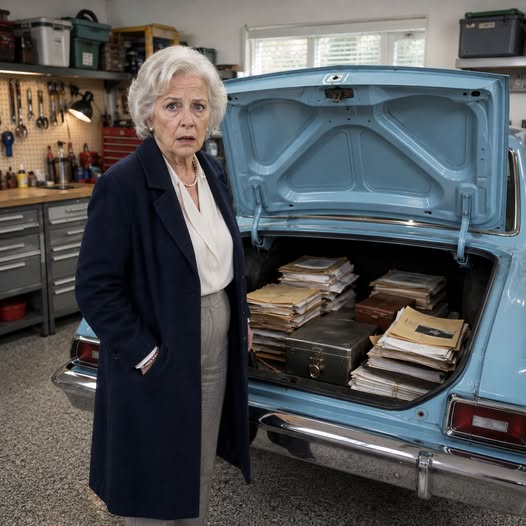
She found the Ford under a tarp.
She lifted it.
The car was spotless, despite being abandoned. She reached under the rear bumper and found a magnetic box with a key.
She opened the trunk.
Inside there were no tools.
No spare parts.
There were six black folders, a metal box, and a red envelope with her name.
Mercedes opened the first folder.
DEBT — PUBLIC.
Inside were the documents her sons had used to despise their father: loans, lawsuits, negative balances, credit blocks.
She opened the second.
PRIVATE ASSETS.
Her breath stopped.
Industrial land in Querétaro. Shares in four logistics software companies. Protected accounts. Corporate structures. Properties under trust funds. Warehouse rental contracts she had never known existed.
The numbers did not decrease.
They rose.
And kept rising.
Roberto had not died bankrupt.
He had hidden a fortune.
At the bottom of the metal box was a USB drive and another letter.
She opened it with shaking fingers.
Meche,
Debt exists, but it is not ruin. It is structure. It is a curtain. I built it to protect what I created from those who only see money where I see work.
If our children abandoned me when they believed I would leave them nothing, then you already have your answer.
But what comes next will be worse.
Because when they learn the truth, they will come back.
And they will not come to ask forgiveness.
They will come for everything.
Mercedes looked at the blue Ford, the letter trembling in her hands.
She had no idea what was about to begin.
PART 2
Mercedes did not return home immediately. She sat for more than two hours inside the warehouse, surrounded by folders that completely rewrote her marriage.
The USB contained twelve videos.
In the first, Roberto appeared in his office, calm, composed.
—Meche —he said— I am sorry I didn’t tell you sooner. Not because I didn’t trust you. But because I didn’t trust them.
The next videos revealed everything.
Shell companies. Hidden assets. Legal structures. Evaluations. Protection systems.
The debt of 124 million pesos was real—but covered by assets worth more than 360 million.
Mercedes placed a hand on her chest.
For three years, she had lived with anxiety over those numbers. For three years, Darío and Bruno had pushed for liquidation, for selling, for “simplifying things.”
Now she understood why Roberto resisted.
In video seven, his tone changed.
—Darío asked me to mortgage the house to fund his company. When I refused, he told me I was a coward.
Mercedes remembered that dinner.
In video eight:
—Bruno tried to transfer the Cuernavaca house to his name before Christmas. He said it was to protect it. It was a lie. He already had a buyer.
Mercedes felt sick.
That house had been their family’s summer home.
In the final video:
—If they sue you, open the file called October. If it comes to that, Meche, stop protecting them from their own choices.
Mercedes closed the laptop.
For six weeks, she did not call her sons.
She met with Roberto’s lawyer, Urrutia, and a notary named Cervantes. She learned she was the sole administrator of the main trust.
—Your husband was very clear —the notary said—. If your children pressured you, they would lose access to control.
—And if they regret it? —Mercedes asked.
—Regret is proven through actions, not inheritance hunger.
The sons returned anyway.
Darío arrived first.
—Mom, we need to talk as a family.
Bruno came the next day.
—We’re sorry about Dad.
But soon, the apologies turned into demands.
—The banks are easing pressure —Darío said one day—. What is happening?
—Your father organized his affairs —Mercedes replied.
—So there was money? —Bruno asked.
—There was work. Discipline. A life you both dismissed.
Then came the lawsuit.
They accused Mercedes of manipulation, coercion, and inheritance fraud.
Mercedes read it without blinking.
Then she opened the USB again.
And found “October.”
The video began.
PART 3
The hearing took place on a rainy Tuesday in Mexico City.
Mercedes arrived in black—not for mourning, but for certainty.
Darío and Bruno sat across from her with three lawyers.
The sons’ attorney spoke first: a story of confusion, manipulation, vulnerability.
Mercedes listened silently.
Then Roberto appeared on the screen.
—If you are watching this, it means my children have decided to attack my memory.
Darío stiffened.
Bruno froze.
—Let’s be clear —Roberto continued— I was not confused. I was not incapable. I was disappointed.
The room went still.
—Darío, on June 12 you asked me for 15 million pesos. I refused. You called me a coward.
Darío clenched his jaw.
—Bruno, you tried to transfer the Cuernavaca house. You already had a buyer.
Bruno closed his eyes.
The judge reviewed everything.
Medical reports. Notary confirmations. Financial audits.
All valid. All real.
The case was dismissed.
But the true sentence came later.
Roberto had left them a monthly allowance—but only under conditions: therapy, verified work, and community service.
Darío exploded.
—You want us serving coffee?
Mercedes looked at him calmly.
—Your father started carrying boxes. If that humiliates you, you still don’t understand anything.
Bruno was the first to break.
Not immediately. Almost a year later, during the opening of a technical training center funded by Roberto’s foundation.
He was arranging chairs when Mercedes saw him.
After the event, he approached.
—Mom… I really tried to sell Cuernavaca.
—Thank you for telling the truth —she said.
That was not forgiveness.
But it was a crack in the wall.
Darío took longer.
But eventually, he stopped talking about inheritance and started talking about logistics, routes, and systems.
And slowly, something rebuilt itself.
EPILOGUE
Two years after the funeral, Mercedes restored the blue Ford.
One morning, she drove it to the cemetery.
She told Roberto everything.
That the boys were changing.
That the foundation was growing.
That she still missed him.
And still blamed him.
But also understood him.
Then she found a hidden compartment under the seat.
Inside was a small box.
And two plane tickets to Italy.
A house on the Amalfi Coast.
In her name only.
No conditions.
No companies.
No structures.
Just a life he had prepared for her quietly.
Mercedes cried.
Then she started the car.
And for the first time in years, she did not follow instructions.
She followed her own path.