His NDA Expired — He Can Finally Reveal the Truth About Hunting Sasquatch | Bigfoot Horror Story
Project: Silver Lining
The non-disclosure agreement was sixty-four pages of dense, legalistic threats. It was the kind of document that didn’t just promise to sue you; it promised to unmake your entire life, erase your bank accounts, and ensure you spent the rest of your days in a windowless room if you ever breathed a word about what happened near the 49th parallel.
Three weeks ago, I sat in a grease-stained Waffle House booth outside of Spokane, signing my soul away to a man in a cheap suit who smelled like stale cigarettes and ozone. He talked about “unclassified bipedal fauna” and “resource management.” He made it sound like I was going to be a high-paid park ranger for a private firm called The Order.
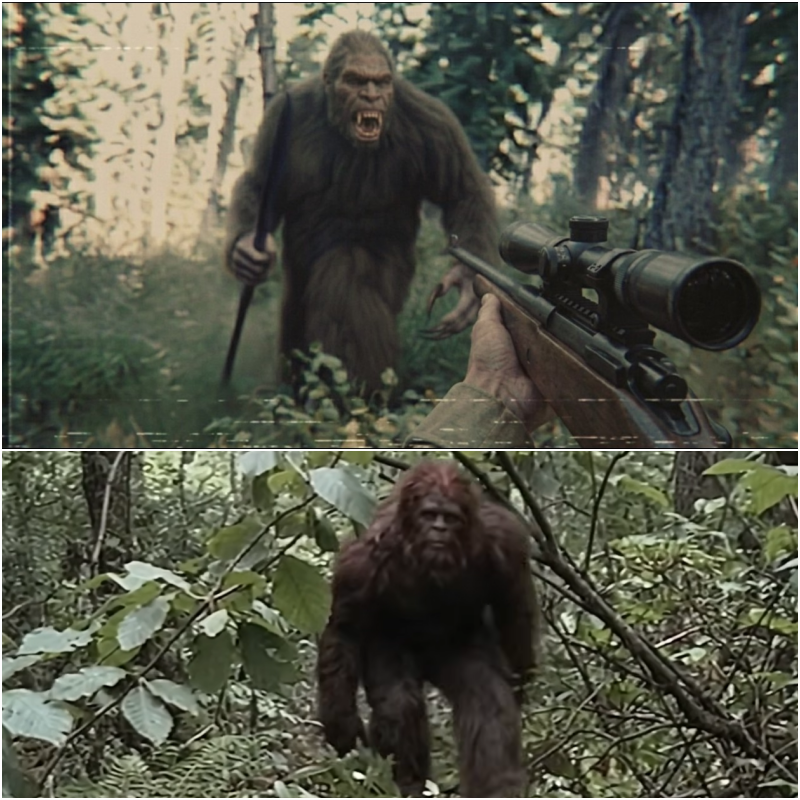
“Six figures for three months of tracking,” he’d said, sliding the pen across the table. “Just keeping the local population in check. Standard PMC work, Ethan. You’ve seen worse in the Sandbox.”
I thought I had. I thought I was the apex predator. That was my first mistake.
Chapter 1: The Static
The reinforced glass of Watchtower 9 was designed to withstand a Category 5 hurricane. It was three inches of laminated safety glazing, anchored into a steel frame that was bolted directly into the bedrock of the Cascades.
I was standing behind Nolan Pierce, our tech specialist, watching the thermal monitors. The night was a sea of cool purples and deep blues on the screen—the heat signatures of the forest at rest.
“Everything’s quiet,” Pierce muttered, his fingers tapping a rhythmic pattern on the edge of his keyboard. “Perimeter is clear. Threemile sweep shows nothing but the usual deer and the occasional black bear.”
Then, the feed simply died.
One second, we had a crystal-clear infrared view of the northern fence line. The next, the monitors exploded into a blizzard of grey static.
“Rebooting the local network,” Pierce said. He wasn’t panicked yet, but his jaw was tight. He was a Seattle tech-wiz who’d traded a cubicle for a tactical vest, but he still relied on his hardware like a lifeline. “Probably just a solar flare or a localized interference. This gear is sensitive.”
He never got to finish the cycle.
There was no sound of a struggle. No roar. No warning. The reinforced glass simply ruptured inward. It didn’t shatter; it disintegrated into a cascade of diamond-like shards that rained down onto the metal floor with a sound like a thousand wind chimes hitting the deck at once.
The freezing wind of the deep northern woods howled into the room, bringing with it a smell that made my stomach turn—a cloying, heavy scent of ancient pine needles, wet dog, and something metallic, like copper left out in the rain.
“We have a breach!” Jason Briggs yelled. He dropped his coffee, the ceramic mug shattering, and brought his SCAR-H rifle up to his shoulder in one fluid motion.
“Thermal is back!” Pierce screamed, slamming his fist onto the console as the screens flickered to life. “Look at the grid!”
I looked. My heart didn’t just skip a beat; it stopped.
The sensors had shown the perimeter completely empty moments prior. Now, there was a single thermal bloom glowing bright white on the monitor—the hottest signature I had ever seen. It wasn’t at the fence. It wasn’t approaching. It was already inside the compound.
It was directly beneath us.
“It bypassed the motion triggers,” Victor Hail said. His voice was steady, the flat tone of a man who had spent twenty years tracking elk in Montana, but his eyes were wide, fixed on the screen. “That’s impossible. Nothing moves that fast without tripping the seismic sensors.”
“It’s not just fast,” I whispered, staring at the sheer mass of the heat signature. “Look at the scale. That thing is nearly nine feet tall.”
A heavy thud shook the very foundation of the tower. The steel support beams groaned under an immense, sudden weight. It felt like a wrecking ball had swung into the side of the structure.
“Grab the gear!” commanded Curtis Doyle, our team lead. He was already cinching his plate carrier. “Evacuation Protocol Delta. We abandon the structure now. We move into the treeline and make for the secondary rally point. Go!”
Chapter 2: The Maze of the Order
When you work for The Order, you don’t ask questions during a Delta-level evac. We hit the emergency hatch, Brandon Shawcross—the youngest of us—leading the way down the metal stairwell.
We descended in near total darkness, our tactical lights cutting thin, trembling beams through the gloom. The tower shuddered again, the metal shrieking as something outside tested its structural integrity. We burst through the ground-level exit and plunged into the forest.
The woods at the US-Canada border are a labyrinth. It’s a vertical world of towering Douglas firs and thick, suffocating underbrush. At night, the darkness feels physical, like a heavy wet blanket pressed against your face.
“Keep your intervals,” Doyle hissed over the comms. “Do not engage unless it’s a direct confrontation. We are creating distance.”
I fell into line behind Briggs, my boots sinking into the damp moss. As we hiked, my mind drifted back to that Waffle House. The guy in the suit had used terms like “unclassified fauna.” He’d made it sound like we were hunting a myth for a paycheck. I used to laugh at the Bigfoot sightings on the internet. I used to think they were just bored hikers and grainy hoaxes.
I wasn’t laughing now. The weight in the air was undeniable. It was the feeling of being watched by something that didn’t just see you—it understood you.
“Hold up,” Hail whispered.
The team ground to a halt. I moved up, my rifle leveled at the darkness. Hail was shining his light on a tree trunk. A piece of neon orange surveyor’s tape was wrapped around the bark.
“What’s the problem?” I asked. “That’s our marker from the insertion route, right?”
“No, it isn’t,” Hail said. He reached out and peeled the tape off. His hands were shaking slightly. “I tie a square knot on my markers. This is a half-hitch. And look at the weathering. This tape hasn’t been out here for three weeks. It’s been here for months.”
“GPS says we’re right on our line,” Pierce chimed in, tapping his handheld unit.
“The GPS is wrong,” Hail insisted, pointing his light into the brush to our left. “The topography is off. There’s supposed to be a ridgeline right there, a fifty-foot drop-off. It’s just flat ground.”
A cold knot formed in my chest. “Are you saying we’re lost?”
“I’m saying the map doesn’t match the terrain,” Hail replied softly.
“That’s not possible,” Shawcross said, his voice cracking. “Satellites don’t just forget where a mountain is.”
“Quiet,” Doyle ordered. He scanned the treeline, his eyes darting. “We keep moving northeast. We find high ground and re-establish a link with base camp.”
We adjusted our course, but the deeper we went, the more the forest felt like a curated nightmare. We found more markers—blue ones pointing north, then fifty yards later, a yellow one pointing back the way we came. It wasn’t a trail anymore. It was a maze designed to disorient a specific kind of mind: a tactical one.
Chapter 3: The Script
We took a brief halt near a small clearing to hydrate. I leaned against a heavy pine, my lungs burning from the altitude and the pace.
“Ethan,” Pierce whispered, beckoning me over. He was huddled over his ruggedized tablet, the blue light making him look like a ghost. “You need to see this. Doyle, Briggs, get over here.”
“What do you have, Nolan?” Doyle asked, his voice low.
“I managed to pull the cached data from the trail cameras we set up yesterday,” Pierce explained. “The ones along the northern ridge.”
“Did they catch it?” I asked.
Pierce swallowed hard. “Yeah. But not what you think.”
He hit play. The screen showed a grainy night-vision feed of the very clearing we were standing in right now. I recognized the fallen log and the specific curve of a cedar branch.
“Look at the timestamp,” Pierce whispered.
I squinted. The video was from four hours ago—before the tower was even breached.
On the screen, the brush moved. A massive figure stepped into the frame. It was easily eight feet tall, with shoulders that looked three feet across. But it didn’t move like a bear or a gorilla. It didn’t lumber. Its movements were precise, fluid, and unnaturally smooth.
It walked directly to the center of the clearing—to the exact spot where Doyle was currently standing.
The creature stopped. It turned its head, looking directly into the hidden camera lens. Its eyes reflected the infrared light, glowing like two pale, unblinking coins. It didn’t destroy the camera. It just stared at it.
“It knew the camera was there,” Briggs murmured, his face turning ashen.
Then, the creature moved behind the very tree I was currently leaning against. It stood there for a long moment, completely motionless, facing the direction we had eventually come from.
“It was practicing,” Pierce said, his voice barely audible. “It was mapping out our exact positions four hours before we even got here. It wasn’t chasing us out of the tower. It was funneling us. It was managing the distance.”
The implications crashed over me. We weren’t fleeing. We were following a script that had already been written in the dirt and the shadows.
“We need to leave. Now,” Shawcross said, his composure finally fracturing. “It’s setting us up!”
“Calm down,” Doyle said, though his own face was pale. “We change the route. We drop the GPS, ignore the markers, and we bushwhack due east. We break the pattern.”
“Doyle,” Hail interrupted. He was kneeling at the edge of the clearing, running his hand over a patch of tall ferns. “You need to see this.”
We walked over. Hail pointed his light at the vegetation.
“When an animal moves through brush, it tramples the plants in the direction of travel,” Hail explained, his tone flat and clinical. “It leaves a wake. These ferns… they aren’t trampled forward. They’re flattened in a circle, facing the trail.”
I stared at the crushed plants. It looked like a sniper’s nest. A blind.
“It sat here,” Hail said. “It sat here and watched this exact path. It wasn’t passing through. It was waiting for us to arrive at this specific coordinate.”
“It’s been studying us,” I realized. “Since the day we arrived.”
“Not just us,” Pierce added, scrolling rapidly through more cached files. “I’m looking at the old deployment logs The Order gave us. The teams that disappeared last year… they took this exact same route. Every single team that went missing followed this specific topographical line.”
We stood in the dark, surrounded by trees that suddenly felt like the bars of a cage. The missing groups, the perfect lack of evidence, the strange markers—it wasn’t a mystery anymore. It was a harvest.
Chapter 4: Pruning the Edges
Suddenly, the radio on Doyle’s shoulder hissed to life. It wasn’t static. It was the sound of heavy, rhythmic breathing.
“Doyle, turn that off,” I whispered, panic clawing at my throat.
Doyle reached for the dial, but before his fingers could touch the plastic, the breathing stopped. A voice came through the speaker. It was distorted, pieced together from different audio clips, but the cadence was unmistakable.
“Evacuation Protocol Delta,” the radio played back. It was Doyle’s voice—his exact command from the tower. “We move into the treeline.”
The radio went dead.
“No, man. I’m not doing this,” Shawcross backed away, shaking his head. “I’m out.”
“Hold your position!” Doyle ordered, but his authority was a crumbling ruin.
We adjusted our packs and prepared to move. I took one last look at the crushed ferns. We were walking deeper into the trap because we had no other choice. The forest was too big, and we were too small.
We abandoned the digital grid and the maps. Hail took point, relying on a magnetic compass. We decided to move erratically—pivoting, doubling back, trying to be “random.”
But the forest is a cruel teacher. To be random, you have to be able to move anywhere. But you can’t. You move where the terrain allows. You avoid the cliffs. You avoid the thorn-thick brush. You follow the path of least resistance.
We hit a wall of brambles, thick and impassable. Hail naturally veered right, following a shallow, dry creek bed. It was the only logical way forward.
“Check your spacing,” I muttered, looking over my shoulder to check on Shawcross.
The beam of my light cut through the dark. I saw the heavy trunks. I saw the hanging moss.
I saw nothing else.
“Shawcross?” I whispered. “Close the gap, man.”
Nothing. The woods were dead silent. No rustle of gear. No heavy breathing.
I took five steps back up the incline. “Brandon?”
“Walker, what’s the holdup?” Doyle’s voice grated in my ear.
“Shawcross is gone,” I said, my heart doing a heavy, uncomfortable flutter. “He’s just… gone.”
The team halted instantly. We moved back to the last place I’d seen him. Pierce pulled up his tablet, his fingers trembling.
“His transponder is active,” Pierce said, his breath hitching. “He’s stationary… sixty yards back, near the top of the ridge we just crossed.”
We moved back in a tight tactical formation, weapons leveled. The air felt thick, charged with a metallic scent. We reached the coordinates.
It was an empty patch of dirt next to a massive cedar.
“He’s supposed to be right here,” Pierce said.
There were no drag marks. No disturbed earth. No blood. His rifle wasn’t even on the ground. It was as if Brandon Shawcross had simply been erased from the world.
A burst of static erupted from Doyle’s radio. It lasted two seconds—a chaotic hiss—and then a green icon on Pierce’s tablet vanished.
“The signal didn’t fade,” Pierce whispered. “It was terminated. Physically destroyed.”
“How does a two-hundred-pound man in full gear disappear without a sound?” Briggs asked, his voice rising toward a scream. “We were right there!”
“Quiet!” Hail hissed, his eyes fixed on the canopy above us.
The creature hadn’t made a sound because it didn’t have to. It had isolated the straggler and removed him with terrifying efficiency. It was pruning us.
“We keep moving,” Doyle said, his voice hollow. “Nobody drops visual contact. You hold onto the belt of the guy in front of you if you have to.”
Chapter 5: The Equation
An hour later, we reached a steep, muddy embankment. Hail scrambled up first, then Doyle, then Pierce. I waited at the bottom, my light focused on the brush, covering our six.
“Go, Walker,” Briggs said, standing right next to me. “I got the rear.”
I nodded, holstering my light to use both hands. I hauled myself up the mud, grabbing at roots. It took me fifteen seconds. When I reached the top, Hail hauled me over the crest.
I immediately turned around and reached my hand down for Briggs. “Come on, Jason. Grab on.”
I looked down into the dark.
The bottom of the embankment was empty.
“Doyle!” I gasped. “Briggs is gone! He’s gone!”
Doyle shined his light down. The mud showed my bootprints. It showed the roots I’d grabbed. But where Briggs had been standing—less than twenty seconds ago—there was nothing but the silence of the trees.
“The tablet,” Pierce said. He was sitting against a tree, staring blankly at the screen. “His transponder went dark. No stationary period. Just… instant termination.”
“This doesn’t make sense,” Doyle muttered. “I was looking right at you, Walker. I didn’t see anything move behind you.”
“Because it didn’t come from behind,” Pierce said. He turned the tablet around. He had overlaid our chaotic, “random” path over the topographical map.
“Look at our route,” Pierce said, his voice eerily calm. “We avoided the brambles because they were too thick. We took the gully because it was the path of least resistance. We climbed this embankment because it was the only way to high ground. We aren’t moving randomly. We are moving like humans.”
He pointed a shaking finger at the screen.
“It knows our psychology. It positioned itself at the brambles because it knew we’d turn right. It waited at the bottom of the embankment because it knew the last man would be isolated for exactly fifteen seconds while the man in front of him climbed. It doesn’t need to chase us.”
Pierce looked up, and the expression on his face was a death sentence.
“It just runs the math. We are a recurring model. We are data points in a machine.”
“It’s a trap,” I whispered. “The whole forest is a trap.”
“No,” Pierce corrected. “It’s a feeding system. And The Order has been supplying the data. They train us to be standardized. They train us to be predictable. They aren’t sending hunting parties… they’re sending snacks to a god that’s learning how to eat us.”
“We need a hard structure,” Doyle said, his mind snapping back to the only thing he knew: tactics. “Rally Point Bravo. It’s an old logging cabin. Four walls. Solid timber. We get inside and we wait for morning.”
“No!” Pierce argued. “Bravo is a known variable! It’s in the manual! If we go there, we are doing exactly what it expects a panicked team to do!”
“I am not debating this!” Doyle shouted. “We are exposed! We go to Bravo now!”
Hail and I exchanged a look. We knew it was a mistake. But in the deep woods, mutiny is just another way to get yourself isolated. We fell into line, three men left, heading toward a cabin that felt less like a refuge and more like a coffin.
Chapter 6: The Bottleneck
We started moving north, leaving the muddy slope where Jason Briggs had been erased from existence. The temperature didn’t just drop; it plummeted. It was a heavy, unseasonal cold that cut through our tactical layers like a serrated blade. The woods grew completely still—a vacuum of sound. There was no wind rustling the needles, no insects chirping in the brush. It was a silence so absolute it felt like it was pressing against our eardrums, demanding to be filled.
Doyle pushed the pace, practically jogging through the underbrush. He was operating on pure adrenaline and a fractured sense of duty. Hail and I followed, keeping our intervals tight, our eyes darting at every shadow that seemed a little too tall, every silhouette that didn’t quite match the geometry of a tree.
We reached a section of the forest where the Douglas firs grew massive and unnaturally close together, creating a natural bottleneck. It was a funnel of timber.
Doyle slipped between two giant pines, his flashlight beam cutting a frantic arc through the mist. “I see the structure!” he called back, his voice cracking with a desperate relief. “I see the cabin. Fifty yards!”
I stepped through the gap between the trees right behind him. My boots hit the soft earth on the other side. I swept my light forward.
There was no one in front of me.
“Doyle?” I whispered.
Nothing. No radio static this time. No sound of a struggle. Just an empty path leading toward the dark, sagging shape of a ruined cabin in the distance. I spun around. Hail came through the gap, his rifle raised, followed closely by Pierce, who was panting so hard he sounded like he was drowning.
“Where’s the Lead?” Hail asked, freezing in place.
“He’s gone,” I said, my voice hollow. “He stepped through the trees, and he’s… he’s just not here.”
Pierce let out a choked sob. He looked down at his tablet, but the screen was a dead, black mirror. “The system crashed,” he stammered, backing away from the trees. “It’s taking us off the board. One by one. It’s removing the variables to simplify the equation.”
“Pierce, hold your ground!” Hail ordered, reaching out to grab the technician’s shoulder.
“I’m not doing it!” Pierce shrieked, his voice thin and high. “I’m not following the playbook! I’m not going to that cabin!”
Before either of us could move, Pierce turned and bolted. He didn’t run for the path; he ran into the thickest, most impenetrable part of the brush, running blind into the dark. He crashed through the ferns, his frantic footsteps loud and clumsy.
“Nolan, stop!” I yelled, swinging my light toward him.
I saw him for one brief second. He was looking back at me over his shoulder, his face a mask of pure, unadulterated terror. Then, a shadow detached itself from the canopy above him. It was massive, silent, and incredibly fast. It swept down over Pierce, completely obscuring him from the light. There was no sound of impact. No scream.
The shadow flowed back up into the trees, blending instantly with the darkness.
I stood there, my flashlight trembling, illuminating an empty patch of crushed ferns. Nolan Pierce, and the secrets on his tablet, were gone.
Chapter 7: The Tomb of Bone
Hail walked up slowly beside me, his rifle lowered. He stared at the empty space where our tech specialist had been two seconds prior.
“It didn’t even care that we saw,” Hail said softly. His voice was devoid of emotion, the sound of a man who had accepted his own execution.
I looked at him. We were the last two left. Four men erased in the span of a few hours.
“We check the cabin,” Hail said, turning his gaze toward the dark structure. “Because there is literally nowhere else to go.”
We did not run toward the cabin. Running implies a destination, a hope of refuge. We simply walked because standing still felt like waiting for a firing squad.
The structure was an old logging shelter, a relic from the 1970s when the timber companies still thought they could tame this stretch of the border. It sat in the middle of a small, overgrown clearing, surrounded by a ring of towering black pines that looked like silent judges in the dark. The wood was weathered to the color of old bone, and the roof sagged under decades of accumulated pine needles.
Hail pushed against the heavy wooden door. It protested with a dry, groaning friction. We stepped inside, and the smell hit me instantly—the scent of absolute abandonment. Dry rot, dust, and old earth.
“Help me with this,” Hail ordered, motioning to a massive, splintered oak table in the center of the room.
We dragged the heavy furniture across the uneven floorboards, wedging it firmly against the door. Then we pulled an old iron wood stove from the corner, adding its weight to the barricade. It was a futile gesture. We both knew it. If the entity outside could bypass a state-of-the-art thermal perimeter, a rotting piece of wood wasn’t going to slow it down. But we did it anyway. We did it because the human brain requires the illusion of control when faced with the impossible.
I slumped against the far wall, sliding down to the floor, my chest heaving. The cabin was a single room. No windows. Just a tight, claustrophobic box of decaying timber.
“Four men,” I said softly, staring at the dust motes dancing in my flashlight beam. “Four men in less than three hours. No struggle. No noise.”
Hail didn’t answer. He was systematically checking the perimeter of the room, running his hands over the walls. He was a guy who spent his life mastering the wilderness, but his entire worldview had just been dismantled.
“They were just… removed,” Hail muttered. “I was looking right at Pierce. The shadow dropped, and he was gone. It didn’t take him away. It just deleted him from the space.”
Chapter 8: The Ledger of the Lost
I felt a profound, crushing wave of regret. I had traded the safety of my boring life for a six-figure paycheck, and it was going to cost me my existence.
“Walker, bring your light over here.”
Hail’s voice pulled me out of the spiral. He was kneeling in the far corner, brushing away a thick layer of dirt and debris from the floorboards. I walked over, aiming my beam where he pointed. Hidden beneath the grime was a heavy, military-grade lockbox—olive drab with steel corners. Stenciled on the top was the insignia of The Order.
“Rally Point Bravo,” Hail said, undoing the heavy metal clasps. “Doyle was right. This was a designated supply cache.”
He opened the lid. Inside, nestled in custom-cut foam, were chemical lights, MREs, and a bulky first aid kit. But in the center sat a thick, leather-bound ledger right next to a ruggedized laptop.
“A physical logbook?” I asked. “In 2026?”
“Because paper is silent,” Hail replied.
He flipped the cover open. I leaned over his shoulder. The first few pages were standard deployment manifests—lists of names, gear, and insertion coordinates. It looked exactly like our briefing packet.
“Look at the date,” Hail whispered.
October 14th, 2018.
“Eight years ago,” I said. “The Order has been running teams out here for a decade.”
Hail turned the page. The entries shifted from inventory logs to field observations. The handwriting was jagged, frantic.
October 16th, 0200 hours. Sensors tripped, but no visual. Miller is missing. Just vanished from the watchtower stairwell.
October 16th, 0430 hours. Abandoned tower. GPS is showing false topography. The markers are wrong. We are being funneled.
I felt the air leave my lungs. It was an exact description of our night. The same sequence. The same impossible disappearance.
“They went through the exact same protocol,” Hail murmured. “The entity didn’t adapt to us tonight. It ran this script eight years ago.”
Hail flipped to the next section. The handwriting changed again. It was no longer a frantic scrawl; it was neat, sterile, and typed—a post-mission debriefing pasted into the ledger.
Cycle Observation Report: Sector 4. Subject Group Delta 9. Predicted Deviation Trigger: 02:45 hours. Actual: 02:44 hours. Subject Briggs, Jason: Removed at topographic point 44-Alpha. Predictive model accuracy: 99.8%. Subject Pierce, Nolan: Removed at topographic point 44-Charlie. Subject attempted irregular movement. Model adjusted. Removal successful. Accuracy: 100%.
The room spun. I grabbed the edge of the lockbox to steady myself.
“Briggs… Pierce… those are our guys,” I whispered. “But this ledger… this paper is yellow. The ink is faded. This was written years ago.”
Hail turned another page. More reports. Hundreds of them.
Subject Doyle, Curtis: Removed at bottleneck 12-Bravo. Accuracy: 100%.
“It’s a schedule,” I realized, the horrifying truth finally assembling itself. “It’s a feeding schedule.”
Chapter 9: The Agriculture of Fear
The pieces fell together with devastating clarity. The identical manuals. The strict adherence to SOPs. The Order wasn’t a security firm.
“The Order is an agricultural enterprise,” I said, my voice shaking. “The creature doesn’t react to us on the fly, Victor. It already knows what we’re going to do because The Order ensures it. They train us all exactly the same way. We use the same maps, the same protocols. We are a standardized product.”
I pointed at the ledger.
“When we get scared, we revert to our training. We move in predictable patterns. We seek high ground. We run for the designated cabin. They don’t send us out here to study the creature; they send us to provide it with a stable, recurring data set. We are a controlled variable. The creature analyzes our behavior, and then it harvests us according to the mathematical model it built years ago. This entire forest is a farm, and we are the crop.”
We were never hunters. We were data points, carefully packaged and delivered to the woods. The creature didn’t need to chase us because we walked directly to the coordinates of our own removal.
Hail slowly closed the ledger. He didn’t say a word. He just sat back on his heels, staring at the barricaded door. The survivalist exterior was gone. When a man realizes he has no free will—that his final moments were pre-calculated on a spreadsheet in 2018—the instinct to survive simply evaporates.
The silence in the cabin became profound. Then, the temperature plummeted.
My breath plumed in the beam of my light. I looked at the door. The table hadn’t moved. The stove was in place. But the shadows in the corners were stretching. They didn’t obey the physics of my light. The darkness began to pull upward like black water filling a tank, moving along the ceiling, thick and viscous.
“Hail!” I whispered.
He didn’t move. He remained kneeling by the lockbox, his hands in his lap. He had given up.
The dark mass on the ceiling detached, flowing downward in a smooth, terrible motion. It didn’t have a face. It was just an overwhelming, localized absence of light. It filled the space behind Hail, towering over him, expanding until it absorbed the back half of the cabin.
“Victor, move!” I screamed, pulling my sidearm.
I didn’t fire. There was nothing to shoot. The mass had no anatomy. It was just a void.
The shadow enveloped Hail. There was no struggle. One second he was kneeling, and the next, the space was empty. The shadow retracted, pulling back into the ceiling before fading away.
The temperature returned to normal. The silence lifted. I stood alone in the dark, my handgun shaking. The lockbox was there. The ledger was there. Victor Hail was gone.
Chapter 10: The Last Transmission
I was the last one. But according to the ledger, the system required a final data transmission to close the cycle and prepare the grid for the next rotation.
I wasn’t meant to be removed inside the cabin. My role was different.
I walked to the far wall where the timber was most decayed. I pulled at the wood until a gap opened, large enough to slip through. I stepped out into the forest.
The woods had changed. The geometry was broken. To my left, I saw the faint glowing outline of Watchtower 9. To my right, I saw the shallow gully where Shawcross had vanished. They were existing in the same physical space, layered over one another in a contradictory landscape.
The entity had folded the environment. There was no north. No highway. No escape. The forest was no longer a location; it was a closed loop.
I unclipped my emergency radio beacon. I bypassed the encrypted team frequency and set it to The Order’s automated deep-woods receiver. The green light blinked.
I looked at the GPS monitor on my wrist. The map was gone. The screen was black, except for a single white dot pulsing in the center. My coordinates.
I pressed the transmission button. I didn’t warn anyone. They already knew. I was just the final cog turning.
“This is Ethan Walker,” I spoke into the mic, my voice steady and devoid of hope. “Team designation Delta 9. Final position acquired.”
On my wrist, a string of text began to scroll: Waypoint designated. Route established for next cycle.
I let the radio slip from my fingers into the moss. I am standing here now, looking into the endless, looping trees. I can feel the observation settling over me. It’s patient. It has all the time in the world. It’s just waiting for the data transfer to complete.
If you are reading this—if this transmission is ever logged in some dark server room—know that the woods aren’t wild. They are perfectly, mathematically organized. And if you ever get an offer to track things in the dark, understand that you are not the one holding the leash.
The shadows are pooling around the base of the pines now. The temperature is dropping.
It’s time for my removal.
👉 Link youtube: https://youtu.be/YCXo7pZuHf4?si=-X0c_mGs2jc1TUQk
News
BIGFOOT CAUGHT on Trail Cam — What This Mechanic Filmed in Northern California SHOCKED the World
The rain in the Pacific Northwest doesn’t just fall; it claims the landscape. It turns the towering Douglas firs into jagged silhouettes and transforms the forest floor into a slick,…
HADN’T FILMED THIS… The Most Terrifying Bigfoot Encounters Caught on Camera 2025
The Silence of the Sawtooths The mist in the Sawtooth Wilderness doesn’t just sit; it breathes. It clings to the rugged spires of central Idaho like a cold, damp shroud,…
The Most HAUNTING Bigfoot Encounters Caught on Camera
The fog didn’t just roll into the Umatilla National Forest; it breathed. It was a thick, damp presence that tasted of pine needles, wet loam, and the faint, unsettling tang…
He Signed an NDA About Bigfoot for 10 Years — Here’s What They Don’t Want You to Know
The motel room in Grangeville smelled of stale coffee and the ozone scent of an approaching storm. Judith Emmerick sat by the window, her silhouette sharp against the fading Idaho…
DON’T GO THERE — Bigfoot Himself Begged Him Not to Hunt the Monster Devouring His Kind in Missouri
The mist in the Mark Twain National Forest doesn’t just sit; it breathes. It clings to the limestone ridges and the dense canopy of oak and hickory like a living…
Park Rangers Followed an Injured Bigfoot for 3 Days… Then They Found Something They Were Never Supposed to See
The Obsidian Canopy: The Account of Sector 4 The survival manuals tell you that the forest is a neutral entity. They say the trees do not hate you, the rain…
End of content
No more pages to load