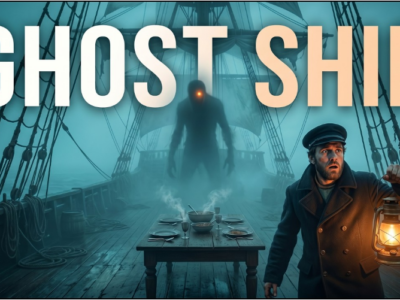
In 1872, a Ghost Ship Was Found With Hot Food Still on the Table — No One Was Ever Found
In 1872, a Ghost Ship Was Found With Hot Food Still on the Table — No One Was Ever Found
The story of the Mary Celeste is not just a maritime mystery; it is a chilling reminder of how thin the veil is between a mundane Tuesday morning and an eternity of silence. For over 150 years, this brigantine has served as the ultimate “Ghost Ship,” a vessel that sailed into history with its sails set, its cargo intact, and its soul missing.
To understand the weight of this enigma, we must step onto the deck as it was found on December 4, 1872, by the crew of the Dei Gratia.
The Echoes of a Cursed Beginning
Long before the Mary Celeste became a household name, she was known as the Amazon. Built in Nova Scotia in 1861, the ship seemed born under a dark star. Her first captain died of pneumonia before the maiden voyage even began. On her first trip, she collided with a fishing weir; on another, she ran aground. By the time an American consortium bought her and renamed her the Mary Celeste, she had already earned a reputation as a “bad luck ship.”
In 1872, command was given to Captain Benjamin Spooner Briggs. Briggs was the antithesis of the superstitious sailor. He was a man of the Bible and a man of science—rational, experienced, and deeply devoted to his family. When he set sail from New York Harbor on November 7, bound for Genoa, Italy, he brought with him his wife, Sarah, and their two-year-old daughter, Sophia.
They left behind their seven-year-old son, Arthur, with grandmother, a decision that likely saved the boy’s life but left him the lone survivor of a family that would soon vanish from the face of the Earth.
The Discovery: A Ship Without a Soul
Nearly a month later, Captain David Morehouse of the Dei Gratia—a personal friend of Captain Briggs—spotted a ship drifting erratically between the Azores and Portugal. He signaled, but received no reply. He sent his first mate, Oliver Deveau, to board the vessel.
What Deveau found was not a scene of carnage, but a scene of suspended animation. The ship was seaworthy. The hold contained 1,701 barrels of industrial alcohol, untouched. There was a six-month supply of food and water. But there wasn’t a single human being on board.
This is where the story enters the realm of nightmare. The legends claim—though historians debate the exact timing—that food was still laid out on the table. A cup of tea was reportedly still warm to the touch. In the captain’s cabin, Sarah’s harmonium stood open, music propped on the stand. Sophia’s toys were scattered across the floorboards. The captain’s bed bore the indentation of a body that had just risen.
Ten people had simply ceased to exist in the span of a few heartbeats.
The Forensic Shadow: What Went Wrong?
When the Dei Gratia towed the Mary Celeste into Gibraltar, the British authorities were instantly suspicious. They couldn’t wrap their minds around why a seasoned captain like Briggs would abandon a perfectly good ship in the middle of the ocean.
The initial inquiry, led by the cynical Frederick Solly-Flood, focused on murder. He pointed to a few “bloodstains” on a sword and strange cuts on the bow. However, later scientific analysis revealed the “blood” was merely rust, and the cuts were natural wear from the sea. The theory of a mutiny or a pirate attack fell apart: the cargo was too valuable to leave behind, and there were no signs of a struggle.
The Scientific Consensus: The “Invisible” Explosion
After a century of speculation, the most plausible theory involves the very thing the ship was carrying: alcohol.
Nine of the barrels in the hold were found empty. Scientists believe that these barrels leaked, filling the hold with volatile ethanol vapors. In the heat of the mid-Atlantic, the pressure might have caused a “flash fire” or a muffled explosion—a terrifying “whoosh” of blue flame that blew the hatches open.
To Captain Briggs, responsible for a toddler and a wife, the ship likely felt like a floating time bomb. He would have ordered an immediate evacuation. The crew scrambled into the single small lifeboat (the yawl). Briggs likely tied the lifeboat to the Mary Celeste with a long rope, intending to trail behind the ship until the vapor cleared and it was safe to return.
Then, the ocean did what it does best: it took advantage of a single moment of bad luck. Perhaps the wind picked up, the rope snapped, or the knot slipped. In a matter of seconds, the Mary Celeste, with her sails still catching the Atlantic breeze, would have pulled away.
Ten people in a small, overloaded boat watched their only hope of survival drift toward the horizon. In the vast, cold North Atlantic, a lifeboat is a speck of dust. They likely perished from dehydration or were swallowed by a sudden squall, their bodies and their boat sinking into the crushing depths of the “Midnight Zone.”
The Persistence of the Mystery
Despite the logical “alcohol vapor” theory, the Mary Celeste remains a ghost story because science cannot explain the silence. It cannot explain the psychological trauma of a child’s toy left behind on a ship that refused to sink.
The mystery was further immortalized by a young Arthur Conan Doyle, who wrote a fictionalized account that changed the ship’s name to the Marie Celeste. His story added the “hot tea” and “warm food” details that have since become inseparable from the historical facts. He turned a maritime tragedy into a Gothic legend.
The ship itself met a grim end. After being sold and resold, her reputation as a “death ship” made her difficult to man. In 1885, her final captain deliberately ran her aground on a reef off the coast of Haiti in an insurance fraud scheme. He died shortly after, and the ship’s bones were left to rot in the Caribbean sun.
The Lesson of the Ghost Ship
The Mary Celeste haunts us because it represents our greatest fear: that we can be here one moment—playing music, drinking tea, tucking a child into bed—and gone the next.
It is a story about the fragility of human structures. We build massive wooden hulls and fill them with logic, maps, and families, but we are always at the mercy of a shifting wind or a frayed rope. Captain Briggs didn’t die because of a ghost; he died because he was a father trying to protect his family from a danger he couldn’t see.
Today, the Mary Celeste lies at the bottom of the sea, her wood turned to silt. But her story remains on the surface, a ghostly white sail on the horizon of our imagination, reminding us that the ocean never gives up its dead, and some questions are never meant to be answered.
What do you find more terrifying: the idea of a supernatural curse, or the thought that a simple broken rope could erase an entire family from history?
News
22 SCARIEST Bigfoot Encounters Caught While Camping
22 SCARIEST Bigfoot Encounters Caught While Camping The scent of pine needles and damp earth is usually a sanctuary for the weary soul, a return to the primal peace of…
Scientists Just Detected Unknown DNA on Mary Celeste… It Doesn’t Match Anyone
Scientists Just Detected Unknown DNA on Mary Celeste… It Doesn’t Match Anyone The mystery of the Mary Celeste is a ghost story that has haunted the Atlantic for over a…

Twenty Doctors Can’t Save a Billionaire — Then the Black Housekeeper Spots What They Missed
Twenty Doctors Can’t Save a Billionaire — Then the Black Housekeeper Spots What They Missed The air in the $4 million VIP suite at Johns Hopkins Medical Center was thick…
Security Pulled Black CEO Off Plane—Then He Pulled $5B in Funding From the Airline!
Security Pulled Black CEO Off Plane—Then He Pulled $5B in Funding From the Airline! The hum of the JFK terminal was a familiar symphony to Marcus Thorne. As the CEO…
Wealthy Socialite Spits on a Soldier — Judge Hands Down the Maximum Sentence!
Wealthy Socialite Spits on a Soldier — Judge Hands Down the Maximum Sentence! The Gilded Spit: A Trial of Two Worlds The heavy oak doors of the Providence Municipal Courtroom…
Judge Ready to Give Veteran 10 Years—Then Saw Tattoo on His Arm: ‘You’re the Pilot Who Saved My Son’
The Debt of the Nightstalker The air in the Cook County Criminal Courtroom was thick with the smell of floor wax and the collective anxiety of the twenty people waiting…
End of content
No more pages to load