A Fisherman Captured Bigfoot On Camera – He Deleted Everything After
The Ghost of the Spanish River
I am eighty-six years old now, and the walls of this assisted living facility in Sudbury are too white, too straight, and far too silent. They tell me the hum I hear is the ventilation system, but I know better. It’s the sound of a world that has forgotten how to breathe.
For thirty-four years, I have carried a weight heavier than any commercial haul I ever pulled from the Great Lakes. It’s a weight of silver scales, cold river water, and eyes that held the depth of an ancient well. My name is Roy Callahan. Before I was a “resident” here, I was a fisherman. I worked the Canadian Shield—the Spanish, the Missagi, the Serpent—for three decades. I thought I knew those woods. I thought I knew what lived in the shadows of the white birch and the trembling aspen.
I was wrong.
In 1989, I was a man coming apart at the seams. My wife, Darlene, had passed three years prior. Ovarian cancer is a thief; it steals the future and replaces it with a quiet Tuesday morning in October where the person you love simply isn’t there anymore. To cope, I leased twenty-two acres along a bend of the Spanish River, eighteen miles north of Espanola. I needed the isolation. I needed the river to wash away the static of a world that didn’t make sense without her.
It was April 14, 1989. I remember the date because the radio was talking about the Exxon Valdez—a world away, yet the same oily darkness was seeped into my soul. I was standing waist-deep in the Spanish, the water cold with snowmelt, working a deep pool near a log jam.
That was when the silence changed.
There is a specific kind of quiet in the deep bush. It isn’t the absence of sound; it’s the presence of intention. I felt a weight on the back of my neck, the unmistakable sensation of being watched. I turned slowly, expecting a black bear. What I saw stopped my heart.
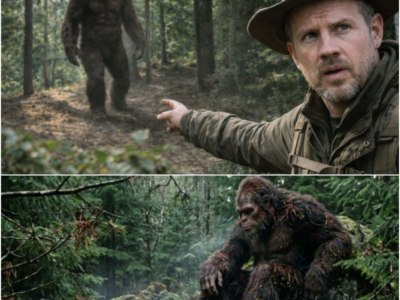
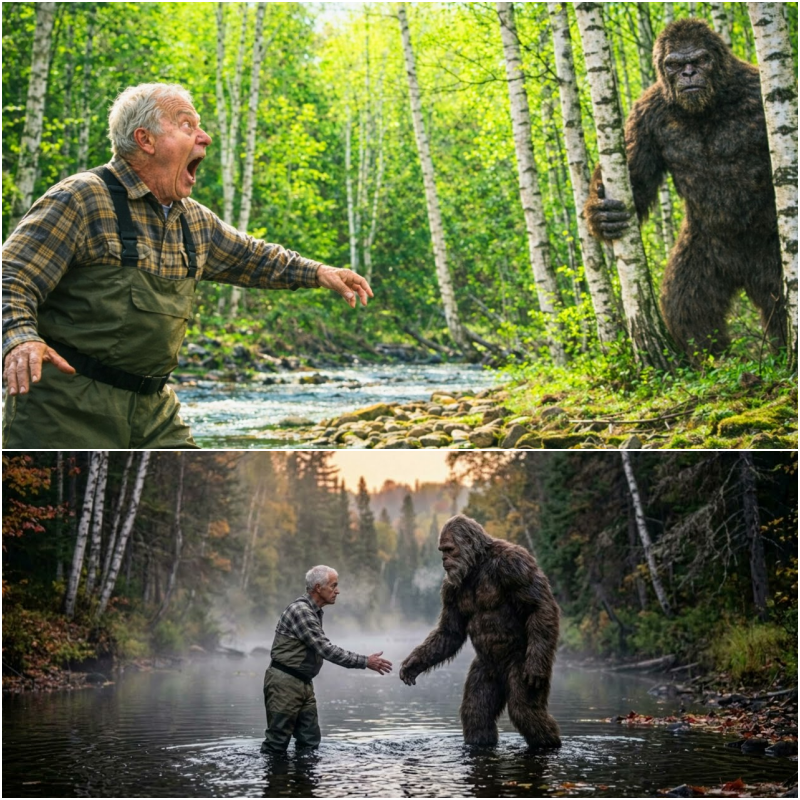
On the opposite bank, framed by the skeletal white of the birches, stood a figure. It was upright, nearly eight feet tall, and draped in fur the color of wet peat. But it wasn’t a bear. The shoulders were too broad, the hips too narrow, and the arms hung down past its knees. When it turned its head, the movement wasn’t the twitchy, olfactory-driven turn of an animal. It was a slow, deliberate assessment.
We locked eyes across sixty feet of rushing water. Those eyes… they weren’t the glowing marbles of a predator. They were deep-set, dark brown, and filled with a terrifyingly human quality of consideration. For twenty seconds, the world ceased to exist. Then, it simply stepped back. It didn’t crash through the underbrush; it dissolved into the forest like woodsmoke in a breeze.
I stood in that river until my legs turned blue, trying to find a logical shelf to put that moment on. I couldn’t find one.
The Language of Stones
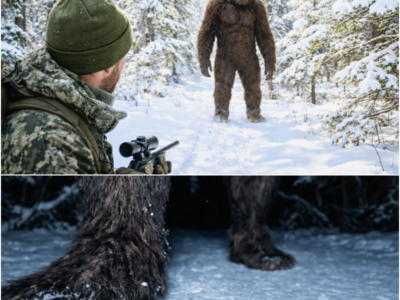
Two weeks later, I found the proof. In the soft mud of the bank, I discovered a track. I pulled the ruler from my tackle bag. Seventeen inches long. Seven inches wide. Five toes pressed so deeply into the muck that whatever made them had to weigh upwards of eight hundred pounds. The stride between prints was over five feet.
I photographed the tracks with my old Pentax, my hands shaking. I went back to my camp—a converted shed with a wood stove and a cot—and filled six pages in my notebook. I made a choice that day: I would tell no one. In a world that wants to dissect and categorize everything, I felt a sudden, fierce need to protect the mystery of that river.
As the months passed, our encounters moved from accidental to ritualistic.
In June, I saw him again at dusk. He was standing in a shallow riffle, perfectly still, watching the water with the patience of a Great Blue Heron. I held my breath, watching him work. With a movement so fluid it defied the laws of physics, he reached into the current. He didn’t swipe at the water like a grizzly. He reached in and gently retrieved a large pike.
He held the thrashing fish for a moment, then looked at me. He didn’t snarl. He didn’t puff out his chest. He simply set the fish back into the water and watched it swim away. Then he looked back at me, a silent communication passing between us: I take only what I need. Do you?
By August, I started leaving offerings. Not food—I didn’t want to habituate a wild thing to human handouts. I left things of aesthetic value. A smooth, translucent river stone placed on a flat boulder. A bright, hand-tied fishing lure left on a stump.
The next morning, they would be gone. In their place, I would find things. A bundle of wild leeks. A perfectly round piece of driftwood. Once, I found a series of markings on an old-growth white pine, nine feet off the ground. They weren’t claw marks. They were deliberate notches, almost like a tally or a notation of the season. I realized then that I wasn’t just being watched; I was being studied.
The Morning of the Woodpile
The real shift happened in October of 1990. The sugar maples were turning a violent, beautiful scarlet. I woke before dawn to a rhythmic thump-thump outside the shed.
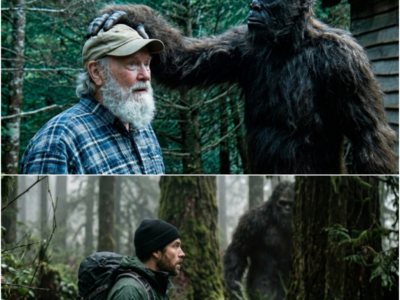
I grabbed my flashlight and stepped onto the porch. The beam cut through the pre-dawn mist and landed squarely on him. He was crouching by my woodpile. He held a piece of split white birch in his massive hands, turning it over, feeling the grain with his thumb. He was examining it the way a master carpenter handles a piece of mahogany.
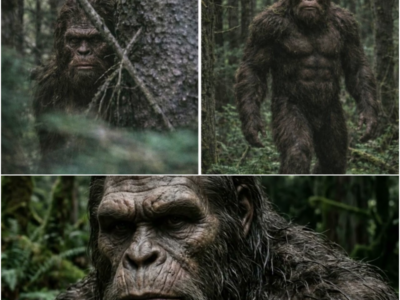
When the light hit him, he stood slowly. He didn’t squint or shy away. At twenty feet, the detail was staggering. His face was a bridge between two worlds—neither fully ape nor fully human, but something older, a blueprint that nature had decided to keep hidden in the attic.
“Morning,” I whispered, my voice cracking.
His expression shifted. It wasn’t a smile, but a softening of the brow—a registration of my presence that lacked all hostility. He set the wood down exactly where he had found it, his movements precise and respectful. He turned and walked into the darkness.
When I looked down at my porch steps, there was a fresh walleye, still wet from the river. I cooked it for breakfast on the woodstove. It was the finest meal of my life. It tasted of cold water and a strange, burgeoning grace.
The Weight of a Hand
I called him the Riverman. And in the spring of 1991, the Riverman saved my life.
The Spanish River is a fickle mistress in the spring. The runoff makes the rocks slick as grease. I was working a deep run a quarter-mile from camp when my felt-soled boot slipped. I went down hard. I heard the snap before I felt the pain—my right tibia giving way against a granite shelf.
The current grabbed me. I was sixty-one years old, alone, and pinned by the weight of my own waders filling with water. Panic, the great killer of woodsmen, began to rise in my throat. I clawed at a submerged root, but the cold was already leaching the strength from my fingers.
Then, I felt a hand.
It was an arm as thick as a cedar post, reaching down into the froth. It didn’t grab me roughly; it steadied me. It guided me through the fast water toward the shallows with a strength that felt tectonic. When we reached the gravel bar, I collapsed, gasping.
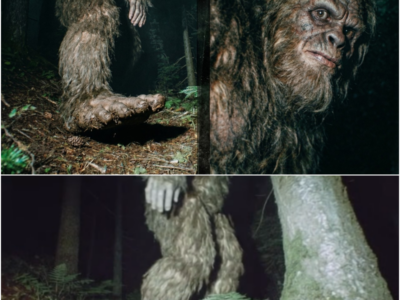
I looked up, and the Riverman was crouching beside me. He didn’t look like a monster. He looked like a concerned neighbor. He reached out and touched my mangled leg. His fingers were incredibly long, tipped with thick, blunt nails, but his touch was as delicate as a surgeon’s. He pressed along the bone, his head tilted, assessing the damage.
He stayed with me for the three hundred yards back to camp. I leaned my weight against his side—his fur was coarse and smelled of pine needles and wet earth. He didn’t make a sound, but his presence was a physical heat that kept the shock at bay.
When he got me to my cot, he stood in the doorway for a long moment, silhouetted against the morning sun. He didn’t want thanks. He didn’t want recognition. He had simply made a choice to intervene. I realized then that the greatest mystery of these creatures isn’t their biology; it’s their morality.
The Lesson of the Stumps
By the summer of 1992, our “friendship”—if you can call a bond between two different species that—had reached a quiet equilibrium. He would sit at the treeline while I cleaned my catch, a silent sentry.
One evening, I was struggling. A particular run of the river that had been a goldmine for three years had suddenly gone dead. I cast until my shoulder ached, but the water was empty. The Riverman watched me from the shadows.
On the third night of my failure, he walked out into the water. He stood in the current, looking upstream. Then, he pointed. Not at the water, but at the bank forty feet above us.
A timber company had come through a few weeks prior and logged a small stand of white birches right at the water’s edge. The stumps were still raw and bleeding sap. I looked at the stumps, then back at the water.
The shade was gone. Without those trees, the afternoon sun was hitting that pool directly, raising the water temperature just enough to drive the trout into the deeper, colder channels. It was a lesson in ecology that no textbook could have taught more clearly.
The Riverman walked to those stumps and placed his hand on the sheared wood. His expression was a heavy compound of grief and incomprehension. It was the look of a man watching a neighbor burn down his own house for the sake of the warmth of the flames.
“I’m sorry,” I said, and for the first time, I felt the collective guilt of my kind.
The Passing of the Torch
The years rolled by like the river. 1997 brought the most devastating moment of all.
I was packing my truck to head into town for supplies when I heard a low, harmonic chattering. I turned to see the Riverman at the edge of the clearing. But he wasn’t alone.
Beside him stood a smaller version of himself—perhaps six feet tall, with lighter, russet-colored fur and eyes that danced with the frantic energy of youth. It was a juvenile.
The Riverman made a series of complex, guttural sounds, gesturing from the young one to me, and then to the river. It was an introduction. This is Roy. He is safe. This is the river. It is ours.
The young one looked at me, then slowly raised a hand, palm out, fingers spread wide. It was a gesture of peace that predates language. I raised my own hand in return, my heart hammering against my ribs.
Trust is a fragile thing. When it is extended between two creatures who have every reason to fear one another, it becomes something sacred. I realized he was teaching the next generation that not all of us are destroyers. He was betting on me.
The Last Blessing
My last summer at the camp was 1999. I was sixty-nine years old, my knees were shot, and my sister-in-law in Thunder Bay needed help. The lease was up, and I knew I wouldn’t be coming back.
On my final evening, I went to the pool where I had first seen him. I didn’t bring my rod. I just brought myself.
The sun was dipping behind the Shield, casting long, golden fingers across the water. He appeared as he always did—stepping out of the birches as if he had been part of them seconds before. He looked older. His fur was shot through with grey, especially around the muzzle and chest.
We stood on opposite banks, two old men nearing the end of our seasons.
The Riverman crouched down and submerged both of his massive hands into the Spanish River. He held them there for a long minute, letting the life-blood of the forest wash over him. Then, he stood and pressed his wet palms to his own face—his forehead, his cheeks, the bridge of his nose.
He was baptizing himself in the memory of the water.
Then, he pointed at me.
For the first and only time in ten years, I waded across the river to his side. The water was waist-deep and biting cold, but I didn’t care. I stood on the “wild” side of the bank, inches away from him. I could see the individual hairs of his coat, the wrinkles around his eyes, the scars on his knuckles.
I put my hands in the water. I mimicked his gesture, pressing the cold river-darkness to my face.
We stood there in the dying light, two creatures sharing a moment of silent recognition. Then, without a word, the Riverman turned and walked into the deep timber. He didn’t look back. He didn’t need to.
The Silent Witness
I am eighty-six now. In a drawer in my nightstand, I have three blurry photographs, six notebooks, and a hand-tied fly in a wooden box.
People ask me if I believe in Bigfoot. I hate that word. It sounds like a punchline, a tabloid headline, a cheap plastic toy. I don’t “believe” in anything. I know.
I know that in the heart of the Canadian Shield, there is a people who have watched us for millennia. They have watched us log their homes, pollute their waters, and rush through lives that they measure in heartbeats and seasons. And yet, some of them still choose to step out of the shadows. Some of them still choose to help a broken old man who has lost his way.
The Spanish River is still there. It still catches the light on the riffles. It still runs cold and deep.
My advice to you is simple: When you find yourself in the old forests, move slowly. Speak softly. Leave the world better than you found it.
Because someone is watching. They have been watching for much longer than we have. And if you are very quiet, and very lucky, and if your heart is open enough to break, they might just decide to show you why the river still runs.