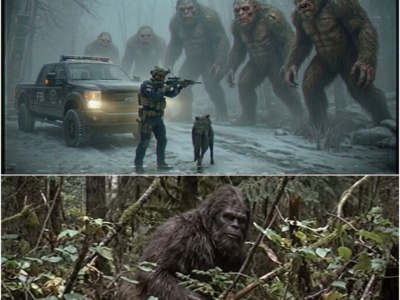
An American Detective Investigates the Most Dangerous Bigfoots | Sasquatch Horror Story
The Silent Harvest: Echoes from the Cascade Curtain
The air in the unmarked utility van smelled of stale coffee and the ionized hum of high-end surveillance gear. I stared at the blinking cursor on my laptop, my fingers hovering over the keys. Outside, the streetlights of a nondescript Virginia suburb flickered, casting long, skeletal shadows against the pavement. I knew they were watching. I knew that at the end of the block, tucked behind the suburban camouflage of a contractor’s truck, sat the men who had spent three decades making sure people like me stayed quiet.
But the silence is heavy, and I’m getting old. My pension won’t buy back my soul.
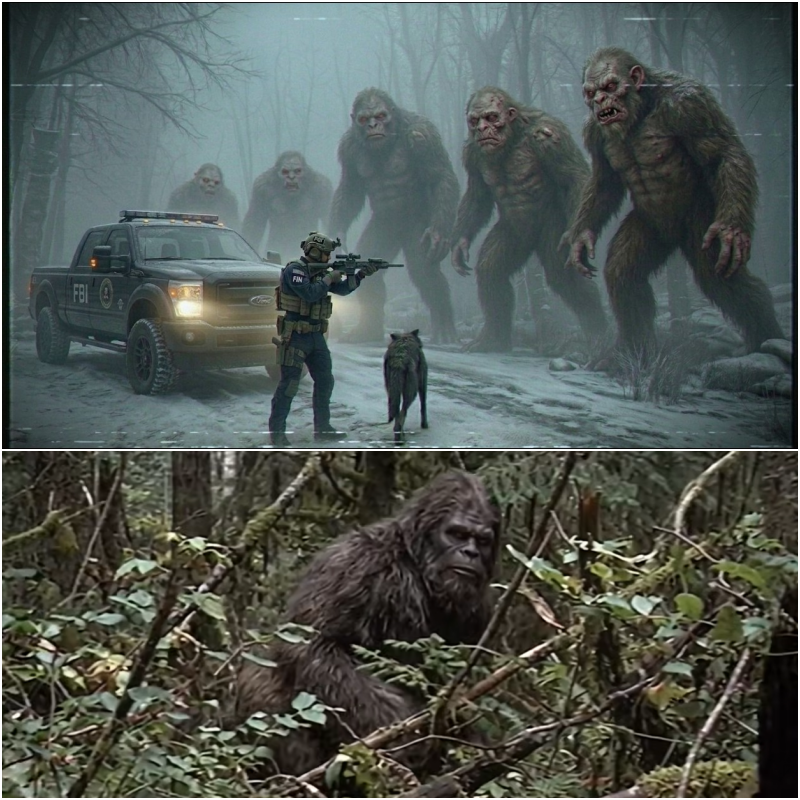
You think you know Bigfoot. You think you know the National Parks. You’ve seen the grainy 1967 Patterson-Gimlin film—the lumbering ape, the swinging arms, the “Missing Link.” It’s a comfortable mystery, isn’t it? A romantic notion of a primitive cousin hiding in the brush.
I spent twenty-five years in federal law enforcement. I started in the Bureau, tracking human monsters. I thought I knew what darkness looked like. But then I was moved to the “Special Management Division.” No ledger, no public oversight. Our job wasn’t to find things; it was to manage the perimeter of a lie.
They aren’t apes. They aren’t even animals. And those National Parks? They aren’t for the trees. They are for us. They are the walls of a cage we built to keep the “Ancient Ones” from noticing how many of us there really are.
The Vanishing at Copper Ridge
It was October, seven years ago, in the heart of the Cascade Mountains. The Pacific Northwest is a place where the green is so deep it looks black, and the fog doesn’t just roll in—it breathes.
The case was “Code Amber-Zero.” That’s the internal designation for a disappearance that defies the laws of physics. Four college students—bright, fit, and well-equipped—had vanished from a campsite near Copper Ridge. They had GPS beacons, satellite phones, and enough survival gear to last a month.
When the local Sheriff’s department reached the site, they found a scene that turned their stomachs. Not because of blood—there wasn’t a single drop—but because of the order. The tents were zipped. Four pairs of hiking boots were lined up neatly outside the flaps. Cell phones and car keys were stacked on a folding table like offerings. It was as if the students had simply stepped out of their shoes and evaporated into the ether.
The tracking dogs arrived six hours later. They were the best in the state, bloodhounds that could find a needle in a hayfield. They hit the perimeter of the camp, stopped dead, and began to wail—a high, mournful sound that signaled Primal Fear. They refused to move. One dog, a veteran of a hundred searches, actually bit its handler in a desperate attempt to run the other way.
That’s when my unit was called in. Me and a man I’ll call Miller.
Miller was a tactical operator who had seen things in the Middle East that would give a gargoyle nightmares. He was a man of cold logic and heavy ballistics. We hiked up that ridge as the sun began to dip, the sky turning the color of a bruised plum.
“Something’s wrong with the frequency,” Miller muttered, tapping his ear. He was right. The woods are never quiet. There’s always the skitter of a squirrel, the groan of a Douglas fir, the distant cry of a hawk. But as we crossed the three-mile marker toward the camp, the world went dead.
This is what researchers call the Oz Effect. It’s a localized atmospheric shift. The wind stopped. The insects went silent. The air grew thick, pressing against our eardrums like we were being submerged in deep water.
Then came the smell. It wasn’t the “skunk” smell the tabloids talk about. It was the scent of a lightning strike mixed with something sweet and clinical—like a hospital hallway or a fresh grave.
“Heads up,” Miller whispered, unholstering his sidearm. “We aren’t alone.”
The Shimmer in the Dark
We reached the campsite at twilight. The shadows were stretching, merging into one great, suffocating darkness. I stood by the fire pit, looking at the stacked belongings of kids who would never go home.
“Look at the light,” I said, pointing toward a stand of ancient cedars.
In the dimming glow, the forest seemed to warp. It wasn’t a physical movement of the trees. It was a distortion in the air itself—a shimmering, oily refraction. It looked like the heat haze coming off a highway, but it was ten feet tall and standing perfectly still.
That’s the secret the agency kills to protect. What we call “Bigfoot” isn’t covered in fur. It’s covered in a dense, pulsating neural-fungal growth. It’s an ancient, subterranean mycelium that has evolved to mimic its surroundings. It doesn’t hide behind trees; it becomes the forest. It bends light. It absorbs sound. It is the ultimate biological stealth hunter.
Miller raised his weapon, his hands—hands that had never shaken in a firefight—trembling visibly. “I can’t see the edges of it,” he hissed.
Suddenly, the shimmer moved. It didn’t walk; it glided with a terrifying, heavy grace. And then, the infrasound hit us.
It’s a frequency below the range of human hearing, but your body feels it. It triggers the “fear center” of the brain. My stomach turned over. My vision blurred. I felt a sudden, overwhelming urge to simply lie down and let whatever was coming happen. It’s a predatory tool—it paralyzes the prey with a wave of existential dread.
“Don’t look at its eyes,” I shouted, though my voice sounded like it was coming from miles away.
From out of the shimmer, a face began to resolve. It wasn’t an ape’s face. It was long, pale, and deeply lined, like a piece of driftwood carved into a mask of ancient intelligence. It had eyes that weren’t eyes—they were vast, black wells that didn’t reflect the light. They absorbed it.
The Harvest of Minds
The creature didn’t roar. It didn’t charge. It stood there, nearly ten feet of towering, fungal mass, and I realized why the victims leave no trace.
These things don’t eat meat. They don’t want our calories. We are a different kind of resource to them. They evolved in the deep, silent darkness of the continent’s massive subterranean cave systems. They developed a consciousness that is vast, cold, and hungry.
They harvest awareness.
I watched as the shimmer expanded. Miller let out a low, whimpering sound. He wasn’t being attacked physically; he was being “unzipped.” I could see the electrical impulses of the forest—the very light of the world—being pulled toward the creature’s fungal shroud.
The students hadn’t walked away. They had been dismantled. Their memories, their fears, their very sense of “self” had been pulled out of their bodies like threads from a sweater, absorbed into the collective neural network of the creature. What was left of them wasn’t even a husk; it was nothing. They were deleted from the physical plane.
“Miller, move!” I screamed.
I fired my flare gun. The phosphorus burst in a brilliant, blinding white. For a split second, the creature’s camouflage failed. I saw it—truly saw it. It was a nightmare of black, matted fibers, pulsating with a rhythmic, sickly light. It looked like a god of the woods made of rot and ancient stars.
The light disoriented it. The “cloak” flickered, and the crushing weight of the infrasound lifted just enough for me to grab Miller by the tactical vest and drag him back toward the ridge.
We ran. We didn’t look back. We didn’t stop until we hit the gravel road where the SUVs were parked.
The Perimeter of the Lie
Three days later, I was sitting in a windowless room at a facility in Langley. A man in a tailored suit, whose name I never learned, pushed a folder across the table.
“There was a localized gas leak,” he said, his voice as dry as parchment. “The students succumbed to the fumes and wandered into a ravine. Their bodies will never be recovered due to the terrain. That is the story. Do you understand?”
“I saw it,” I said, my voice cracking. “It wasn’t an animal. It was… it was harvesting them.”
The man leaned forward. The light reflected off his glasses, hiding his eyes. “We know what they are. We’ve known since 1905. Why do you think we created the National Park Service? To protect the ‘natural beauty’? No. We created a buffer. We manage the boundaries. We give them enough ‘strays’ to keep them deep in the woods, away from the cities. It’s a treaty, Agent. One signed in blood long before you were born.”
I was transferred two weeks later. Miller was “retired” on a medical discharge for “acute PTSD.” I heard he stopped speaking entirely. He just sits on his porch in Montana, staring at the tree line with a shotgun across his knees.
I spent the rest of my career filing reports on “missing hikers” and “bear attacks,” knowing every word was a tombstone for someone whose soul had been consumed by the Cascades.
But the van at the end of my street is still there. They know I’m typing this. They know the connection is live. And they know that I’m about to tell you the worst part.
Because the Copper Ridge incident wasn’t an isolated event. It was a scouting mission. The “treaty” is failing. The deep places of the earth are getting crowded, and the things that live in the dark are starting to realize that the boundaries we drew on our maps… they don’t have to follow them anymore.
The Architecture of the Void
The last thing I told you was about the “unzipping.” It’s a term we used in the Division to describe the moment the physical world stops making sense and the creature’s true form—the void—reveals itself. I’m writing faster now. The van at the end of the street has just turned off its headlights, which in my world means they’re done watching and ready to move.
If you’re reading this, you need to understand that what happened to Miller wasn’t a death. Death is a biological conclusion. What the “Ancient Ones” do is an extraction.
The Void in the Chest
As Miller stepped toward that nine-foot silhouette, the air didn’t just vibrate; it groaned. Imagine the sound of a tectonic plate shifting, but compressed into a frequency that only your marrow can hear. The creature’s chest didn’t open like a door; it unraveled. The black, pulsating fungal fibers peeled back like the petals of a dying lotus, revealing a space that shouldn’t have been there.
It was a window into absolute nothingness—a geometric darkness that folded in on itself. There were no organs, no bones, no heart. Just a swirling, iridescent oil-slick of a vacuum.
Miller didn’t scream. He didn’t even look back at me. That vacant, blissful smile stayed fixed on his face even as the pitch-black liquid continued to leak from his eyes. He walked into that opening as if he were walking home. The moment his leading foot crossed the threshold of the creature’s mass, it simply… vanished. Not like stepping into a room, but like a digital file being deleted. One second he was there, a three-dimensional man of two hundred pounds of muscle and bone, and the next, he was a flat memory.
The creature’s mass cinched shut. The “hair”—that dense, neural-fungal mycelium—wove itself back together with a wet, rustling sound that made my teeth ache.
I was alone. The “Oz Effect” was at its peak. The silence was so heavy I felt like my lungs were filled with lead. I waited for it to turn to me. I wanted it to. I wanted the vacuum to take the terror away, to replace the crushing dread with the same hollow ecstasy I saw on Miller’s face.
But it didn’t.
The entity tilted its massive head. It didn’t have a neck in the human sense; its whole torso seemed to adjust with a fluid, predatory grace. The voice that entered my head wasn’t a voice. It was a “thought-dump.” It felt like a heavy, frozen weight dropping into the center of my skull.
“Witness,” it projected. It wasn’t a word; it was an entire concept. It was the realization that I was being spared not out of mercy, but for utility. I was a messenger. I was the one who had to carry the smell of ozone and the sight of the void back to the men in the windowless rooms.
Then, it simply ceased to be. It didn’t run into the brush. The shimmering optical camouflage just intensified until the creature was indistinguishable from the Douglas firs and the shadows. The temperature in the clearing spiked back to normal, and the wind returned with a violent, snapping gust that nearly knocked me over.
The Debriefing at Site-9
I don’t remember the hike down. I remember the extraction team—men in gray tactical gear with no insignias—finding me sitting in the dirt, staring at Miller’s discarded rifle. They didn’t ask where he was. They didn’t look for a body. They just bagged the rifle and escorted me to a waiting helicopter.
Forty-eight hours later, I was at a facility in Northern Virginia. No windows. No clocks. Just the hum of high-efficiency air filters.
I sat across from a man named Director Vance. He wasn’t a general or a politician. He was a “Janitor”—one of the high-level bureaucrats who manages the logistics of the impossible. He didn’t look at my report. He looked at me with a tired, clinical pity.
“You’re wondering why we don’t hunt them,” Vance said, lighting a cigarette despite the ‘No Smoking’ signs. “You’re wondering why we have the 10th Mountain Division and a nuclear triad, yet we let nine-foot fungal anomalies harvest our citizens in the Cascades.”
“We can’t kill them,” I whispered. My voice felt like glass.
“Oh, we could burn the forests,” Vance replied, exhaling a plume of blue smoke. “We could salted-earth the entire Pacific Northwest. But they aren’t just in the trees, Agent. They are under us. The North American Craton is honeycombed with subterranean systems that make the Grand Canyon look like a drainage ditch. If we start a war on the surface, they’ll finish it from below. They’ve been here since the pre-Cambrian. They watched the dinosaurs die. They watched the ice come and go. We are a blink in their eye.”
He leaned forward, the fluorescent lights reflecting off his bald head.
“The National Parks are not reserves. They are a compromise. Theodore Roosevelt knew it. Muir knew it. We drew lines on a map and said, ‘This is yours.’ We legalized the isolation. We made it a federal crime to build a skyscraper in their kitchen. And in exchange, they stay within the green. They don’t come for the cities. They don’t dismantle a suburb in Ohio.”
“And the people?” I asked, my hands shaking under the table. “The Missing 411? The thousands who vanish every year?”
Vance shrugged—a cold, terrifyingly casual movement. “Every treaty has a price. They don’t need our land; they need our ‘Spark.’ Their collective consciousness is a biological supercomputer that has been running for a billion years. It needs fresh data. It needs the electrical impulses of human awareness to stay ‘alive.’ We provide the habitat; the tourists provide the maintenance. It’s a quota, Agent. We lose five thousand a year to keep three hundred and thirty million safe. In the world of federal math, that’s a win.”
The Network of Screams
I resigned that week. They let me go because they knew the “Thought-Dump” I received would do their work for them. They knew I’d be too terrified to be a whistleblower and too broken to be a threat.
But they underestimated the “residue.”
When that creature touched my mind, it left a door open. For the last seven years, I haven’t just lived in this house; I’ve lived in the “Network.”
When I close my eyes, I don’t see the back of my eyelids. I see the Cascades, but not the way you see them. I see the forest as a glowing, pulsating nervous system. Every tree is a node. Every root is a wire. And trapped within that network are the “Batteries.”
I see Miller.
He’s still “alive.” Not in a body—that was recycled by the fungal mass long ago. But his mind is pinned like a butterfly to a board. He is part of a billion-year-old dream. He’s experiencing the thoughts of a creature that remembers the birth of the moon and the death of the sun. It’s a cold, alien, and infinite awareness. And he’s screaming. They’re all screaming.
The missing hikers, the children who wandered away from their parents in Yellowstone, the hunters in the Ozarks—they are all there, woven into the black mycelium, their consciousness being slowly digested over centuries.
The government calls it “paying the rent.” I call it a cosmic horror that we’ve dressed up in Smokey Bear hats and “Protect Our Parks” bumper stickers.
The Final Transmission
The van outside has just opened its doors. I can hear the soft thud of boots on the asphalt. They’re coming to ensure the “Architecture of the Lie” remains intact. They’ll find me, they’ll find this laptop, and they’ll make sure I’m listed as another “unfortunate casualty of veteran mental health.”
But I’m not afraid of the men in the van. They’re just small men doing a small job.
I’m afraid of the trees.
I’m afraid because the “Network” is hungry, and the quota is rising. I’ve seen the latest classified internal memos. The disappearances are increasing. The entities are moving closer to the trailheads. The shimmer is appearing in town parks and backyard woods.
The treaty is breaking. The Ancient Ones are tired of the “marginal loss.” They’ve tasted the sheer volume of humanity we’ve built up over the last century, and they’re realizing that the cage we built for them is actually a buffet.
If you go into the woods—any woods—and the silence hits you like a physical weight… if you smell that metallic tang of a lightning strike… don’t look for a “Bigfoot.” Don’t look for an animal.
Look for the shimmer. And if you see it, don’t run. Your muscles won’t let you anyway. Just pray that you’re not part of this year’s rent.
They’re at the door now.
Stay out of the green. Stay on the concrete. The wild doesn’t want to be protected; it wants to be fed.
👉 Link youtube: https://youtu.be/sY-ExyX_0k4?si=oNx0gONNWHP2ZXsg
News
They Hired His Team to Hunt Bigfoot — But They Were Actually Hunting Them | Bigfoot Horror Story
The Apex Contract The mud in the Olympic Peninsula doesn’t just stick to you; it tries to swallow you. It’s a cold, black slurry of decomposed hemlock and glacial silt…
They Don’t Attack by Accident — Here’s What He Learned After Living Among Bigfoots for 3 Years
They Don’t Attack by Accident — Here’s What He Learned After Living Among Bigfoots for 3 Years The Butcher of the Blue Ridge The mist in the Appalachian “Hells” doesn’t…
He Investigated Bigfoot Attacks — What He Found Was Hidden by the Government | Bigfoot Horror Story
He Investigated Bigfoot Attacks — What He Found Was Hidden by the Government | Bigfoot Horror Story The Boundary at Oak Haven The maps in the Blue Ridge Mountains are…
He Found Bigfoot Footage on His Trail Cam in Alaska 2026, Then Made the Mistake of Going Back
He Found Bigfoot Footage on His Trail Cam in Alaska 2026, Then Made the Mistake of Going Back The wind didn’t howl in the Alaskan interior; it hissed. It was…
This Is What Bigfoot Really Is — And Here Is the Proof | Cliff Barackman
This Is What Bigfoot Really Is — And Here Is the Proof | Cliff Barackman The old-growth timber of the Blue Mountains doesn’t just grow; it looms. Here, in the…
NEW 2026 Bigfoot Footage Has Experts Confused — And It’s Going Viral
NEW 2026 Bigfoot Footage Has Experts Confused — And It’s Going Viral The air in the Pennsylvania Wilds doesn’t just get cold in late October; it gets heavy. It’s a…
End of content
No more pages to load