PART 2 Officer Calls Him “Boy” During a Traffic Stop, Then Learns He’s a Federal Judge
Officer Calls Him “Boy” During a Traffic Stop, Then Learns He’s a Federal Judge
.
.
.
🇺🇸 PART 2 — “THE AFTERSHOCK FILES”
The precinct lights were still buzzing the morning after Judge Marcus Ellis walked out, but nothing inside Sycamore Falls Police Department felt alive anymore.
Not in the way it used to.
The building had survived scandals before—complaints buried, reports rewritten, quiet settlements signed in rooms without windows—but this was different. This time, the silence wasn’t covering anything up. It was exposing everything.
And the exposure had just begun.
1. THE NIGHT AFTER THE VIDEO WENT GLOBAL
By 2:13 a.m., the traffic stop video had crossed every boundary of containment.
Local Facebook groups shared it first. Then Reddit threads dissected every second. By dawn, national news outlets had picked it up, looping the same frozen frames:
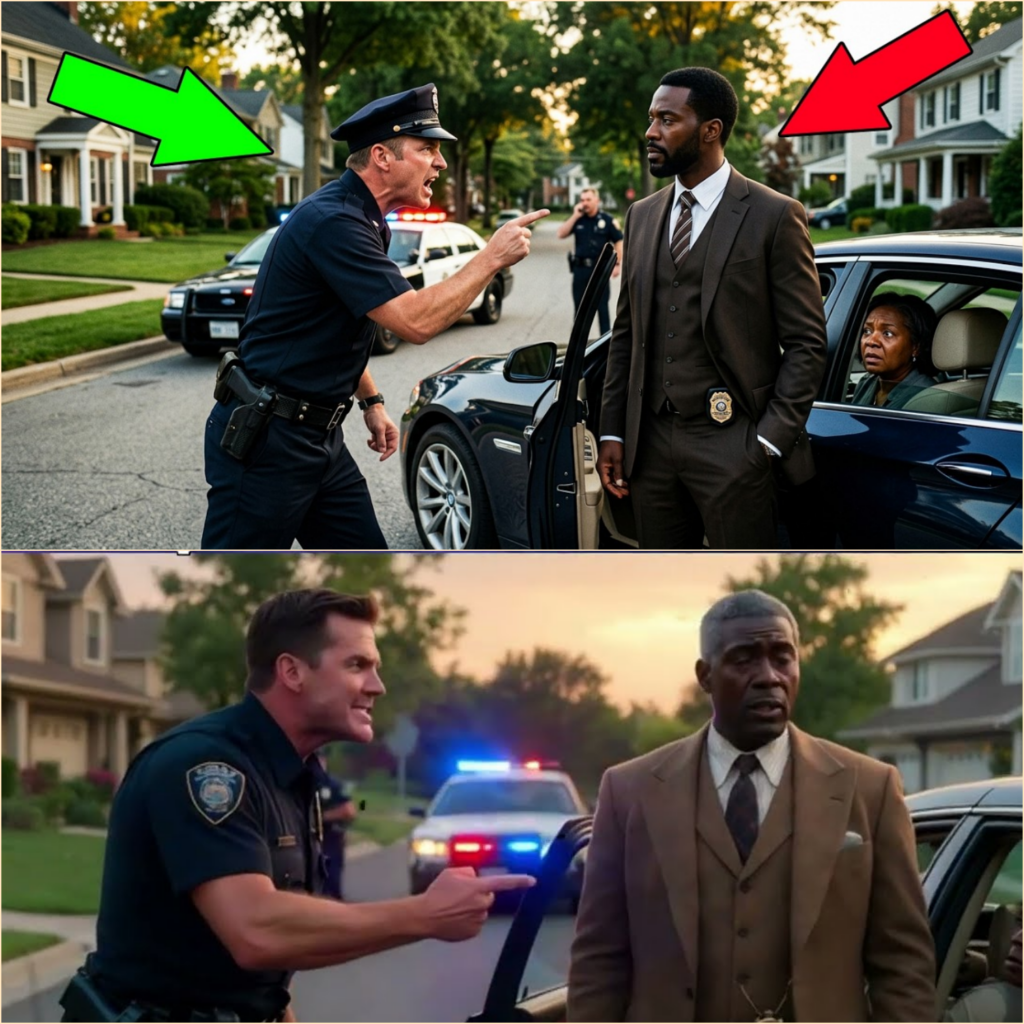
A federal judge on his own hood.
A badge pressed too close to a window.
A voice saying: “I am the law here.”
But what spread faster than the video… was the disbelief.
Because people couldn’t decide what shocked them more:
That it happened at all—
Or that it looked so ordinary while it happened.
Inside the Ellis residence, there was no celebration. No relief party. No champagne.
Just silence.
Elena sat at the kitchen table with her laptop open, replaying internal footage that had already been leaked to legal counsel. Marcus stood near the window, still in the same posture he used in court—hands behind his back, eyes fixed outward, like he was waiting for something that had not arrived yet.
Elena finally spoke.
“They’re not arguing whether it happened,” she said. “They’re arguing whether it was justified.”
Marcus didn’t turn.
“That’s always the second phase,” he replied quietly. “First they deny the person. Then they debate the truth.”
Outside, news vans were already gathering at the end of their street.
They had become a location.
Not a home anymore.
2. INTERNAL AFFAIRS: THE SECOND LOOK
Inspector Elena Marsh had not slept.
Not because she was overwhelmed—but because she understood momentum.
Once a case like this gains oxygen, it stops belonging to the department.
It belongs to everyone else.
She sat in the internal affairs office with three monitors running simultaneously:
Body cam. Dash cam. Dispatch logs.
Each screen told the same story from a different angle.
No violation.
No probable cause.
No justification.
Just escalation.
Then she did something she hadn’t done yet.
She rewound further back.
Not the stop.
Not the confrontation.
But the officer’s entire shift.
That’s when she saw it.
Officer Ryan Harlon had stopped three other vehicles that week.
Two warnings. One citation.
All three drivers were Black men.
All three stops lacked clear infractions until after the fact explanations were written.
Marsh leaned back slowly.
Patterns weren’t evidence on their own.
But patterns with intent behind them?
That was a structure.
And structures don’t collapse quietly.
They fail loudly.
She opened a new file titled:
PRELIMINARY PATTERN ANALYSIS — HARLON, R.
Then added one line at the bottom:
“Escalation behavior not isolated.”
3. THE UNION RESPONSE
By noon, the police union had issued its first statement.
It was careful.
Deliberate.
Legally armored.
“Officer Harlon acted within perceived threat protocols under rapidly evolving conditions.”
But inside the union office, the tone was very different.
Because perception didn’t matter anymore.
Footage did.
And worse—
Identity did.
Someone had finally confirmed what the system had failed to recognize in real time:
Judge Marcus Ellis was not just a judge.
He was a federal judicial appointment with constitutional protection from arbitrary detention.
That detail alone transformed the case from misconduct into something far more dangerous for the department:
A federal civil rights violation.
And that meant the conversation was no longer internal.
It was now federal jurisdiction.
The union attorney closed the file and muttered:
“This isn’t discipline anymore. This is exposure containment.”
4. RYAN HARLON, ALONE
Ryan Harlon did not watch the news that night.
He didn’t need to.
His phone told him everything.
Missed calls. Unknown numbers. Messages that started as questions and ended as accusations.
But what unsettled him most wasn’t the public response.
It was the silence from inside the department.
No one defended him.
Not publicly.
Not confidently.
Even Sergeant Morrison—who had once said “Harlon has got this”—had gone quiet.
That silence felt heavier than anger.
Because it meant distance had formed.
And in policing culture, distance is the first step before abandonment.
Harlon sat in his apartment, uniform folded on a chair like it belonged to someone else.
The badge wasn’t there anymore.
But its absence felt louder than its presence ever had.
He replayed the moment.
The window.
The hand movement.
The phrase:
“I am the law here.”
He repeated it once.
Then stopped.
Because for the first time, it didn’t sound like authority.
It sounded like a mistake trying to sound confident.
5. THE FEDERAL RESPONSE
The call came at 9:08 a.m.
United States Marshals Service.
Two federal investigators.
One directive:
Preserve all evidence. Do not alter chain of custody. Do not interview involved officers further without counsel present.
And one sentence that changed everything:
“Judge Ellis is requesting federal review under Section 242 civil rights statute.”
That meant the case was no longer about discipline.
It was about criminal liability.
At headquarters, Chief Whitaker stared at the directive for a long time before speaking.
“We don’t survive this quietly,” he said.
Nobody responded.
Because nobody disagreed.
6. ELENA’S FILE
Elena Ellis did something unexpected.
She didn’t prepare for media.
She didn’t prepare for court.
She prepared a timeline.
Not emotional.
Not rhetorical.
Just factual:
Time of stop initiation
Absence of probable cause
Officer escalation sequence
Failure to identify judicial immunity status
Improper detention duration
Supervisory endorsement chain
At the bottom, she added one sentence:
“This was not miscommunication. It was assumption reinforced by authority.”
Then she closed the file.
And finally said to Marcus:
“They’re going to try to turn this into a mistake.”
Marcus nodded slightly.
“It wasn’t.”
“No,” she said. “It wasn’t.”
7. MORRISON BREAKS SILENCE
Sergeant Victor Morrison did not sleep the second night either.
But unlike Harlon, his silence wasn’t internal.
It was strategic.
Because investigators had already reached him.
And when they did, Morrison realized something uncomfortable:
He was no longer a supporting officer in the narrative.
He was a decision point.
In interviews, he tried to maintain structure.
But structure collapses when confronted with specifics.
“Did you verify probable cause?”
“I relied on officer assessment.”
“Did you observe compliance?”
“Yes.”
“Then why was force escalation approved?”
Silence.
Then finally:
“I didn’t intervene.”
That sentence would later appear in the official report.
Not as explanation.
As admission.
8. THE TURNING POINT HEARING
Two weeks later, an emergency administrative hearing was held.
Not public.
Not yet.
But final in tone.
Harlon sat across from a panel that did not look at him with anger.
They looked at him with something worse.
Correction.
Inspector Marsh presented findings.
No embellishment.
No interpretation.
Just sequence.
When she finished, she slid a single still frame across the table.
The image of the credential holder sitting face down on the hood of the car.
Unopened.
Unseen.
Unacknowledged.
“This,” she said quietly, “is the moment intent stopped being arguable.”
Harlon stared at it.
For a long time.
Then asked:
“Was I supposed to know?”
Marsh didn’t hesitate.
“Yes.”
That was the end of the hearing.
Not officially.
But functionally.
9. THE CONSEQUENCE
Termination was not immediate.
It was procedural.
But inevitable.
Morrison received demotion first.
Then mandatory federal oversight review.
Then removal from supervisory authority.
Harlon’s termination came after.
But by then, it was already public.
And public cases don’t end quietly.
They echo.
They expand.
They rewrite policy faster than institutions can adapt.
Within weeks:
Body cam policy revised statewide
Traffic stop justification requirement tightened
Supervisory intervention protocols rewritten
Civilian review board expanded with subpoena authority
Sycamore Falls became a case study.
Not of corruption alone.
But of unchecked assumption.
10. THE LAST SCENE
Months later, Marcus Ellis returned to court.
Same robe.
Same bench.
Same quiet authority.
But something had shifted.
Not in him.
In the room.
People noticed differently now.
How quickly assumption can become consequence.
How quickly authority can be misread as permission.
At the end of the day, a clerk handed him a new case file.
Civil rights violation.
Different city.
Different officer.
Same pattern.
Elena watched from the gallery.
Marcus opened the file, read the first page, and exhaled slowly.
Not frustration.
Not anger.
Recognition.
Because some cases don’t end when they’re resolved.
They repeat until they’re understood.
FINAL NOTE
The intersection in Sycamore Falls still exists.
No memorial.
No marker.
Just asphalt, traffic, routine movement.
But something invisible changed there.
Not because one incident was extraordinary—
But because it was documented when it shouldn’t have been ignored.
And in systems built on assumption…
Documentation is disruption.
The truth didn’t begin that night.
It was just finally recorded.
And once something is recorded…
It cannot be erased.
Not anymore.