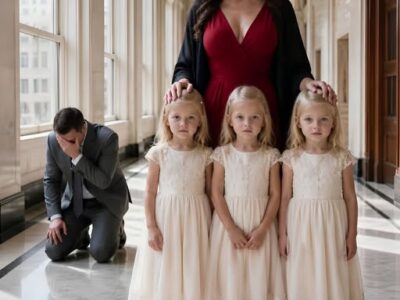
A patient asked me to call her husband. I picked up the phone… and the name I saw was my own husband’s.
A patient asked me to call her husband. I picked up the phone… and the name I saw was my own husband’s.
PART 1
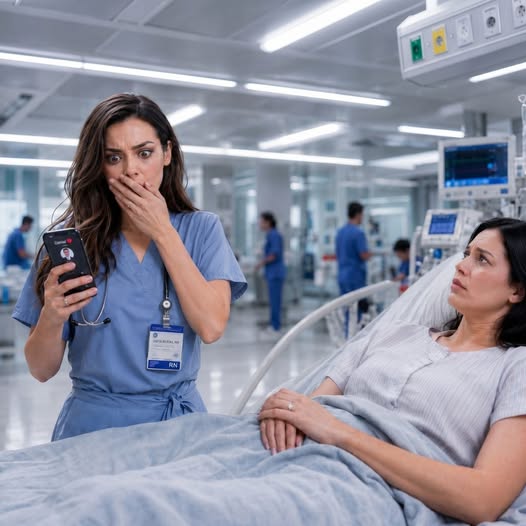
The injured woman asked her to call her husband, and Valeria saw on the screen the same name engraved inside her wedding ring: Rodrigo.
The noise of the emergency room became distant. The stretchers, the monitors, the screams behind the curtains — everything hung suspended in one impossible second. The patient was pale, her black hair stuck to her forehead with sweat, a splint on her wrist, and fear filling her eyes. In her trembling hand, she held her phone as if it were a lifeline.
“Please, call him. He’s at the top of my contacts. He’s my husband.”
Valeria did not answer. She looked at the screen again: “Rodrigo ❤️.” The same Rodrigo who made café de olla for her on Sundays. The same one who kissed her forehead before sleep. The same one who, for two years, had held her hand in fertility clinics while swearing that one day they would have a baby.
“Ma’am, are you all right?” the patient asked.
Valeria swallowed hard. Her voice came out clean, professional, almost perfect.
“I’ll ask a colleague to make the call. Don’t worry, you’re safe.”
She walked away without running. At the nurses’ station, she placed the phone on the counter as if it were burning her. She asked Nadia to cover bed six and locked herself in the staff bathroom. There, in front of the stained mirror, she did not cry. She only breathed. Once, twice, three times. Then she called Rodrigo from her own phone.
He answered on the second ring.
“My love, is everything okay? Another rough shift?”
“Yes. I just wanted to hear your voice. What are you doing?”
“I’m here at home, watching a series. I’m waiting for you.”
Valeria closed her eyes. On the other side of the hospital, an unknown woman was waiting for him too.
“Rest,” she said.
“I love you, Vale.”
She hung up without answering.
Three years earlier, Valeria had met Rodrigo Salazar in a café in the Roma neighborhood. She was late for a nursing course, he was reviewing some projects, and her stumble ended with hot chocolate spilled across his white shirt. Rodrigo laughed with a tenderness that disarmed her.
“You are the most beautiful accident that has ever happened to me in this city.”
After six months, he proposed to her in that same café, with mariachis that were far too loud and a simple ring. Rodrigo was an architect, the owner of a small but promising firm. She was a trauma nurse in a public hospital, used to seeing how life could change in seconds. With him, however, she believed she had found stability.
They lived in an apartment in Narvarte. Valeria kept pots of basil and rosemary by the window. Rodrigo hung her nursing diploma in the living room as if it were a work of art. On Sundays, they cooked chilaquiles, argued about how spicy they should be, and dreamed of a house in Querétaro, with a backyard, a lemon tree, and children running around.
Everything began to crack with a boarding pass.
Rodrigo had said he was traveling to Cancún because of a hotel project. Valeria was washing his clothes when she found the folded paper in the inner pocket of his suit jacket. Mexico City to Cancún. That made sense. But on the back, there was another flight: Cancún to Monterrey, that same weekend.
He had never mentioned Monterrey.
Then came the phone calls on the balcony, the laptop suddenly closed, the new shirts, the different perfume. And one afternoon, during a family lunch, her mother-in-law looked at her with a poisonous smile in front of everyone.
“Sometimes men get tired of waiting for children, Valeria. Not everything is their fault.”
Rodrigo did not defend her. He only gripped his napkin and lowered his eyes.
That night, Valeria understood that something was rotten. But she did not imagine how rotten it was.
After the shift in which she met the woman with the phone, she checked Rodrigo’s computer while he slept. She did not search out of curiosity. She searched out of survival. She found a hidden email account, open in a minimized tab.
The messages went back fifteen months.
“I can’t wait to see you.”
“Mateo asked about you.”
“Renata can’t sleep unless she hears your voice.”
Valeria felt the air split apart.
Then she read a sentence that chilled her:
“Promise me again that soon we’ll be a real family, without lies.”
At that moment, she heard the key turning in the door. Rodrigo had come back earlier than expected, and Valeria was still sitting in front of the open screen.
PART 2
Rodrigo walked in with a bag of sweet bread and a rehearsed smile.
“I thought you’d like to have breakfast with me.”
Valeria closed the laptop calmly, although inside she felt as if she were bleeding.
“How strange. You said you wouldn’t be back until tomorrow.”
He looked at her for one second too long.
“The meeting was canceled.”
The silence between them was a table full of knives. Valeria said nothing. Not yet. She had learned in the emergency room that when a wound was deep, you did not put your hands in before knowing where the blood was coming from.
That afternoon, she called Nadia, her friend from the hospital, and a lawyer named Lucía Armenta, famous for not trembling in front of men with money. In less than forty-eight hours, they had contracts, receipts, transfers, and a rental in San Pedro Garza García. The apartment was in Rodrigo’s name. The file listed two dependents: Mateo, four, and Renata, two.
Valeria stared at the screen without blinking.
“The boy is four,” Nadia said.
“Rodrigo and I have been married for three years.”
Nadia went silent.
Then Valeria understood something worse than infidelity: Rodrigo had not fallen into an affair. He had already had another life before marrying her. She had been the respectable ornament for his Mexico City family, the nurse wife, decent and self-sacrificing, the woman he could take to Sunday lunches while hiding Marisol Ortega and the children in Monterrey.
Valeria traveled north the following weekend. Rodrigo said he was going to Guadalajara because of a project. She took a flight to Monterrey with Nadia.
They waited inside a rental car in front of the building. At five in the afternoon, Marisol came out with two children. Mateo wore an América soccer shirt and held a plastic dinosaur. Renata walked unsteadily, clinging to her mother’s dress. Marisol crouched, wiped the little girl’s face with a napkin, and kissed her forehead.
Valeria expected to feel hatred. But she felt something else.
Pain.
Because Marisol did not look like a hidden mistress. She looked like a woman who also believed she had been chosen.
That night, Valeria called her.
“Marisol, this is Valeria Gómez. I was the nurse who treated you in the emergency room.”
There was silence.
“Yes, of course. You were very kind.”
“I need to tell you something difficult. I ask that you listen to me until the end.”
Valeria spoke for nine minutes. She did not insult her. She did not cry. She listed dates, flights, emails, rentals, lies. When she finished, Marisol could barely breathe.
“He told me his wife was only his wife on paper,” she whispered. “That you didn’t love him. That you were separated.”
“I am his wife.”
On the other end, there was a noise, maybe a chair. Then Marisol’s voice changed. She was no longer a confused woman. She was a mother.
“My children have his last name.”
“I know.”
“What are we going to do?”
“The right thing,” Valeria said. “And this time, he doesn’t get to decide for either of us.”
The turning point came three days later, in the middle of a family lunch at the Salazar house. Rodrigo was sitting between his parents, pretending everything was normal, when Valeria placed a folder on the table with copies of everything. Her mother-in-law opened the first page and went pale.
“What is this?”
Valeria looked at Rodrigo.
“Your other family.”
Marisol walked through the door with Mateo by the hand and Renata in her arms. Rodrigo stood up so fast he knocked over his chair.
“Vale, please, this isn’t what it looks like.”
Then Mateo smiled when he saw him and shouted:
“Daddy!”
The entire family froze.
PART 3
No one in the room breathed.
Mateo ran to Rodrigo with the trust of a child who never imagines his love could become evidence. Rodrigo caught him by instinct, but all the color drained from his face. Renata, from Marisol’s arms, stretched out her tiny hands.
“Daddy,” she babbled.
Rodrigo’s mother pressed a hand to her chest. His father said nothing; he only looked at his son as if he had just discovered a stranger sitting at his table.
“Explain it to them,” Valeria said.
Rodrigo opened his mouth, but he could not find a lie large enough.
“I was going to fix this.”
Marisol let out a dry laugh.
“Fix what? Your children? Your wife? Me? Or your accounts?”
Valeria pulled out another document. Lucía, the lawyer, had found more than infidelity: Rodrigo had used money from his firm to support his double life. Duplicate payments, fake invoices, diverted advances. His partner, Ernesto, had already received copies.
“I didn’t come to destroy you,” Valeria said. “You were already destroyed from the moment you started lying. I just stopped covering for you.”
Her mother-in-law, the same woman who months earlier had blamed Valeria for not getting pregnant, tried to stand.
“This should be resolved within the family.”
Valeria looked at her without hatred. That made her seem even stronger.
“No. Family also breaks when it protects the guilty and humiliates the victim.”
Rodrigo fell to his knees in front of her.
“I love you, Vale. I made a mistake, but I love you.”
“You don’t know how to love. You know how to need an audience.”
Then she turned to Marisol.
“You and your children are not alone.”
That sentence changed everything.
The divorce took seven months. Valeria recovered her share of the assets and left the Narvarte apartment with her plants, her books, and her grandmother’s earrings. Marisol obtained formal recognition of paternity, child support for Mateo and Renata, and a civil claim for the money Rodrigo had borrowed from her under false promises.
Rodrigo’s firm collapsed faster than his excuses. Ernesto found five years’ worth of irregularities and forced him to sell his share for far less than it was worth. The clients fled. In a country where everyone knows someone who knows someone, his name began circulating in chats, dinners, offices, WhatsApp groups. No longer as a brilliant architect, but as a warning.
Rodrigo ended up in a small apartment in Portales, without family, without an office, and without the ability to look himself in the mirror. He called Valeria thirty-six times. She answered only once.
“Let me explain.”
“No, Rodrigo. Explanations are for things that are not understood. This is perfectly clear.”
“I lost you.”
“No. You used me. And I recovered.”
She hung up.
Marisol and Valeria did not become friends immediately. First, they shared documents, hearings, uncomfortable silences. Then coffee. Then another. One day, Marisol sent her a photo of Mateo with his broken dinosaur and wrote: “He said you heal people. Can you heal the T-Rex?” Valeria laughed for the first time in weeks.
With time, the pain stopped being a locked room.
Eight months later, Valeria met Tomás Ibarra in a café in Coyoacán. He was a reconstructive surgeon, reading medical charts with an iced tea beside him. She accidentally dropped her bag, and he bent down to help without invading her space.
“I think your pen was trying to escape.”
Valeria smiled.
“I don’t blame it.”
He did not pressure her. He did not fill her with perfect lines. He was simply consistent. He called when he said he would call. He arrived on time. He listened without interrupting. When she told him the truth about Rodrigo, Tomás did not promise to save her.
“I’m sorry you had to carry that,” he said. “You didn’t need to prove your worth to anyone.”
Valeria cried that night, but not from sadness. She cried because someone looked at her without asking her to explain herself.
They married one year later, in a small ceremony in Tepoztlán. Nadia cried from the beginning. Marisol sent white flowers with a card: “Some lives begin after the fire.” Mateo and Renata sent a drawing in which Valeria appeared wearing a superhero cape.
Only one dream remained, one Valeria barely dared to touch: becoming a mother.
Tomás had a sister, Dr. Teresa Ibarra, a fertility specialist. She reviewed every old exam, every ignored result, every misdirected treatment. In the end, she sat Valeria down in front of her with a luminous calm.
“Your body was not failing. It was fighting too many things.”
She explained that there had been an altered immune response, mild inflammation, and low progesterone at key moments. Nothing impossible. Nothing that deserved blame.
“You were not broken, Valeria. The life you were trapped in was.”
The treatment was simple, careful, humane. Medication, rest, monitoring, and a peace Valeria was still learning to accept.
Three months later, on a Thursday morning, Valeria held a positive pregnancy test in the bathroom. She did not scream. She did not run. She sat down on the floor, just like that time when she had read Rodrigo’s emails. But this time, she did not cover her mouth to keep from crying. This time, she cried fully, alive, free.
Tomás appeared at the door.
“Vale?”
She lifted the test.
He crossed the bathroom and embraced her on the floor.
“I’m here,” he whispered.
At eight weeks, Teresa showed the ultrasound screen. She stayed silent for too long. Valeria felt afraid.
“What is it?”
Teresa smiled, her eyes full of tears.
“There are two hearts.”
Twins.
Luna was born first, on a clear November morning, calm and awake. Emiliano arrived two minutes later, crying loudly, as if he wanted to announce to the world that Valeria had never been empty; she had only been waiting for the right place to bloom.
Tomás cried without hiding it. He kissed Valeria’s forehead again and again.
“Thank you for existing,” he said.
She looked at her children, sleeping together, their fists tucked beside their cheeks. By the window were flowers from Nadia, a card from Marisol, and a small dinosaur Mateo had sent to watch over the babies.
Valeria thought of the woman who, one night, held a stranger’s phone and saw her husband’s name with a red heart. She thought of the humiliation, the anger, the lies told around family tables, all the times she had believed there was something in her that was not enough.
Then she looked at Tomás, who was still beside her, disheveled, exhausted, happy.
“Are you okay?” he asked.
Valeria squeezed his hand.
“For the first time, yes.”
Outside, Mexico City was waking up with car horns, tamale vendors, and golden light over the buildings. Inside, between two cribs and a love without theater, Valeria understood that not every story begins when someone arrives.
Some truly begin on the day a woman stands up, says “enough,” and chooses herself.