(PART 3) HER TRUE STORY FROM NEW YORK. They Refused to Help So She Removed Them From Everything
Part III: The Boundary of Blood
In late December, the ice inside me solidified into iron. I drove myself to the offices of James Whitmore, the family attorney who had managed Richard’s and my legal affairs since 1995.
“Susan,” James said, rising from his leather chair to offer me a cup of coffee. “You’re looking steady on that cane. What can we do for you today?”
“I want to change everything, James,” I said, placing my new silver keys on the mahogany table. “The will, the family revocable trust, the house deed succession, the life insurance beneficiary forms. All of it.”
James adjusted his reading glasses. “Alright. What are the adjustments?”
“I want Michael, Jennifer, and David removed entirely. Erase their names from every line of capital I own. Upon my death, the house is to be sold immediately by an independent executor. The entire estate is to be split equally between three charities: the Westchester Elder Care Coalition, an underprivileged inner-city literacy fund, and the regional no-kill animal shelter.”
James stopped writing. The office became deathly quiet. “Susan… this is an extraordinary step. Have you discussed this with them? Families have friction, but a total disinheritance is almost impossible to walk back once you’re gone.”
“They told me they couldn’t drop everything for me when I was lying on a concrete floor with a broken hip, James,” I said, my voice steady, clear, and perfectly cold. “They told me their time was worth hundreds of thousands of dollars. I am simply agreeing with their math. If they cannot drop everything for my life, they will not pick up everything from my death.”
We spent three hours drafting the new documents. I stripped Michael of his Power of Attorney and removed Jennifer as my healthcare proxy. I assigned both legal roles to Patricia, who had agreed to remain on my personal payroll as a weekly companion.
On a Friday morning in late January, I sent three certified letters to Boston, Connecticut, and Austin. I didn’t use exclamation points. I didn’t use angry adjectives. I simply stated the legal facts: the estate plan had been altered, their access to my financial resources was terminated, and the keys currently in their possession had been legally revoked. I included a final sentence: You are welcome in my life as my children, but you are no longer welcome in my will. Let us see what remains of our relationship when the money is removed from the table.
The storm hit on Monday afternoon at exactly 2:15 PM.
My phone lit up like a Christmas tree. I didn’t answer. I sat at my kitchen table—the same table where I had served them thousands of breakfasts—and watched my new security cameras.
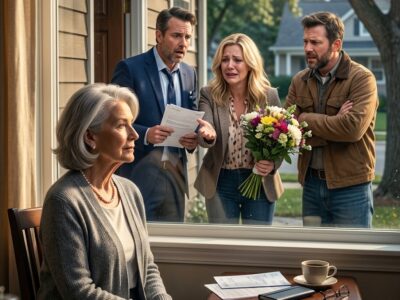
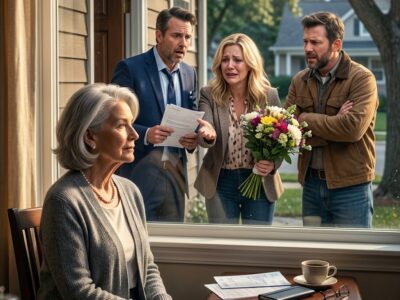
On Wednesday at 3:00 PM, all three of their cars pulled into my driveway. They had coordinated an emergency summit. I watched the monitor as Michael walked up the brick steps, pulled out his old brass key, and shoved it into the deadbolt. He twisted it. The key wouldn’t turn. He shook the door handle violently, his face darkening with immediate rage.
Jennifer ran around to the side entrance, her high heels clicking loudly against the flagstones, trying her key against the laundry room door. David walked the perimeter, staring up at the newly installed security cameras with an expression of pure disbelief.
They converged on the front porch, ringing the doorbell repeatedly. I walked to the door, opened it halfway, and let the heavy security chain lock catch with a metallic snap.
“Mom! Let us in!” Michael demanded, his leather briefcase trembling in his hand. “What is the meaning of this ridiculous stunt? The keys don’t work!”
“The keys don’t work because the locks have been changed, Michael,” I said through the three-inch gap in the door. “And you do not have permission to enter this house without an invitation.”
“An invitation?” David yelled from behind his brother. “This is our childhood home, Mom! You’re suffering from post-surgical paranoia! You can’t just legally lock your own kids out of the family asset!”
“This isn’t a family asset, David. This is my house. I pay the taxes, I bleed on the floors, and I own the title. You told me three months ago that your obligation to me ended when you turned eighteen. I am simply extending that logic to my property.”
“Mom, please,” Jennifer cried, her eyes red with a mixture of anger and humiliation. “We flew across the country for this! We missed work!”
“You flew across the country within forty-eight hours because your inheritance was threatened,” I said, looking directly into my daughter’s eyes. “But you couldn’t drive forty-five minutes down the Merritt Parkway when my hip was held together by surgical steel. Your priorities have never been clearer, Jennifer.”
Michael took a deep, deep breath, attempting to use his courtroom voice. “Susan, listen to yourself. You are making a permanent, destructive decision based on a temporary emotional slight. We made a mistake during a busy quarter. We apologized. If you don’t take this down, I will file a petition for a mental competency evaluation tomorrow morning. We will have a judge review your medical capacity.”
I looked at my eldest son—the boy whose high school essays I had edited until midnight, the man whose law school loans Richard and I had paid off entirely.
“Go ahead and file the paperwork, Michael,” I said softly. “James Whitmore has already filed the affidavits from two independent neuropsychologists who evaluated me last Tuesday. I am perfectly lucid. I simply no longer wish to fund a family that treats me like a cash dispensing machine.”
I closed the oak door and turned the new silver deadbolt.
Michael filed the competency challenge the following week. The judge threw it out within fourteen days, citing the overwhelming psychological evaluations and James Whitmore’s meticulous documentation.
A year has passed since Carlos changed those locks. My life looks vastly different now. I don’t sit by the phone waiting for a Sunday call that costs $15,000. I volunteer twenty hours a week at the local literacy center, teaching immigrant women how to read English. I have a small circle of widowed friends who join me for dinners where we talk about books, travel, and our future—not our pasts.
Jennifer was the first to crack. Two months ago, she showed up on my porch without her briefcase or her phone in her hand. She sat at my kitchen table, wept honestly, and admitted that the distance had become a lazy habit she had used to avoid facing her own fears about my mortality. We are rebuilding slowly, cup of tea by cup of tea. Michael sent a brief, formal letter of apology last month; he has a long way to go, but he called yesterday just to ask if my hip ached during the rainstorm. David remains silent in Texas, his pride too bruised to bridge the distance.
They don’t know that three months ago, I instructed James Whitmore to create a conditional trust structure. If my children maintain a consistent, authentic, non-financial relationship with me over the next five years, forty percent of the estate will revert to them in structured segments. If they disappear again, the money goes to the shelter animals.
I haven’t told them about the trust, and I never will. Let them think they are completely cut out. Because I have finally learned that blood only gets you through the front door if you’re willing to help clean the house when the floors are cold.