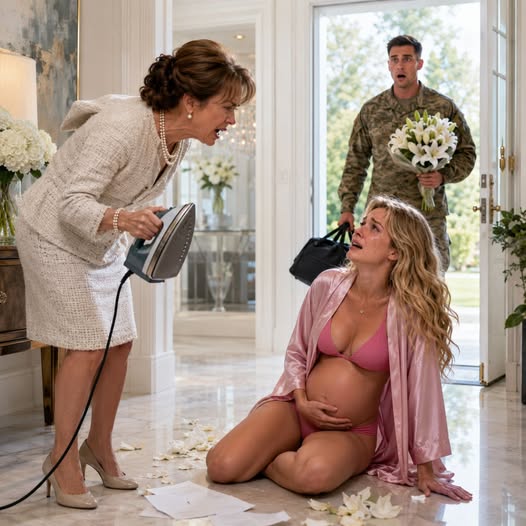
My mother-in-law brought a burning-hot iron close to my eight-month pregnant belly.
My mother-in-law brought a burning-hot iron close to my eight-month pregnant belly.
PART 1
“If you don’t sign these papers, I swear by the Virgin that your daughter will not be born in this house.”
Doña Elvira’s voice did not tremble. Her hand did not tremble either when she brought the hot iron close to my eight-month pregnant belly. The steam burned the fabric of my dress, and I felt my baby move inside me, as if she also understood the danger.
I was sitting in the kitchen of the family house, in a quiet neighborhood of Puebla, where everyone greeted Doña Elvira with respect. To the neighbors, she was a devout, elegant woman, the exemplary mother of a captain in the Mexican Army. To me, ever since my husband had been sent on a mission to the north of the country, she had become my jailer.
On the table were the papers: a divorce petition, a transfer of assets, a letter in which I accepted that I was “not mentally capable” of caring for my baby, and a temporary custody document in her name.
“Sign, Mariana,” she said, smiling with horrible calm. “Diego is not coming back. And even if he did, he would never allow a weak woman to destroy the Sandoval name.”
I could barely breathe.
Two weeks earlier, she had shown me a supposed official notice: Diego had died in a confrontation. The paper had stamps, signatures, cold words. I fainted when I read it. After that, Doña Elvira began telling everyone that I was “losing my mind because of the pregnancy.”
She took away my phone “so I could rest.” She canceled my appointments with the gynecologist. She answered my messages. She told my mother, who lived in Veracruz, that I did not want visitors. She wrote to my best friend, Paulina, using my number, telling her to stay away because her “bad energy” was harmful to the girl.
And I, locked between prayers, lies, and bitter teas, began to doubt even my own memory.
“Your daughter needs a strong family,” Doña Elvira continued. “Not a weeping mother who talks to herself.”
“I am not crazy,” I whispered.
She let out a laugh.
“All crazy women say that.”
The iron came even closer. The heat made me close my eyes.
“Sign.”
The tip of the pen touched my hand. I looked at the line where I was supposed to write my name: Mariana Torres de Sandoval. I thought of my daughter, of the yellow little room I had prepared before Doña Elvira filled it with saints, blessed ribbons, and photos of Diego as a child. I thought of my husband, of his voice promising before he left: “I’ll be back before Sofía is born.”
But Diego was dead. Or that was what they had forced me to believe.
Then the back door suddenly opened.
The noise was so loud that Doña Elvira dropped the pen. The iron kept hissing in her hand.
In the doorway stood a man covered in dust, wearing an olive-green uniform, with a military backpack over his shoulder and a crushed bouquet of sunflowers pressed against his chest.
Diego.
My Diego.
He did not shout. He did not run. He did not lose control.
He simply let the backpack fall, looked at the iron, at the papers, at my face soaked with tears, and then at his mother.
He took out his phone.
“Good afternoon,” he said with a calm that froze the blood. “I need a police car and an ambulance at my address. My wife, who is eight months pregnant, has just been threatened with a hot clothes iron. The aggressor is my mother.”
Doña Elvira turned pale.
“Diego, my son, you don’t understand. She is sick. I was only trying to protect the girl.”
Diego did not answer. He approached me slowly, as if any sudden movement might break me.
“Mariana,” he said. “Did she burn you?”
I shook my head. My tears kept me from speaking.
“Not yet,” I managed to say.
Those two words changed something in his face. It was not fury. It was something worse: a cold, absolute decision.
Diego picked up the fake death notice that was on the table. He read it. Then he held it up in front of his mother.
“This is fake.”
Doña Elvira pressed her lips together.
“I did it for you.”
“No,” he said. “You did it to take my daughter.”
Outside, sirens could be heard. The neighbors came out onto the sidewalks. Doña Elvira ran to the front door and began screaming:
“Help me! My son came back disturbed! The war has damaged him! He wants to accuse me of horrible things!”
But when the police officers entered, they found the iron smoking on the floor, the unsigned documents on the table, and me hugging my belly as if I could protect Sofía from the world with my hands.
Diego stayed by my side.
“My wife needs medical attention,” he said.
A police officer asked what had happened.
I looked at Diego, waiting for him to tell me what to answer. For months, Doña Elvira had taught me that speaking was dangerous.
But he only said:
“You are safe. Tell the truth.”
And then I spoke.
I told them about the papers, about the fake notice, about the blocked calls, the teas, the canceled appointments, the messages sent from my phone. Each word felt like tearing a chain from my body.
Doña Elvira stopped crying.
“Lies!” she screamed. “She is a manipulator! She wants to take my granddaughter away from me!”
Diego opened a drawer and found a folder with my name on it: “Mariana — Mental Deterioration.” Inside were notes written by her, screenshots of messages, copies of medical documents, photos of Sofía’s room taken secretly.
The officer looked at the folder and then at Doña Elvira.
She no longer looked like a worried mother. She looked like a woman who had been discovered.
The paramedics placed me on the stretcher. My blood pressure was extremely high. As they carried me to the ambulance, Doña Elvira shouted from the entrance:
“You ungrateful son! That woman has bewitched you! I only wanted to save our blood!”
Diego looked at her with a sadness that broke my soul.
“No, Mother. You just couldn’t stand that I loved someone more than you.”
The ambulance doors closed. Diego held my hand.
Then a brutal pain tore through my back. I felt warm liquid soak the sheet.
“Diego,” I screamed. “The baby… she’s coming now.”
And the worst was only beginning.
PART 2
In the emergency room of the General Hospital, the white lights looked like knives. One nurse connected me to monitors, another put in an IV, and a doctor spoke of a “threatened premature labor” with a seriousness that made me squeeze Diego’s hand hard enough to leave marks.
The sound of Sofía’s heartbeat filled the room: fast, stubborn, alive.
Diego did not leave my side. He was still wearing his dust-covered uniform, as if he had crossed half the country to arrive exactly before everything ended. But when the doctor left and we were alone, my husband collapsed.
He sat in the chair, covered his face with his hands, and cried.
“I should have been here, Mariana. I should have realized.”
“She planned everything,” I told him, my voice weak from the medication. “It wasn’t your fault.”
But he shook his head.
“For months, I was receiving emails from you. You said not to call, that you were too sensitive, that my mother was helping. I thought you were trying to be strong.”
My chest tightened.
“I never sent that.”
Diego took out his phone and opened the emails. There they were. Cold, organized, soulless sentences.
“Diego, don’t worry about me. Your mother knows what to do. I think it’s better if we don’t talk so much. My hormones are making me unstable.”
I felt nauseous.
“That isn’t me.”
“I know,” he answered without hesitation.
That certainty held me up more than any medicine.
The next morning, Detective Ramírez arrived, a woman with a hard gaze and a calm voice. She asked precise questions. When they took my phone. Who canceled my appointments. Whether I could leave on my own. Whether I had money. Whether anyone else had seen anything.
When she asked if, during those months, I had felt free to leave the house, my first instinct was to say yes. Because a part of me was still trained to protect Doña Elvira.
But I remembered the locked door. The neighbors’ looks. The time I tried to call my mother from a store and Doña Elvira appeared behind me before I could dial.
“No,” I finally said. “I did not feel free. I felt trapped.”
The detective closed her notebook.
“That changes everything.”
Later, Paulina, my best friend, arrived. She came in crying, carrying a bag of baby clothes, and hugged me carefully.
“I thought you hated me,” she sobbed.
“What? Why?”
She took out her phone. She showed me messages sent from my number.
“Paulina, don’t contact me again. Your presence upsets me. My daughter needs peace.”
Then another:
“If you insist on coming, we will call the police.”
Paulina had gone to the house three times. Doña Elvira always said I was sleeping, sedated, or too unwell to see her.
Diego asked for copies of everything. So did the detective.
That afternoon, Don Ernesto arrived, Diego’s father. He was a quiet man with worn hands, who always lowered his eyes when his wife spoke. He entered the hospital as if he were entering a trial.
Diego confronted him in the hallway.
“Did you know?”
Don Ernesto swallowed hard.
“Not everything.”
“That is not an answer.”
“I knew your mother didn’t want Mariana. I knew she spoke badly about her at the parish. I knew she said the baby should be raised ‘with discipline.’ But I didn’t know about the iron or the fake document.”
“And you never asked why Mariana stopped going out? Why she cried? Why my mother answered her phone?”
Don Ernesto cried silently.
“I was a coward.”
Diego pointed to the door of my room.
“Then start by asking her for forgiveness, not me.”
Don Ernesto entered. He did not come too close. He simply took off his hat and lowered his head.
“Mariana, forgive me. I saw too much and did nothing.”
I did not know what to say. Sometimes silence also has consequences.
At seven that evening, Doña Elvira was arrested.
The news spread through WhatsApp faster than fire: “Respected woman detained for attacking pregnant daughter-in-law.” In the neighborhood, no one could believe it. The same neighbors who had defended her began to remember things: my muffled cries, her lies, my windows always closed.
But Doña Elvira did not repent.
From the police station, she called Diego. He saw the number and hung up. Then she called Don Ernesto. According to him, she did not cry or ask for forgiveness. She only screamed that I had destroyed her family and that Sofía was Sandoval blood.
The next day, while Diego was arranging a protective order, my phone vibrated.
It was an email from Doña Elvira’s lawyer.
Attached was a letter written by her.
I opened it with frozen hands.
“Do not think you have won, Mariana. Prison is not forever. Judges make mistakes. Sons forgive. And my granddaughter belongs to me more than she will ever belong to you.”
When I finished reading, Sofía’s monitor began beeping faster.
And I knew Doña Elvira still had one last move.
PART 3
Two weeks later, the doctors discharged me under one condition: absolute bed rest, zero stress, and constant monitoring. Diego drove slowly back home, as if every speed bump in Puebla were a threat to Sofía.
When we opened the door, I felt the air crush me.
The house smelled of confinement, old lavender, and fear. In the kitchen, the black mark was still there where the iron had fallen. In the living room, the heavy curtains remained closed, the way Doña Elvira had kept them because, according to her, “light disturbed sensitive pregnant women.” Sofía’s room was arranged, but not by me. Every drawer had blessed ribbons, religious images, and Doña Elvira’s notes about how “the Sandoval girl” should eat, dress, and sleep.
I froze at the entrance.
Diego placed the keys on the table.
“We can leave today,” he said. “We’ll sell the house, rent somewhere else, start over.”
I looked at the stairs. I thought of all the times I had climbed them crying in silence. I thought of my daughter, who had not even been born yet and was already carrying a war upon herself.
“No,” I answered. “This house is mine too.”
Diego looked at me.
“Then we’ll take it back.”
We started with the kitchen. Diego removed the burned flooring with a hammer and chisel. Each strike sounded like a declaration. I, sitting in a chair, sorted baby clothes while watching the stain that had almost become a scar on my daughter disappear.
When he removed the last black piece, he asked:
“Do you want to keep it as proof that you survived?”
“No,” I said. “Throw it away.”
He threw it out. The sound against the trash can made me breathe in a way I had not breathed in months.
Then we opened every window. We changed the locks. We threw away the teas. We tore up the notes. We took down the curtains. Paulina arrived with tacos, paint, and a little speaker, where she played Juan Gabriel so loudly that even the neighbors heard.
My mother traveled from Veracruz and cried when she saw me, but she did not treat me like glass. She hugged me, made broth, checked my medicine, and then said:
“Now we are truly going to make this house beautiful for my granddaughter.”
We painted Sofía’s room yellow. Not a sad beige, not a color imposed by anyone. Strong, warm yellow, like the facades of villages where the sun does not ask permission.
Don Ernesto arrived one Sunday with a toolbox.
Diego opened the door, but did not let him in before looking at me.
My father-in-law lowered his head.
“I didn’t come to ask forgiveness again,” he said. “I know that can’t be demanded. I only want to fix something that’s broken, if you allow it.”
I watched him for a long moment.
“The crib is loose.”
He nodded.
“I’ll fix it.”
He worked for three hours. He tightened screws, sanded down a dangerous corner, reinforced the base. When he finished, he put away his tools and left without waiting for coffee, food, or an invitation. It was the first time he respected a boundary without anyone needing to explain twice.
One month before my due date, we had to go to court.
Doña Elvira entered dressed in navy blue, wearing pearls and an offended expression, as if she were the victim. Behind her sat two women from the parish who, in the beginning, had defended her. But neither of them could hold my gaze when the prosecutor showed the evidence.
Detective Ramírez explained the confinement, the false documents, the threat with the iron. Paulina read the messages she had received from my phone. My gynecologist stated that someone had canceled appointments while pretending to be me. An expert confirmed that Diego’s death notice was fake.
Then they called Diego.
My husband testified with the same calm with which he had called the police. He described how he came home earlier than expected, how he saw the iron, the papers, my face. Doña Elvira’s lawyer tried to suggest that, because of his military work, Diego might have exaggerated the situation.
“Captain Sandoval,” he asked, “did your training influence the way you interpreted the scene?”
Diego looked at his mother.
“Yes. It taught me that a real threat does not stop being a threat just because it comes from someone who shares your blood.”
The silence in the room grew heavy.
Then it was my turn to speak.
I walked to the stand with trembling legs. My enormous belly seemed to remind me that I was not alone. Diego stayed within my line of sight. He did not smile. He did not gesture. He was simply there.
And that was enough.
I told them everything. The blocked calls. The fake notice. The iron. The nights when Doña Elvira sat beside my bed to tell me that a good mother knew when she had to step aside. I told them how she made me believe Diego was dead. How she convinced me that everyone saw me as a madwoman.
The lawyer stood to question me.
“Mrs. Mariana, isn’t it possible that your emotions because of the pregnancy led you to misinterpret the firm, yet loving, concern of a grandmother?”
I looked at him. Yes, I felt fear. But I also felt something new: a clean anger.
“Pregnancy swelled my feet and gave me nausea,” I said. “Your client took away my freedom and threatened my daughter with a hot clothes iron. Let’s not confuse one thing with the other.”
The lawyer did not respond.
Faced with the amount of evidence, Doña Elvira accepted a plea agreement. She was sentenced to two years in prison, five years of probation, mandatory psychiatric evaluations, and a permanent order prohibiting her from approaching me, Diego, or Sofía.
Before they took Doña Elvira away, the judge allowed me to give one final statement.
I stood up.
“Doña Elvira said my daughter needed a strong woman to raise her. In that, she was right. She only chose the wrong woman.”
Her jaw tightened.
“My daughter will not inherit her grandmother’s fear. She will inherit the truth: that her mother spoke, that her father believed her, and that no family has the right to destroy someone in the name of blood.”
Don Ernesto cried in the last row. Diego closed his eyes, as if he could finally release the air he had been holding for months.
When the officers handcuffed Doña Elvira, she turned her head toward me. Her lips moved without sound:
“This is not over.”
But this time, I did not feel terror.
I felt a strong pain in my back.
Then another.
I leaned on the table. My water fell onto the courtroom floor.
Sofía decided to be born on the day her grandmother lost power.
She arrived that dawn, at 2:33, in the middle of a rainstorm that beat against the hospital windows like furious applause. She was born small, red, with an enormous cry. Diego held her in his arms and cried without shame.
“She’s here,” he whispered. “Our little girl is here.”
I touched her tiny cheek.
“And no one took her from us.”
The following months were not perfect. Freedom also hurts when a person has lived too long in fear. There were nights when I woke up sweating, certain I could hear Doña Elvira’s voice in the kitchen. There were early mornings when Diego stood beside the crib, watching Sofía sleep, his fists clenched with guilt for not having been there sooner.
We went to therapy. We learned words for what we had lived through: control, manipulation, psychological violence, isolation. Naming the horror did not erase it, but it helped us understand that it had not been born from my weakness. It had been born from the abuse of someone who confused love with possession.
Don Ernesto kept visiting on Sundays. At first, he stayed in the yard. Later, in the living room. He always asked before picking Sofía up. He always left when I said it was time. Over time, I understood something: forgiveness was not opening the door all at once. It was watching to see whether the other person had learned to knock before entering.
Three years later, on Sofía’s birthday, Diego arrived with an enormous bouquet of sunflowers.
I was in the kitchen, watching our daughter try to spread cake frosting into her hair.
“Very discreet flowers, Captain,” I joked.
Diego kissed my forehead.
“You’re not discreet either when you decide to survive.”
That night, after everyone had left and Sofía was sleeping with a yellow teddy bear in her arms, I stood looking at the back door.
“That’s where you came in,” I said to Diego.
He came closer.
“Yes.”
“Covered in dust, with crushed flowers and that terrible calm.”
Diego smiled faintly.
“Inside, I was terrified.”
“It didn’t seem like it.”
“That’s why my mother lost.”
I shook my head slowly.
“No. She lost because you believed me before the world could convince you I was broken.”
The mark from the iron no longer existed. In its place was a new floor, smooth and clean. But I did not need to see it to remember. Some scars do not stay on the skin. They stay in the way a woman learns to close doors, raise her voice, and say no without apologizing.
Doña Elvira believed that blood gave her rights. She believed a family could hide violence behind rosaries, surnames, and good appearances. She believed a pregnant woman was easy to break.
She was wrong.
My daughter was born without marks. I was not erased. Diego never obeyed out of guilt again. And in this house painted yellow, we learned that love does not imprison, does not threaten, does not falsify papers, and does not demand silence.
True love opens the door, turns on the light, and stands beside you while you tell the truth.
And sometimes, that truth is enough to destroy the person who thought fear would always win.