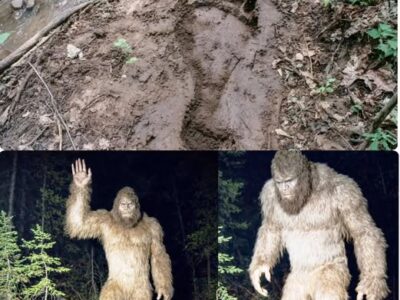
I Accidentally Hit Bigfoot With My Car, Then Had To Help It
I Accidentally Hit Bigfoot With My Car, Then Had To Help It
In the damp, mist-choked autumn of 1996, the Cascade Mountains felt like they had been swallowed by the sky itself. Rain had been falling for hours, turning the narrow logging roads into slick ribbons of mud and gravel. Visibility was poor, the kind of thick gray night where even headlights struggled to push more than a few feet into the darkness. Field researcher Dale Patterson had driven these roads countless times, but tonight felt different in a way he couldn’t quite explain. The forest seemed too quiet, the kind of silence that presses against the ears rather than simply existing. He told himself it was just fatigue, just another long day of fieldwork cataloging wildlife patterns for a private conservation study. Still, his grip on the steering wheel tightened as he followed the winding road deeper into the forest.
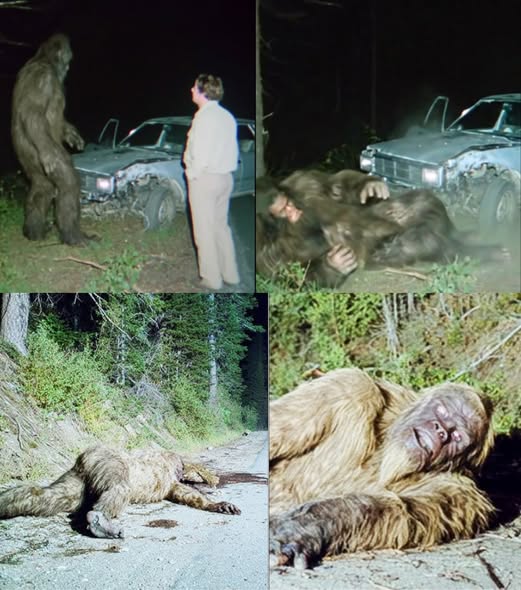
It happened without warning. One moment there was nothing but wet asphalt reflecting the beam of his headlights, and the next something massive stepped into the road. Dale barely had time to react before the impact jolted through the truck. The Ford Ranger lurched violently, tires skidding across gravel as he slammed the brakes. The sound that followed was not like hitting a deer or bear; it was heavier, deeper, as though he had struck something far denser than any animal he knew. For a long moment, everything went silent except for the rain tapping against the windshield and the ticking engine cooling down. Dale sat frozen, breath shallow, trying to understand what he had just seen in the brief flash of headlights before impact. It hadn’t looked right. Too tall. Too upright. Too human.
Against every instinct screaming at him to stay inside the truck, Dale grabbed his flashlight and stepped out into the storm. Rain soaked him instantly, cold and relentless, as he moved toward the front of the vehicle. The beam of his light swept across the hood, then down toward the road. At first he saw nothing except shattered branches and disturbed mud. Then the light caught something that made his entire body lock in place. A shape was lying near the edge of the road, partially obscured by ferns and fallen logs. It was large—far larger than any bear he had ever encountered—and it was moving.
Dale approached slowly, each step heavy with disbelief. As he got closer, the impossible truth began to take form. The creature was upright in structure even while prone, its limbs long and powerful, covered in thick dark hair matted with rain and dirt. Its chest rose and fell unevenly, and when its head shifted slightly, the reflection of its eyes caught the flashlight beam in a way that sent a shock of primal recognition through him. This was not a bear. It was not a known animal. Every rational explanation in his mind fractured at once.
The creature made a low sound, something between a groan and a breath, and tried to pull itself away from the road. It was injured. Badly. Dale could see unnatural angles in its movement, signs of trauma that suggested broken ribs or a fractured limb. For a moment, fear rooted him in place. Every story he had ever heard about Bigfoot, every warning whispered in camping tales, surged to the surface. But what followed was not aggression. The creature did not attack. It did not lunge or roar. It simply struggled to breathe, and that changed everything.
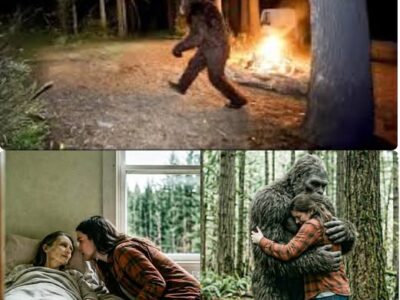
Dale made a decision that would define the rest of his life. He ran back to the truck, grabbed his first aid kit, and returned to the creature’s side. The rain continued to fall in heavy sheets as he worked, hands shaking while he assessed injuries that should not have been real because the being itself should not have existed. He wrapped bandages around deep wounds, checked for bleeding, and tried to stabilize what he could without fully understanding the anatomy in front of him. The creature watched him the entire time. Not with mindless panic, but with awareness. With patience. With something disturbingly close to understanding.
Hours passed. The storm did not ease. At one point, Dale spoke softly without thinking, as if the situation required reassurance. “I’m not going to hurt you,” he said, not expecting any response. But the creature made a faint sound in return, low and controlled, almost as if acknowledging the statement. It was then Dale realized something even more unsettling: it was not behaving like an animal. It was waiting. Observing. Learning.
By the time the rain began to thin near dawn, the immediate danger had passed. The creature was still alive, still conscious, but no longer struggling violently. Dale sat back against a wet rock, exhausted, his mind unable to reconcile what his eyes had witnessed. He had spent years studying wildlife in the Cascades, convinced that nature still held unknowns waiting to be discovered. But nothing in his training prepared him for this. The creature shifted slightly, turning its head toward him, and for a brief moment their eyes met in the pale gray light of early morning. There was no rage there. No confusion. Only recognition.
And then, slowly, it lifted one massive hand and placed it on the ground between them—not as a threat, but as something closer to trust. In that silent gesture, something unspoken passed between two species that were never meant to meet. Dale understood, without knowing how, that this moment would not be forgotten by either of them. Whatever this being was, it had chosen not to end him. And in return, he had chosen not to let it die.
What neither of them knew was that the forest had already begun to remember what had happened on that road. And it would not stay silent for long.
Dawn came slowly through the Cascade canopy, bleeding pale gray light into the drenched logging road. The storm had finally weakened, leaving behind a heavy, wet silence that felt even more unnatural than the rain. Dale Patterson hadn’t slept. He sat against a moss-covered boulder near the edge of the road, soaked through, exhausted, and unable to look away from the creature lying only a few yards away. It had not moved much since the early hours of the morning, but it was still breathing, still present, still real in a way that kept breaking his understanding of the world. Every rational explanation he had once relied on felt increasingly fragile, like it might collapse if he thought about it too hard. Yet what disturbed him most was not the creature’s existence, but the fact that it had not left. It could have vanished into the forest at any point. Instead, it remained within sight, as if it had chosen to stay.
When it finally shifted again, Dale tensed instinctively, expecting sudden violence or escape. But there was none. The movement was slow, controlled, almost deliberate. The creature pulled itself into a more upright position against a fallen log, its massive frame trembling slightly with pain. Up close, Dale could see details he had missed in the chaos of the night—deep scars across the shoulder and torso, older injuries that suggested a long life shaped by survival rather than chance. The more he observed, the harder it became to categorize what he was seeing. It was not behaving like a wounded animal. It was enduring like something that understood suffering and had learned how to carry it.
Dale carefully reached into his kit again, pulling out what remained of his medical supplies. He hesitated for only a moment before moving closer. Every survival instinct he had told him this was madness, yet something else—something quieter—kept pushing him forward. The creature did not react aggressively as he approached. Instead, its eyes followed him with steady attention, tracking each movement with unsettling precision. When Dale began adjusting the bandages he had applied earlier, he noticed something even more disturbing: the creature was watching his hands, not his face, as if analyzing technique, learning process. It understood cause and effect. It understood intention. That realization made his stomach tighten.
Hours passed as Dale continued treating injuries, improvising where he had no knowledge to rely on. At one point he spoke again without thinking, breaking the silence that had settled between them. “I don’t know what you are,” he admitted quietly, almost to himself. The creature made a low sound in response, not quite a vocalization of language, but not meaningless either. It carried rhythm. Structure. Something that felt like acknowledgment. Dale froze, realizing he was no longer alone in his assumptions. Communication, however primitive, was happening.
By midday the forest had begun to change. Light filtered more strongly through the trees, and distant wildlife sounds slowly returned, but the immediate space around them remained unnaturally still. It felt as though the area had been marked by something unseen, a boundary that other animals instinctively avoided. Dale noticed it when a passing deer froze at the treeline, stared toward them for several seconds, then turned and fled without hesitation. Even the forest seemed aware.
The creature shifted again, this time attempting to stand. Dale instinctively moved forward, ready to intervene if it collapsed, but stopped when he saw how deliberate the movement was. It did not rush. It tested weight, balance, strength. When it finally reached a partial standing position, towering far above him even while injured, Dale felt an overwhelming sense of scale that no photograph or legend had ever conveyed properly. This was not a story-sized myth. It was real mass, real presence, occupying space in a way that changed how the forest itself felt. For a brief moment, the creature looked down at him, and Dale had the unsettling impression that it was not simply seeing him, but understanding him.
Then it did something unexpected. It extended one arm slowly, not toward him aggressively, but downward, palm open. It was not a strike posture. It was not a warning. It was a gesture that looked almost deliberate in its simplicity. Dale stared at it, unsure how to interpret it, until something in him made the decision before fear could interfere. He placed his hand—small, fragile in comparison—against the massive palm. The contact lasted only a few seconds, but in that moment, something unspoken passed between them that Dale would struggle to explain for the rest of his life. There was no hostility. No confusion. Only recognition of existence.
The creature withdrew its hand first, then turned slightly toward the forest. It paused, as if considering something unseen beyond the trees, then looked back once more at Dale. There was no farewell in any human sense, but there was acknowledgment, as if a boundary had been crossed and understood. Slowly, painfully, it stepped away from the road and disappeared into the dense timber without sound. Dale did not follow. He could not. He remained standing in the damp clearing long after the last trace of movement had vanished, listening to the forest return to its normal rhythm while knowing that nothing about it was normal anymore.
When he finally returned to his truck, the engine still cold and untouched since the crash, he sat in silence for several minutes before starting it. As he drove away from the logging road, he did not look back. Not because he wanted to forget, but because he understood, in a way he could not yet articulate, that what had happened was not an encounter that ended. It was an encounter that had begun something. And somewhere deep in the Cascades, the forest had already decided to keep the memory alive.