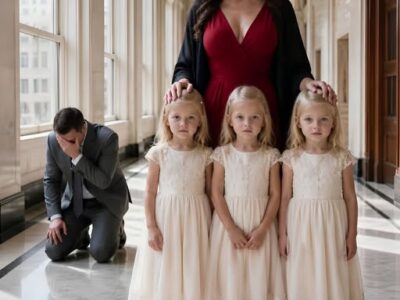
The party looked perfect until the father asked where his son was and heard, “I locked him up just to calm him down.” After that, secrets about another boy’s own mother came to light, and no one could pretend everything was normal anymore.
The party looked perfect until the father asked where his son was and heard, “I locked him up just to calm him down.” After that, secrets about another boy’s own mother came to light, and no one could pretend everything was normal anymore.

PART 1
“Your son was pretending to be sick just to ruin my son’s party, so I locked him in the basement for a little while.”
When my sister Juliana said that, standing in the middle of the kitchen with her hands stained blue from cake frosting, I felt as if someone had ripped the floor out from under my feet.
I did not scream right away. I couldn’t. I just stared at her as if the woman in front of me was not the same sister who had grown up with me in Santos, the same sister my mother, before she died, had asked me to protect.
Behind me, my wife Camila had already gone pale.
“Where is Gabriel?” she asked, her voice almost disappearing.
Gabriel was eight years old. That afternoon, we had taken him to his cousin Lucas’s birthday party, Juliana’s son. The party was at a beautiful house in a gated community in the interior of São Paulo, with a pool, a superhero backdrop, a table full of sweets, and guests taking pictures of everything.
Gabriel and Lucas had been inseparable since they were little. They studied at the same school, traded stickers, played soccer during recess, and slept over at each other’s houses whenever the family got together.
Before we left Gabriel there, he complained of a stomachache.
“Do you want to go home, son?” I asked.
He shook his head, trying to smile.
“No, Dad. I want to stay with Lucas. I promised I’d help him when it’s time for the candles.”
I trusted my sister.
That was the mistake I would never forget.
Camila and I took the chance to go to the supermarket and run a few errands downtown. I called Juliana twice during the afternoon. She did not answer. I sent a message. Nothing. I tried calling the simple phone Gabriel carried in his backpack for emergencies. Nothing either.
Camila started getting uneasy.
“André, this isn’t normal. Let’s go get our son now.”
When we arrived, the party was already ending. There were disposable cups scattered around, deflated balloons on the floor, and children running through the living room. Lucas was on the couch with two classmates, laughing at a video on a phone.
Gabriel was not there.
“Juliana, where is my son?” I asked.
She froze.
“He’s resting.”
“Resting where?”
“André, for God’s sake, don’t make a scene in front of the guests.”
Camila stepped forward.
“I want my son now.”
Juliana glanced quickly at the door leading to the back of the house. I did not wait anymore. I crossed the kitchen and went straight down the hallway. She tried to grab my arm.
“No, wait, I’ll get him.”
That was when she said that absurd sentence. She said Gabriel was “being dramatic,” that he had asked to call me, and that she had taken his phone because children did not give orders in her house. She said he cried, insisted, disrupted the birthday song, and that she had only put him in the basement “so he could calm down.”
“For how long?” Camila asked, trembling.
Juliana did not answer.
I ran down the stairs. The basement was cold and dark, smelling of mold and old boxes. In the corner, near a folded mattress, I found my son curled up on the floor, sweaty, pale, his shirt soaked and vomit near his feet.
“Dad…” he whispered, as if he could not believe I had arrived.
Camila screamed.
I picked him up in my arms. His body was cold and limp.
“I told Aunt Ju it hurt a lot… I asked her to call… but she closed the door.”
I carried Gabriel upstairs while Juliana whimpered behind me.
“André, I swear I thought it was a tantrum. He’s always been too sensitive.”
I stopped in the middle of the kitchen and looked at her.
“My son asked for help. You punished a child for being sick.”
She tried to touch him, but Camila stepped in front of her.
“Don’t touch my son.”
We went straight to the hospital. Juliana followed in her car, even though I told her I did not want to see her there. In the waiting room, she kept repeating empty excuses, more worried about what the guests had seen than about Gabriel.
Half an hour later, my father, Seu Antônio, arrived with Marcos, Juliana’s husband.
“What happened?” my father asked.
Juliana tried to speak first.
“Gabriel got sick and—”
“She locked my son in the basement,” I interrupted. “She took his phone, ignored my calls, and left him vomiting alone for hours.”
Marcos lost all color.
“Juliana… what did you do?”
She started crying loudly.
My father stayed silent for a few seconds. Then he looked at her in a way I had never seen before.
“I was preparing a living inheritance arrangement for my children and grandchildren,” he said quietly. “After this, you will not receive a cent.”
Juliana lifted her head, horrified.
“Dad, you can’t be serious.”
“My grandson could have died while you were worried about pretty party photos.”
At that moment, while Gabriel was receiving IV fluids behind a curtain, I understood that the worst had not happened yet. Because the woman who destroyed my trust was my own sister… and no one could believe what she would still do after that.
PART 2
The doctors confirmed that Gabriel had severe food poisoning. Maybe something he ate before the party, maybe some spoiled food. The illness was not Juliana’s fault. But the abandonment was.
When we came home, Gabriel barely spoke. He slept between Camila and me, holding onto my shirt as if I might disappear.
The next morning, Juliana sent twenty-seven messages.
“Forgive me.”
“I panicked.”
“Talk to Dad.”
“He’s destroying me.”
“Everyone is treating me like a monster.”
She only asked about Gabriel in message number nineteen.
That killed whatever pity I might still have felt.
Marcos called me that same day.
“André, I’m not going to defend your sister. What she did was cruel. Last night I made her sleep in the guest room. I don’t want her alone with Lucas for now.”
I felt a chill.
“Marcos, Lucas lives with her.”
He went quiet.
“I know.”
Two days later, my father came to dinner at our house. We told him we were thinking about contacting the Child Protective Council and filing everything officially. I thought he would ask us to stay calm. Juliana was still his daughter.
But he only said:
“Protect Gabriel. Don’t apologize for that.”
Then he lowered his eyes.
“And there is something I should have told you before.”
Camila held my hand.
My father took a deep breath.
“This is not the first time I’ve seen Juliana lose control with a child.”
“What do you mean?” I asked.
“With Lucas. Screaming over anything. Pulling him by the arm. Exaggerated punishments. Once, he spilled juice on the couch, and she left the boy sitting outside in the yard for almost an hour, crying, until he apologized ‘like a man.’ I told her to get therapy. She said she would. She never did.”
That night, we filed the report.
The social worker listened to Camila, then to me, then spoke with Gabriel. He came out with red eyes, but he told everything: that he had asked for help, that his aunt had said “stop being dramatic,” that the door had closed, and that he kept calling for me until he had no strength left.
We handed over the medical report and the messages.
Days later, they visited Juliana’s house. She cried, but not for Gabriel. She cried because “the family wanted to destroy her image.”
The recommendation was mild: mandatory therapy, a family guidance course, and no unsupervised contact with Gabriel.
That was all.
Camila cried with outrage. My father stayed silent, his face hard. I felt a dry anger, the kind that does not scream but burns inside.
Months passed. Juliana went to the sessions because she was required to, but Marcos told me that at home, she kept saying everyone had exaggerated.
Then we hired a lawyer to file a lawsuit for moral damages and negligence.
Before the case could move forward, the phone rang one Thursday night.
It was Marcos.
“André… I left the house with Lucas.”
I stood up from my chair.
“What happened?”
In the background, I heard my nephew crying.
Marcos took a moment to answer.
“Your sister threw a plate at him.”
PART 3
It all started because of broccoli.
That was what Marcos testified weeks later.
Lucas was having dinner, tired after school. Juliana had been irritated for days: fighting with my father over the inheritance, complaining about therapy, saying Camila and I had set everything up to humiliate her. That night, Lucas pushed his plate away and said he did not want to eat vegetables.
Juliana lost control.
She did not hit the boy, but she threw the plate with such force that it passed close to Lucas’s face and shattered against the wall. The noise made the boy scream. Shards fell onto the floor, and sauce spread across the table.
Marcos did not argue. He did not try to convince her. He picked Lucas up, packed some clothes into a backpack, and left the house.
That same week, he filed for divorce and primary custody of his son.
When I found out, I felt a sadness that was hard to explain. Part of me was relieved that Lucas was away from that. Another part blamed myself for not seeing earlier that Juliana’s problem was not a “party mistake.” It was a pattern.
My father cried sitting on the porch of my house.
“I should have been harsher,” he kept repeating.
“Dad, it’s not your fault.”
But he did not believe it.
The case against Juliana finally reached the judge. Our lawyer presented Gabriel’s medical report, her messages, the Child Protective Council report, and Camila’s testimony. My father also spoke. He told them about the punishments he had seen, the explosions, the empty promises to change.
Marcos testified next.
That was when Juliana’s defense collapsed.
She tried to present herself as the victim.
“My brother was always the favorite. Now he’s using his son to get the family money.”
The judge interrupted her firmly.
“Mrs. Juliana, this case is not about inheritance. It is about a sick child who was locked in a basement while you continued a party.”
For the first time, she lowered her eyes.
Our lawyer asked:
“When Gabriel asked to call his father, why did you not allow him?”
“Because I thought he was exaggerating.”
“And when he vomited?”
“I didn’t know it was that bad.”
“Because you did not go downstairs to check.”
Juliana fell silent.
That silence said more than any confession.
We won the lawsuit. The money did not make us rich, nor was that the intention. It was deposited into an account for Gabriel’s psychological treatment and well-being. What I wanted was not money. I wanted it recorded, in front of everyone, that a child is not an inconvenience to be locked away when he disrupts an adult.
Marcos’s divorce moved faster than we expected. He received primary custody of Lucas. Juliana would have supervised visits and the obligation to continue treatment.
When I heard the decision, I thought I would feel victory.
I did not.
I felt tired.
Because no sentence erased the image of my son curled up in that basement. No judge returned the trust Gabriel lost when he asked an aunt for help and received a closed door.
Juliana never spoke to me directly again. She sent a long letter to my father, saying he had abandoned her, that I had destroyed the family, that Camila had turned everyone against her.
My father read it in silence, folded the paper, and put it in a drawer.
“I hope one day she understands that loving someone does not mean allowing that person to hurt others,” he said.
The inheritance arrangement was redone. My father placed a protected portion for Gabriel and Lucas, with clear rules so no adult could use that money as a weapon. Juliana was left out.
For a while, I wondered if that was too harsh. But then I remembered my son cold in my arms. I remembered the sweaty shirt. I remembered his voice saying:
“Dad, I called you.”
And then I understood.
Juliana did not lose anything because of me. She lost it because of her choices. Because of the door she closed. Because of the calls she ignored. Because of the shame she preferred to hide. Because of the perfect image she tried to maintain while a child was sick in the dark.
Gabriel continued therapy. At first, he was afraid of being alone in closed rooms. If a door jammed, he panicked. Little by little, he started sleeping in his own room again. He started playing soccer again. He started laughing for real again.
The reunion with Lucas was the most beautiful part of all.
Marcos brought his son to our house on a Saturday afternoon. Lucas arrived shyly, holding a bag of toy cars.
“I brought the ones you liked,” he said.
Gabriel stood still for a few seconds. Then he hugged his cousin tightly.
They did not talk about basements, lawsuits, therapy, or broken adults. They went straight to the living room rug to build impossible tracks, as if the world could still be repaired with toys.
Camila cried in the kitchen.
“Children shouldn’t have to carry the weight of adult cruelty,” she whispered.
She was right.
I do not wish Juliana harm. Truly. I hope that one day she stops seeing herself as the victim and looks at what she did. Not to recover money, reputation, or her place in the family. But so she never again turns her own pain into fear for a child.
But Gabriel will never be near her again.
There are kinds of forgiveness that may come with time. But there are doors that, out of love, must remain closed forever.
And if anyone thinks family should stay silent so as “not to make drama,” I will say only this: reporting my sister was not drama. The real horror was an eight-year-old boy having to vomit alone in a basement so all of us would finally stop making excuses for a grown woman.