OceanGate Titan Sub Debris Video Shows How It Imploded
OceanGate Titan Sub Debris Video Shows How It Imploded
Inside the Depths: Analyzing the Ocean Floor Footage of the Titan Submersible Implosion
Introduction: A Tragedy Beneath the Surface
The story of the Titan submersible is one that captured global attention—a fusion of ambition, engineering risk, and the unforgiving power of the deep ocean. When the submersible vanished during its descent to the wreck of the RMS Titanic, hope initially centered on rescue. But as evidence emerged, that hope transformed into a grim realization: the vessel had suffered a catastrophic implosion.
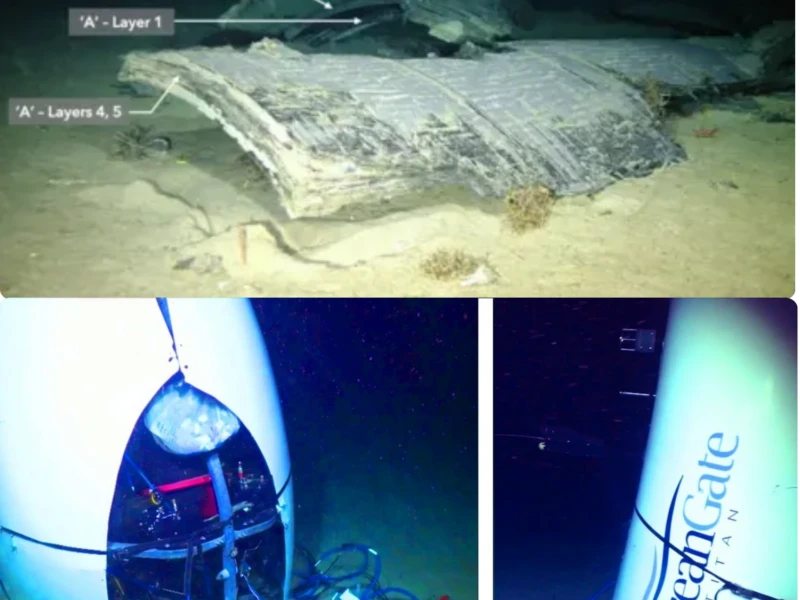
Recently released footage from the United States Coast Guard offers a haunting glimpse into the aftermath. Captured by a remotely operated vehicle (ROV), the video shows debris scattered across the ocean floor—silent testimony to a violent and instantaneous structural failure.
This blog takes a deep dive into that footage, reconstructing what likely happened, analyzing the engineering factors involved, and reflecting on the broader implications of this tragedy.
The First Glimpse: Arrival at the Ocean Floor
The first video segment appears to have been recorded shortly after the ROV reached the seabed. Almost immediately, small fragments come into view—dark, irregular pieces scattered across the sediment. These are believed to be remnants of the Titan’s carbon fiber hull.
As the camera pans forward, a larger structure emerges: the aft section of the submersible. This portion includes the external framework, control housings, and structural components that once formed the tail end of the craft.
What is striking is the relative intactness of this section. Unlike the hull, which appears to have disintegrated, the aft assembly remains largely recognizable. This contrast provides one of the earliest clues about the nature of the implosion.
The emotional weight of this moment cannot be overstated. For the operators guiding the ROV, this was likely the instant when uncertainty gave way to confirmation. What they were witnessing was not a rescue site—it was a debris field.
Identifying the Wreckage: Mapping Debris to Structure
To understand what the footage reveals, it’s helpful to compare it with known designs of the Titan. The submersible consisted of several key components:
A cylindrical carbon fiber pressure hull
Titanium end domes
An aft external frame housing equipment and propulsion
A viewport assembly
The aft section seen in the footage corresponds to the external rear structure. Its survival suggests that it was not part of the primary pressure boundary. Instead, it functioned more like a support system—important, but not subjected to the same crushing forces as the internal cabin.
The fact that this section is still standing upright on the seabed indicates that it detached relatively cleanly and sank intact.
The ROV: Eyes in the Abyss
The footage was captured using a deep-sea ROV, specifically the Pelagic Odysseus 6K. These remotely operated vehicles are designed to withstand extreme depths and pressures, allowing investigators to explore environments that are otherwise inaccessible.
Equipped with high-resolution cameras, lights, and measurement tools (including laser scaling systems), the ROV provides crucial visual data. In this case, it enabled investigators to:
Locate the debris field
Identify major structural components
Estimate distances and sizes
Document the condition of recovered parts
Without such technology, understanding the fate of the Titan would have been far more difficult.
Proximity to the Titanic: A Bitter Irony
One of the most haunting details is the location of the debris field. The Titan’s remains were found approximately 330 meters from the bow of the RMS Titanic.
This means the submersible had nearly reached its destination.
For the passengers aboard, the journey was meant to be a once-in-a-lifetime exploration of history. Instead, they came within sight of their goal—only for disaster to strike moments before arrival.
The Second Video: A Closer Look at Catastrophic Failure
The second clip released by the Coast Guard provides more detail. Here, several critical components come into view:
A circular structure believed to be part of the viewport assembly
A titanium dome
Large fragments of carbon fiber hull
These pieces offer vital clues about how the implosion occurred.
The Titanium Dome
The dome appears largely intact, suggesting that it resisted deformation even under extreme pressure. Titanium is known for its strength and resilience, making it a logical choice for deep-sea applications.
However, its survival also highlights a key point: the failure did not originate in the titanium components.
The Carbon Fiber Hull
In contrast, the carbon fiber hull is heavily fragmented. Large chunks are visible, but the majority appears to have been shattered into smaller pieces.
This aligns with what engineers would expect from an implosion. Carbon fiber, while strong, behaves differently under compressive stress. Instead of bending, it tends to fail abruptly.
Understanding Implosion: Physics at Extreme Depths
At the depth of the Titanic—nearly 3,800 meters—the pressure is immense: roughly 5,500 pounds per square inch (psi).
To put that into perspective:
That’s over 380 times atmospheric pressure
Every square inch of the hull experiences crushing force
Any structural weakness can lead to instantaneous failure
When an implosion occurs at such depths, it happens in milliseconds. The structure collapses inward, compressing air and materials with explosive force.
In the case of the Titan:
The carbon fiber hull likely failed first
Water rushed in at extreme سرعت
The pressure differential caused rapid structural disintegration
The result is not an explosion outward, but a violent inward collapse.
The Glue That Held It Together: A Critical Weak Point?
One of the most discussed aspects of the Titan’s design is the interface between the carbon fiber cylinder and the titanium end caps.
These components were bonded using a specialized adhesive—often described as having a thick, paste-like consistency.
This raises several engineering questions:
Surface Preparation
For adhesive bonding to be effective, surfaces must be properly prepared. This often involves:
Sanding or abrasion
Chemical treatment (etching)
Cleaning to remove oils and contaminants
If these steps are insufficient, the bond may be weaker than intended.
Cyclic Fatigue
The Titan made multiple dives to the Titanic site. Each descent and ascent subjected the hull to cycles of compression and decompression.
Over time, this can lead to:
Microfractures in the carbon fiber
Degradation of adhesive bonds
Delamination between layers
Even small imperfections can grow with repeated stress.
Evidence from the Debris: What It Suggests
The footage reveals that the titanium rings appear relatively clean—lacking significant остатки of carbon fiber.
This suggests that:
The adhesive bond may have failed
The carbon fiber separated cleanly from the titanium
The failure may have originated at or near this interface
Additionally, the presence of large carbon fiber fragments indicates that the hull did not simply detach—it shattered.
Why Some Parts Survived
A common question is: why are some components intact while others are destroyed?
The answer lies in their roles:
Pressure hull (carbon fiber): Subjected to extreme الضغط → failed catastrophically
Titanium domes: Stronger under compression → survived largely intact
External structures: Not pressure-bearing → avoided direct collapse
This uneven destruction pattern is typical in deep-sea implosions.
The Human Element: A Sobering Reflection
Behind the engineering analysis lies a human story.
The Titan carried individuals who trusted in the technology and the mission. Their journey was driven by curiosity, exploration, and a desire to witness history firsthand.
The suddenness of an implosion means there was likely no warning—no time to react. While this is a harsh reality, it also suggests that the occupants were not subjected to prolonged suffering.
Still, the emotional impact remains profound.
The Investigation: Ongoing Questions
The United States Coast Guard has launched a full investigation, including public hearings.
Key questions include:
Was the design fundamentally flawed?
Were safety standards adequately followed?
Could the failure have been predicted or prevented?
What role did material choice play?
These findings will not only determine accountability but also shape the future of deep-sea exploration.
Lessons for Engineering and Exploration
The Titan incident highlights several critical lessons:
1. Material Selection Matters
Carbon fiber is strong but behaves differently under الضغط. Its use in deep-sea الضغط hulls remains controversial.
2. Interfaces Are Critical
The bond between different materials can be a weak point. Even if each component is strong individually, their connection must be equally robust.
3. Testing and Certification Are Essential
Experimental designs must undergo rigorous validation. The deep ocean is not forgiving of shortcuts.
4. Redundancy and Monitoring
Real-time monitoring of structural integrity could provide early warnings—though at such depths, even this may not prevent disaster.
A Final Look at the Footage
Watching the ROV footage is an eerie experience.
The ocean floor is quiet, still, and dark. Scattered across it are fragments of what was once a cutting-edge submersible. The aft section stands like a ghostly relic, while smaller debris lies dispersed around it.
There is no motion, no sound—only the silent aftermath of immense force.
It is a reminder of both human ambition and nature’s overwhelming power.
Conclusion: The Depths Demand Respect
The story of the Titan submersible is not just about a حادثة—it is about the limits of engineering, the risks of exploration, and the lessons learned at great cost.
As technology advances, humanity will continue to push boundaries. We will dive deeper, explore further, and seek answers in the most extreme environments.
But the ocean, especially at depths like those surrounding the RMS Titanic, demands respect.
The footage of the Titan’s debris serves as both evidence and warning—a stark illustration of what happens when even the smallest margin of error meets the immense القوة of the deep sea.
In the end, the Titan reached its destination. But it also became part of the story it sought to explore—a трагедия etched into the ocean floor, not far from one of history’s most famous wrecks.