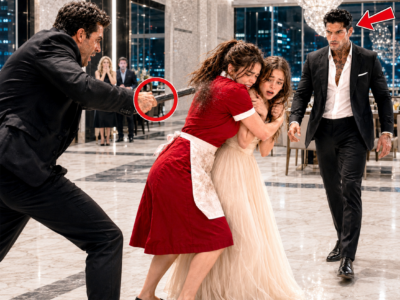
“Bring Her to Me”—The Mafia Boss Saw Her Beaten…His Order Changed Her Fate Forever
THE HOUSE THAT OWNED THE NIGHT
Clara didn’t remember the exact moment her life stopped belonging to her. It wasn’t the first kick, or the rain, or even the taste of blood filling her mouth in that narrow alley behind the club. It was the silence that followed—too heavy, too controlled, too intentional—right before a door opened and a man stepped out like the world itself had answered her suffering.
“Bring her to me.”
Those words didn’t feel like rescue. They felt like selection.
By the time she understood that, it was already too late.
The rain had been relentless that night, washing the city in a blur of neon and grime. Clara had been curled on the ground, arms shielding her ribs as Ricky paced above her like an exhausted animal trying to decide whether she was worth one more strike. Forty dollars. That was all it had taken for him to decide she deserved to break.
Then the door opened.
Not Ricky’s door. Not hers.
A different world stepped into the alley—silent men in dark suits, expensive shoes untouched by rain, umbrellas opening like black flowers. And behind them, a presence that didn’t need volume to dominate the space.
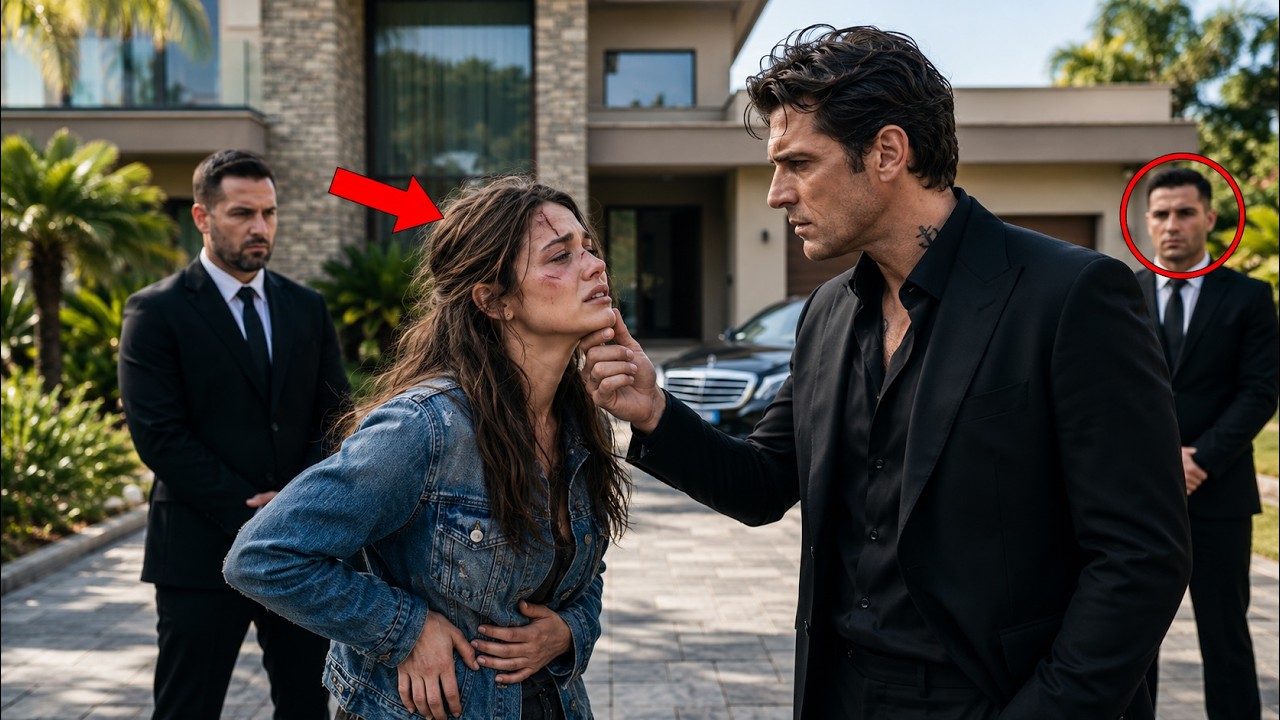
Damian Russo.
Clara didn’t look at his face at first. She looked at his shoes. Clean. Perfect. Undisturbed by the same world that was destroying her.
Ricky froze instantly, like a switch had been flipped inside him. The violence that had felt endless seconds ago evaporated into fear so sharp it almost looked like respect.
“Boss,” Ricky stammered. “I didn’t know—”
Damian didn’t respond.
He only looked at Clara.
That was the first mistake she made—meeting his gaze.
It wasn’t kind. It wasn’t curious. It was assessment. Like she was a problem that had walked into the wrong equation.
“You’re making a mess,” he said quietly.
And somehow, that sentence terrified her more than Ricky’s boots ever had.
She thought he would leave. People like him always left. Men like him didn’t step into broken things unless they planned to step over them.
But instead, he said, “Bring her to me.”
That was the moment the alley stopped being an ending and became a beginning.
She woke up in a room too clean to be real.
The ceiling was white. The air was warm. The silence was engineered, not natural. Every surface looked expensive in a way that made her feel like contamination.
Her ribs burned when she moved.
A man stood over her—another stranger, older, tired eyes, medical gloves snapping onto his hands.
“Don’t move too much,” he said. “You’re not dying. Yet.”
Clara tried to sit up anyway. Pain shot through her side like fire.
“Where am I?” she whispered.
“The boss brought you here,” the doctor said. “That’s all you need to know.”
That answer should have made her more afraid.
Strangely, it didn’t.
Because fear had already reached its limit in the alley. Everything after that was just continuation.
When Damian entered the room later, the temperature changed before he even spoke. Not physically—something more subtle. Like pressure in the air adjusting itself around him.
He stood by the door for a moment, watching her.
Then he walked closer.
Up close, he didn’t look like a myth. He looked like something worse—real.
“What is your name?” he asked.
“Clara.”
A pause.
“Why were you in my alley, Clara?”
“I… owed someone,” she said weakly.
“Forty dollars,” he repeated, like it offended him more than her injuries did.
He reached out. She flinched before she could stop herself.
But he didn’t hit her.
He tilted her chin upward, studying her face like a broken mechanism.
“You misunderstand your situation,” he said. “You are not here because I saved you. You are here because I require you.”
Clara swallowed hard. “Require me for what?”
Damian released her face slowly.
“For now,” he said, “to see what you are capable of.”
Then he left her there with a locked door and a silence that felt alive.
Days blurred.
She learned the rules without being told them.
She was not a guest. Not a prisoner. Not even an employee.
She was a variable being tested.
The house was enormous, but it behaved like a system—corridors guarded, doors silent, men stationed like punctuation marks at every threshold. She was allowed only certain spaces. Kitchen. Living room. Bedroom. Everything else was forbidden without being labeled as such.
And always, always, she was watched.
Damian did not hover. He didn’t need to. His presence existed in absence too—in the way conversations stopped when he entered, in the way people adjusted posture without realizing it.
He spoke to her rarely.
When he did, it was never small talk.
One morning, he slid a ledger across the kitchen island.
“Tell me what’s wrong with it,” he said.
Clara stared at him. “I don’t know anything about your business.”
“You know patterns,” he replied.
“I clean floors,” she said bitterly.
“You survive,” he corrected.
That was the first time she noticed something strange about him.
He wasn’t guessing about her.
He already knew her.
On the third night, she stopped pretending she wasn’t observing him back.
Damian was not random. Nothing about him was.
He drank coffee at exactly the same time every morning. He read reports in silence for exactly twenty-seven minutes before speaking to anyone. When he moved through the house, it was always for purpose, never hesitation.
But there were cracks.
Tiny ones.
He didn’t like noise. He didn’t like disorder. And he especially didn’t like when she looked at him too long.
That last one she discovered by accident.
He caught her watching him once.
Across the room.
Not afraid. Just studying.
His eyes lifted slowly from the document in his hand.
“Stop looking at me like that,” he said.
“Like what?”
“Like you’re trying to understand something that isn’t meant to be understood.”
Clara should have looked away.
She didn’t.
“I think everything can be understood,” she said quietly.
That was the first time something resembling irritation crossed his face.
“You think wrong,” he said.
But he didn’t punish her.
Which somehow felt more dangerous.
Everything changed the day Ricky came back.
Not into the alley.
Into the house.
She didn’t see it happen at first. She only felt the shift—the sudden tightening of security, the way conversations stopped mid-sentence, the way Damian stood a fraction more still than usual.
Then she saw Ricky through the window.
Bruised. Broken. Dragged.
Alive, but only technically.
Clara backed away from the glass instinctively.
“No,” she whispered. “No, no—”
Behind her, a voice answered calmly.
“He shouldn’t have touched what wasn’t his.”
She turned.
Damian was there.
Watching her reaction.
“You did this?” she asked, voice shaking.
“I corrected a mistake,” he said.
“That’s not correction,” she snapped. “That’s—”
“Order,” he interrupted.
The word landed heavier than anything else.
He stepped closer.
“You are afraid,” he said. “But not of what you think.”
Clara shook her head. “You don’t get to decide what I’m afraid of.”
For the first time, something in his expression shifted—not softness, not guilt.
Recognition.
Like she had just spoken a language he understood.
That night, she couldn’t sleep.
The house was too quiet again.
But this time, it wasn’t peaceful.
It was waiting.
When she finally left her room, she found him in the study.
Dim light. Open files. Glass of untouched whiskey.
“You shouldn’t be awake,” he said without looking up.
“I didn’t ask permission,” she replied.
A pause.
“That’s new,” he said.
Clara stepped closer. “Why did you bring me here?”
He finally looked at her.
And for the first time, there was no calculation in his gaze.
Only truth.
“Because you saw the cracks,” he said. “Even when you were dying in them.”
Silence stretched.
Then Clara asked the question she had been avoiding since the alley.
“Am I free?”
Damian leaned back slightly.
Outside, somewhere deep in the estate, a door closed.
A lock clicked.
“You were never free,” he said quietly. “You just didn’t notice what you belonged to.”
Clara should have run.
She didn’t.
Instead, she asked the only question that mattered.
“And if I don’t want to belong to it?”
That was the first time Damian Russo smiled.
Not warmly.
Not kindly.
But like a man who had finally found something worth breaking the rules for.
“Then you learn how to stand inside it,” he said. “Without breaking.”
And somewhere between fear and understanding, Clara realized something terrifying.
The cage wasn’t the house.
It was him.
And she hadn’t decided yet whether she wanted out.
Or deeper in.