A YOUNG BILLIONAIRE SECRETLY FOLLOWED HIS OLD MAID ONE EVENING AND LEARNED A SHOCKING TRUTH
A YOUNG BILLIONAIRE SECRETLY FOLLOWED HIS OLD MAID ONE EVENING AND LEARNED A SHOCKING TRUTH
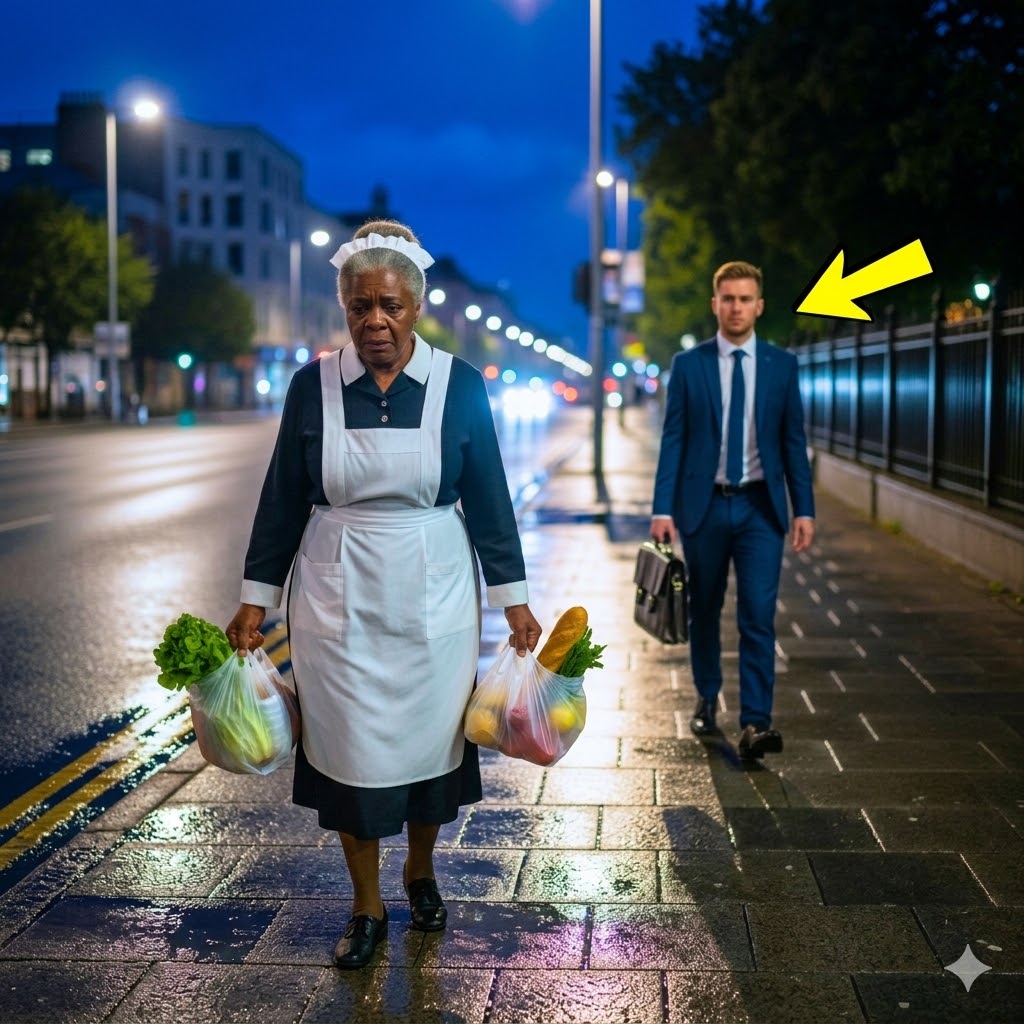
PART 2
By the time Andrew returned to his penthouse, morning light was breaking over Lake Michigan.
The elevator opened directly into marble, glass, polished wood, and silence. Usually, the view made him feel powerful. That morning, it felt like evidence.
Everything was perfect.
Everything was empty.
He stood by the window and looked over the skyline. His skyline. Terry Development owned more buildings than most people could name. Luxury towers, waterfront condos, office spaces, restaurants, boutique hotels. His company had reshaped Chicago one acquisition at a time.
For years, Andrew called it vision.
Now, after one night in a church basement, he wondered if another word fit better.
Blindness.
He heard the front door open at exactly 7:00 a.m.
Elizabeth.
Same as always.
Quiet footsteps. Pantry door. Coffee machine. Knife against cutting board as she sliced fruit for a man who had followed her in suspicion while she was feeding the hungry.
Andrew walked into the kitchen.
Elizabeth was setting out breakfast.
“Good morning, Mr. Terry,” she said.
Mr. Terry.
Not Andrew.
Not the little boy she once held after nightmares.
Mr. Terry.
He noticed her hands now. Thin, worn, swollen around the knuckles. Hands that had served soup to strangers. Hands that had carried him through childhood. Hands that had once saved seventeen lives.
“Elizabeth.”
She paused.
“Are you feeling all right, sir?”
He wanted to apologize. He wanted to ask about her daughter, the war, the medal, the soup kitchen, the years he had missed. But the words jammed in his throat.
“I’m fine,” he said. “I just didn’t sleep well.”
She nodded and poured his coffee.
As she turned to leave, he said, “Thank you.”
She looked back.
“For breakfast?”
“For everything.”
For one second, her face softened. Then she gave the smallest nod.
“Of course, sir.”
And she left him standing alone with a cup of coffee he no longer deserved.
That day, Andrew canceled every meeting.
His assistant looked frightened when he walked out of the office at 11:30.
“Sir, the investors from New York are waiting.”
“Tell them to wait.”
“They flew in for this.”
“Then they can fly out.”
He drove back to the church on 63rd Street.
In daylight, the neighborhood looked nothing like the glossy maps his development team used in presentations. There were cracked sidewalks, yes. Boarded windows, yes. But there were also children playing, old men talking on stoops, women carrying groceries, someone fixing a bike, someone laughing from a second-floor window.
People lived here.
Not units.
Not market opportunities.
People.
The church basement was unlocked. Inside, the tables were stacked, the kitchen cleaned, the smell of soup still hanging in the air.
“Can I help you?”
Andrew turned.
A young man stood in the doorway wearing the same military jacket Andrew had seen the night before.
“Marcus, right?”
The man’s eyes narrowed.
“You were here last night.”
“Yes.”
“You’re the developer.”
Andrew nodded.
Marcus gave a short, bitter laugh.
“Then what are you doing down here?”
“I’m trying to understand Elizabeth.”
Marcus crossed his arms.
“Miss Elizabeth doesn’t need to be studied like one of your buildings.”
Andrew accepted that.
“I know.”
“No, you don’t.”
Marcus walked to one of the tables and pulled out a chair.
“I met her three years ago. I came back from Afghanistan with a bad leg and worse memories. Couldn’t sleep. Couldn’t hold a job. Didn’t want to talk to anyone. I was sleeping behind this church when she found me.”
Andrew listened.
“She didn’t ask what I’d done wrong. Didn’t preach. Didn’t pity me. She brought me soup and sat beside me in the cold. Every week after that, she came back. Got me into a veterans program. Helped me find a room. Checked on me like I mattered.”
Marcus looked toward the kitchen.
“She saved my life.”
Andrew said softly, “She saved seventeen lives in Desert Storm.”
Marcus turned sharply.
“What?”
“She has a Bronze Star.”
Marcus stared at him.
“She never told me.”
“She doesn’t tell anyone.”
Marcus studied Andrew for a long time.
“You’ve known her your whole life, haven’t you?”
“Yes.”
“And you never knew?”
Andrew looked down.
“No.”
Marcus shook his head.
“That’s something, man. She gives everything to people like us, and the people closest to her don’t even see her.”
Andrew felt the words land exactly where they were meant to.
“I see her now.”
Marcus did not smile.
“Do you? Or do you just feel guilty?”
Andrew had no answer.
Marcus pointed toward the stove.
“She comes every Thursday at seven. If you want to understand, show up. But don’t come like a savior. Come ready to wash bowls.”
So Andrew did.
The next Thursday, he canceled a charity gala where he was supposed to give a speech about corporate responsibility and drove to the church instead.
Elizabeth was already there.
When he walked in, she stopped stirring the soup.
“Mr. Terry.”
“I came to help.”
Her face was guarded.
“Help?”
“If that’s all right.”
For a moment, he thought she would refuse.
Then she handed him a wooden spoon.
“Soup needs stirring.”
That was how Andrew Terry, billionaire developer, spent his Thursday night standing over a dented pot in a church basement while people he had never truly seen lined up for dinner.
At first, he was awkward.
He did not know how to speak to them. He did not know where to put his eyes. He kept wanting to explain himself, and every time he did, Marcus appeared nearby with a look that said, Don’t.
So Andrew served.
One bowl.
Then another.
Then another.
An old woman smiled and called him “baby.”
A little boy asked for extra bread.
A man with a cane thanked him without looking up.
Across the room, Elizabeth moved like light. She knew who needed more food, who needed less salt, who needed a blanket, who needed someone to listen. She remembered names, birthdays, medical appointments, court dates, prayer requests.
Halfway through the night, Andrew saw her sway.
She caught herself on the counter.
“Elizabeth.”
“I’m fine.”
“No, you’re not.”
“There are still people waiting.”
“When did you last eat?”
She did not answer.
Andrew filled a bowl and placed it in front of her.
“Sit down.”
Her eyes flashed.
“Don’t order me around in my own kitchen.”
He softened his voice.
“Please.”
Something in the word reached her. She sat.
Andrew returned to the line.
By the time the last bowl was washed and the final chair stacked, Elizabeth looked older than he had ever allowed himself to notice.
He drove her home.
In the car, he asked, “When was the last time you saw a doctor?”
She stared out the window.
“Three years. Maybe four.”
“Why?”
“Doctors cost money.”
“The insurance I provide—”
“Covers almost nothing,” she said. “Not tests. Not specialists. Not the medicine I need.”
Andrew’s throat tightened.
“Medicine?”
She looked at him then.
“Diabetes. Blood pressure. Nothing dramatic if you manage it. Dangerous if you don’t.”
“Why didn’t you tell me?”
“Because you never asked.”
The sentence filled the car like smoke.
The next morning, Andrew upgraded her insurance, scheduled a doctor’s appointment, and waited for her in the penthouse as if he had done something noble.
Elizabeth arrived, heard what he had arranged, and went very still.
“Why now?” she asked.
“I’m trying to help.”
“No,” she said. “You’re trying to fix your guilt.”
Andrew flinched.
“I should have done this years ago.”
“Yes, you should have.”
Her voice trembled, but she did not look away.
“I raised you, Andrew. I held you when your mother died. I packed your bags for college. I prayed over you when you were too proud to admit you were scared. I loved you like my own son.”
Tears rose in her eyes.
“And you never learned my middle name.”
Andrew could not speak.
“You want to help?” she continued. “Then stop trying to rescue me like a project. Look at what you built. Look at the people your buildings pushed out. Look at the families you turned into numbers. Because I am not the only person you never saw.”
She left him in the kitchen with those words.
That night, Andrew opened the files for his newest project: Southside Waterfront.
Six hundred families scheduled for displacement.
He read names for the first time.
Calvin Wilson. Seventy-three. Veteran. Lived in the same apartment for forty years.
Maria Santos. Single mother. Three children. Two jobs. No nearby housing options if displaced.
Darnell Price. Disabled. Fixed income.
Evelyn Brooks. Widow. Lived in the building since 1978.
The reports had been there all along.
Andrew had never read past the financial summary.
The next morning, his phone rang.
“Mr. Terry, this is Dr. Patel from Northwestern Memorial. You’re listed as the emergency contact for Elizabeth Hart.”
Andrew stood so fast his chair fell backward.
“What happened?”
“She collapsed during her appointment. She’s stable, but we admitted her.”
He reached the hospital in twenty minutes.
Elizabeth was asleep when he entered the room. An IV ran into her arm. Machines beeped softly. Without her uniform, without her apron, without a task to hide behind, she looked fragile in a way that terrified him.
Dr. Patel met him outside.
“Her diabetes is advanced. Early kidney damage. Severe anemia. Dangerously high blood pressure. All treatable, but unmanaged for years.”
Andrew pressed a hand to the wall.
“She couldn’t afford treatment.”
“That appears to be true.”
“She was feeding people instead.”
Dr. Patel’s expression softened.
“She told me she had responsibilities.”
Andrew sat beside Elizabeth’s bed after the doctor left.
When she woke, she looked embarrassed.
“I’m sorry, Mr. Terry.”
“Stop apologizing.”
She blinked.
His voice broke.
“Your middle name is Marie. Elizabeth Marie Hart. Born in Birmingham. Joined the Army at nineteen. Served as a combat medic. Saved seventeen lives under fire.”
Tears filled her eyes.
“You had a daughter named Grace,” he continued. “She died from diabetes complications because she couldn’t afford insulin.”
Elizabeth turned her face away.
Andrew leaned forward.
“I didn’t know because I never asked. I paid you, but I never protected you. I gave you the cheapest insurance I could find because you were a line item in a budget, and you turned my indifference into soup for strangers.”
She looked back at him.
“I am sorry,” he said. “I don’t deserve your forgiveness, but I need to become someone different. Not just for you. For everyone I ignored.”
Elizabeth reached for his hand.
Her grip was weak, but steady.
“I forgave you a long time ago, Andrew.”
It was the first time she had used his name in years.
“But forgiveness doesn’t mean nothing changes,” she said. “It means you have a chance to do better.”
He nodded, tears slipping down his face.
“Tell me how.”
“Don’t save me,” she said. “Stand with me. See what I see. And change what you’re building.”
Andrew stayed until she fell asleep.
Then he walked into the hallway and called his lead attorney.
“The Southside Waterfront project is paused.”
His attorney protested immediately.
“Andrew, we’ve already secured financing.”
“Pause it.”
“The board will lose their minds.”
“Then schedule a meeting. And send me every displacement record from the last ten years.”
“That’s thousands of files.”
“I know.”
“Why?”
Andrew looked through the hospital room window at Elizabeth sleeping.
“Because I’m done building on top of people I refuse to see.”
PART 3
The boardroom had never been so quiet.
Andrew stood at the head of the table with no slides, no profit projections, no polished speech. Just a stack of printed files and a face that looked like he had not slept in days.
His CFO, Martin, tapped a pen against the table.
“Andrew, we all understand you’ve had a personal week, but pausing Southside Waterfront is reckless.”
“It’s not reckless,” Andrew said. “It’s overdue.”
His business partner, Claire, leaned forward.
“We have investors. Contracts. Timelines. You cannot freeze a three-hundred-million-dollar project because you had an emotional experience at a soup kitchen.”
Andrew opened the first file.
“Calvin Wilson. Seventy-three. Lived in his apartment for forty years. Our company bought the building, renovated it, raised the rent from eight hundred dollars to twenty-three hundred, and gave him a buyout that lasted six months. He now sleeps in shelters.”
No one spoke.
Andrew opened another file.
“Maria Santos. Single mother. Three children. We displaced her from a neighborhood where she had school, childcare, and two jobs within reach. Now she commutes four hours a day.”
Martin sighed.
“These cases are unfortunate, but development creates winners and losers.”
Andrew looked at him.
“That sentence is exactly the problem.”
Claire crossed her arms.
“What are you proposing?”
“A new model. Mixed-income housing. Community ownership options. Right of return for displaced residents. Local hiring. Advisory boards led by people who live there. Smaller margins, longer timelines, fewer lives destroyed.”
Martin laughed once.
“You’re serious.”
“Yes.”
“We’ll lose investors.”
“Then we find better ones.”
“Our margins could drop forty percent.”
“Then they drop.”
Claire stared at him.
“What happened to you?”
Andrew looked down at the files.
“I followed a woman I thought was stealing from me and discovered she was feeding people my company helped make hungry.”
No one moved.
“I thought I owned half this city,” he continued. “But I didn’t know the people living in it. I didn’t know Elizabeth Hart, the woman who raised me. I didn’t know Calvin Wilson, whose home I took. I didn’t know Maria Santos, whose children I displaced. I knew numbers. And numbers are easy because they don’t look you in the eye.”
He pushed the files across the table.
“I’m asking you to look.”
Two board members left before the meeting ended.
Three threatened legal action.
But one older board member, Mrs. Lang, who had known Andrew’s grandfather, picked up Calvin Wilson’s file and read it silently.
Then she said, “Your grandfather built his first apartments by asking factory workers what they needed.”
Andrew looked at her.
“I didn’t know that.”
“You wouldn’t. Your father stopped telling that story when profit became more impressive than decency.”
Martin scoffed.
“With respect, nostalgia won’t pay debt.”
“No,” Mrs. Lang said. “But greed creates a different kind of debt. And I think we’re looking at the bill.”
By the end of four hours, Andrew had enough votes to restructure the project.
Not unanimous.
Not easy.
But enough.
He drove straight from the boardroom to Elizabeth’s house.
She opened the door in a robe, still recovering, her silver hair wrapped in a scarf.
“Andrew?”
“We’re changing the company.”
She studied him.
“Words or action?”
“Action. Southside Waterfront is paused. We’re rebuilding the proposal. I want you to join us as Community Relations Director. Full salary. Full benefits. Real authority. A seat at every meeting.”
Elizabeth was silent.
“I don’t want you as a symbol,” Andrew said. “I need you because you know what I don’t. You see people before projects.”
Her eyes filled.
“And if I say yes, you’ll actually listen?”
“I will.”
“And when it gets hard?”
“I’ll still listen.”
She stepped closer.
“People won’t trust you right away.”
“They shouldn’t.”
“You’ll be criticized.”
“I should be.”
“You’ll lose money.”
“I’ve lost more by not knowing what my money cost.”
Elizabeth looked at him for a long time.
Then she nodded.
“All right,” she said. “Let’s get to work.”
Three months later, Andrew stood before the city council with a revised plan.
The old presentation had opened with aerial renderings of luxury towers.
This one opened with faces.
“This is Calvin Wilson,” Andrew said.
Calvin sat in the front row, cane resting against his knee. He had agreed to become the community advisory director after making Andrew sit with him for two hours and listen to exactly what it felt like to lose a home after forty years.
“This is Maria Santos,” Andrew continued. “She is now our family services coordinator. She will help make sure no family is moved without real options, real support, and the right to return.”
Maria sat beside Calvin, chin raised, eyes shining.
Andrew clicked to the next slide.
“The new Southside Commons will include affordable housing, workforce housing, and market-rate units. Displaced families will have first right to return, and many will have pathways to partial ownership. Construction jobs will prioritize local residents. A community fund will support small businesses, childcare, and transportation.”
A councilwoman raised her hand.
“Mr. Terry, this is very different from your previous model.”
“Yes.”
“What changed?”
Andrew looked toward the back of the room.
Elizabeth sat there in a purple dress, hands folded in her lap, watching him with the same steady eyes that had watched him grow up.
“I did,” he said.
The vote passed.
When they walked outside, Calvin Wilson stopped beside Andrew.
“Don’t make me regret believing you.”
Andrew nodded.
“I won’t.”
“You might.”
“I know.”
Calvin stared at him, then gave the smallest smile.
“That’s the first honest thing you’ve said all day.”
From then on, Andrew’s life changed in ways no press release could capture.
Every Thursday night, he served dinner at the church basement.
At first, people watched him carefully. Some refused to take food from his hand. Others called him names under their breath. One woman told him, “You don’t get to buy forgiveness with soup.”
Andrew said, “You’re right,” and kept serving.
He learned names.
Marcus became the director of veteran outreach.
Calvin chaired the residents’ board.
Maria designed the relocation support program and insisted every family be spoken to in person, not by letter.
Elizabeth attended every meeting.
She was gentle with the vulnerable and merciless with executives who used phrases like “community friction” when they meant “people are hurting.”
Andrew watched her in awe.
She could silence a room of developers with one raised eyebrow.
One evening after a long meeting, Andrew found her sitting alone in the church basement.
“You’re tired,” he said.
“I’m old.”
“You’re not old.”
“I am old enough to know when a rich man is about to flatter me.”
He laughed.
She smiled too.
Her health was improving. Medication helped. Rest helped. Having people finally care whether she lived helped most of all.
Andrew sat across from her.
“Tell me about Grace.”
Elizabeth looked at the empty tables.
For a moment, he thought she would refuse.
Then she said, “She loved music. Gospel mostly, but also old soul records. She used to dance in the kitchen when she thought I wasn’t watching.”
Andrew listened.
“She had my stubbornness. Too much of it. When she got sick, she kept saying she was fine. I believed her because I wanted to. By the time I understood how bad it was, insulin prices had already forced her to ration. Her body gave out before anyone with power cared.”
“I’m sorry.”
Elizabeth nodded.
“After she died, I needed somewhere to put the love. So I cooked. First one pot. Then two. Then every week. Feeding people didn’t bring her back. But it kept me from dying with her.”
Andrew swallowed hard.
“I wish I had asked.”
“So do I.”
That answer hurt.
But it was honest.
She reached across the table and touched his hand.
“Don’t waste your life wishing backward. Use it forward.”
So he did.
Eighteen months later, Southside Commons opened not with a ribbon-cutting ceremony, but with a block party.
Andrew had wanted something quiet.
The residents refused.
There were long tables down the street, music from speakers, children running between buildings, old neighbors embracing each other, and new front porches facing the evening sun.
Calvin Wilson stood in front of his new apartment, looking toward the lake.
“Same view,” Andrew said.
Calvin nodded.
“Almost.”
Andrew’s face fell.
Calvin glanced at him.
“I’m messing with you. It’s better. My knees don’t hurt on the stairs anymore.”
Andrew laughed, relieved.
Maria’s children ran past them toward the playground. She followed, calling their names with the exhausted happiness of a mother whose children were finally safe.
Marcus arrived with several veterans from the outreach program. One of them had just signed a lease. Another had started work on the construction crew. Another was three months sober.
None of it was perfect.
But it was real.
Elizabeth stood beside Andrew near the community garden.
The late sun turned her silver hair gold.
“You did good,” she said.
“We did.”
“Yes,” she said. “We did.”
Andrew looked at the families around them.
“I spent years building towers I could admire from seventy floors up. But from up there, people disappear.”
“And now?”
“Now I think you only understand a city when you come down low enough to learn its names.”
Elizabeth smiled.
“That’s a good lesson.”
“I had a good teacher.”
A little girl ran up and grabbed Elizabeth’s hand.
“Miss Elizabeth! Come see our kitchen. It has a window!”
Elizabeth laughed.
“I’m coming, baby.”
Before she followed the child, she turned back to Andrew.
“You know, for a long time, I thought you were lost.”
“I was.”
“But you came back.”
He looked around.
“To where?”
Elizabeth’s eyes softened.
“To people.”
Then she walked away.
Andrew stood there as music rose around him. People laughed. Someone shouted for more plates. Children chased each other between the buildings. The community garden smelled of soil and basil. Porch lights began clicking on one by one.
For the first time in his life, Andrew did not feel above the city.
He felt inside it.
Later that night, when the block party was winding down, Elizabeth found him sitting on Calvin’s bench.
“You all right?” she asked.
He nodded.
“I was thinking about the night I followed you.”
She sat beside him.
“I thought you were stealing from me,” he said.
“I know.”
“You knew?”
“Andrew, you are not as subtle as you think.”
He laughed quietly.
Then his eyes grew wet.
“The truth is, you had been giving to me my whole life. Love. Patience. Grace. And I still suspected you before I trusted you.”
Elizabeth looked out at the glowing windows.
“People often suspect what they don’t understand.”
“I don’t want to be that man anymore.”
“You’re not.”
“I don’t know if I deserve that.”
“Deserving is not the point,” she said. “Becoming is.”
He let those words settle.
“Are you proud of me?” he asked.
The question came out small, almost childlike.
Elizabeth turned to him fully.
“I have been proud of you many times,” she said. “When you learned to ride a bike. When you went to college. When you built your first building. But I am proudest of you now.”
Andrew wiped his face.
“Why now?”
“Because now your success has a soul.”
He bowed his head.
For years, he had believed legacy meant a name on steel.
Now he understood.
Legacy was Calvin watching the sunrise from a home he could afford.
Legacy was Maria’s children sleeping in the same neighborhood where their mother worked.
Legacy was Marcus helping another veteran survive the night.
Legacy was Elizabeth living long enough to be cared for by the people she had spent her life caring for.
Legacy was not what rose above people.
It was what held them.
When Andrew finally stood, the stars were out over Southside Commons.
He looked at the buildings, the porches, the families, the garden, the church basement down the street where it had all begun.
A year and a half ago, he had followed Elizabeth expecting to uncover a thief.
Instead, he found a mirror.
And in that mirror, he saw the poverty of a man who had everything except compassion.
He saw the emptiness of success without service.
He saw the woman who had raised him, not as a servant, but as a soldier, a mother, a healer, and a quiet hero.
And because she had not given up on him, he learned to become someone worth knowing.
Elizabeth touched his arm.
“Ready to go home?”
Andrew looked around.
For most of his life, home had meant the penthouse. The private elevator. The silent rooms. The skyline behind glass.
But now home meant something else.
A place where people knew your name.
A place where your choices helped others breathe easier.
A place where love was not spoken as charity, but practiced as justice.
He smiled.
“Yeah,” he said softly. “I’m home.”
And somewhere in the laughter of children, in the glow of kitchen windows, in the old church basement where soup still warmed the forgotten, Andrew Terry finally understood what Elizabeth had known all along:
The richest life is not the one that owns the most.
It is the one that sees the most.
Gives the most.
Loves the most.
And never again walks past another human being as if they are invisible.
News
ICE AGENTS CAREERS DESTROYED AFTER ARREST OF BLACK FEDERAL JUDGE IN HER DRIVEWAY WITHOUT A WARRANT
ICE AGENTS CAREERS DESTROYED AFTER ARREST OF BLACK FEDERAL JUDGE IN HER DRIVEWAY WITHOUT A WARRANT “That’s what you all say,” he snapped. “Turn around before I make you.” She…
RACIST COP ARRESTS BLACK FEDERAL JUDGE FOR DRIVING A “STOLEN” CAR — JURY AWARDS HER $910K
RACIST COP ARRESTS BLACK FEDERAL JUDGE FOR DRIVING A “STOLEN” CAR — JURY AWARDS HER $910K It was 2:15 on a quiet Tuesday afternoon when Judge Patricia Williams pulled into…

RACIST OFFICER ARRESTS BLACK SEAL EVACUATED FROM IRAN AT AIRPORT — PENTAGON STEPS IN, FACES 20 YEARS
RACIST OFFICER ARRESTS BLACK SEAL EVACUATED FROM IRAN AT AIRPORT — PENTAGON STEPS IN, FACES 20 YEARS He was thirty-eight years old, an active-duty Navy SEAL with more than sixteen…
ICE AGENTS CAREERS OBLITERATED AFTER ARREST OF BLACK NAVY SEAL IN HIS DRIVEWAY WITHOUT A WARRANT
ICE AGENTS CAREERS OBLITERATED AFTER ARREST OF BLACK NAVY SEAL IN HIS DRIVEWAY WITHOUT A WARRANT The sun was already warm. Two houses down, a retired couple trimmed hedges. Across…

OFFICER ARRESTED BLACK NAVY SEAL IN UNIFORM AT GAS STATION — PENTAGON STEPS IN, 58 YEARS PRISON
OFFICER ARRESTED BLACK NAVY SEAL IN UNIFORM AT GAS STATION — PENTAGON STEPS IN, 58 YEARS PRISON Darius had been shot at in Iraq. He had carried wounded men through…
COP ASSAULTS BLACK FEDERAL JUDGE AT AIRPORT — SECURITY CAMERA EXPOSES HIM
COP ASSAULTS BLACK FEDERAL JUDGE AT AIRPORT — SECURITY CAMERA EXPOSES HIM What he did not know was that the woman in front of him was not just another traveler…
End of content
No more pages to load