They Hired His Team to Hunt Bigfoot — But They Were Actually Hunting Them | Bigfoot Horror Story
The Apex Contract
The mud in the Olympic Peninsula doesn’t just stick to you; it tries to swallow you. It’s a cold, black slurry of decomposed hemlock and glacial silt that smells like the beginning of time. As I lay there, my cheek pressed against the frozen earth, the transition from hunter to prey felt complete.
The man who signed my paycheck, Thomas Caldwell, was currently trying to put a .300 Win Mag bullet through my skull. Beside me, Robert Callahan was a mess of shallow breaths and leaking crimson. The “Bigfoot” we had been hired to find was no longer a myth—it was a heavy, rhythmic thudding in the darkness, a shadow that moved with a silence that defied its massive displacement.
We were the bait. We were the sport. And the sport was about to get very, very bloody.
I: The Silver Lining and the Silicon Valley Suit
It started three days earlier in a glass-walled conference room overlooking Elliott Bay. The air-conditioning was humming a low, expensive tune. I’m Daniel Harper. My life has been defined by two things: the decade I spent as a Scout Sniper in the Army, and the decade I’ve spent trying to pretend that didn’t change me.
When I got out, I realized I didn’t know how to talk to people who hadn’t seen a sunrise through a thermal scope. So, I built Apex Recovery. We were the guys you called when the Forest Service gave up. We found the missing, we tracked the un-trackable, and we operated in the “gray zones” of the wilderness.
My team was my family. There was Lucas Bennett, a man who could hit a moving target at a thousand yards while nursing a hangover; Samuel Pierce, a former Ranger who could read the forest floor like a morning newspaper; Victor Grant, our medic, who had patched up more sucking chest wounds than most ER doctors; and Robert Callahan, our tech wizard who kept our comms encrypted and our drones flying.
Thomas Caldwell didn’t look like a monster. He looked like a man who spent his weekends on a yacht. He wore a Patek Philippe watch and a tailored wool blazer.
“Mr. Harper,” he said, sliding a manila folder across the mahogany table. “My organization represents a group of private investors. We are interested in a biological anomaly in the Quinault Rainforest. Specifically, an unclassified hominid.”
I didn’t even look at the folder. “I don’t do Bigfoot hunts, Mr. Caldwell. I do search and recovery. There are plenty of guys with podcasts and camouflage hats who will take your money for that.”
“They don’t have your tactical expertise,” Caldwell replied, his eyes like two polished stones. “And they don’t have your survival rate. Open the folder.”
I did. What I saw stopped the sarcasm in my throat. These weren’t grainy “Patterson-Gimlin” clips. These were high-resolution forensic photos. A Douglas fir, four feet in diameter, snapped like a toothpick ten feet off the ground. A Roosevelt elk that had been literally turned inside out. And then, the print. It was eighteen inches long, showing mid-tarsal breaks that no human—and no bear—could replicate.
“A six-figure payout,” Caldwell said. “Half up front. One week. We provide the observers; you provide the safety and the tracking.”
Money talks. In my case, it screamed. I called the boys. We thought it was the easiest payday of our lives. We were wrong.
II: Into the Emerald Cathedral
The Olympic Peninsula is one of the wettest places on Earth. It’s a vertical jungle where the moss grows so thick it can muffle a gunshot. We met Caldwell’s “observers” at a trailhead near Lake Quinault. There were four of them: Vance, Miller, Stokes, and Davis.
They weren’t scientists. I knew the type immediately. They carried themselves with the tight, coiled aggression of private military contractors. They were carrying suppressed HK417s—not exactly the gear you bring for a “biological survey.”
“Nice hardware for a birdwatch,” Lucas muttered, adjusting his pack.
Vance, the leader of their security detail, gave a thin, predatory smile. He had a scar that ran from his temple to his jaw. “Lots of predators out here, Bennett. Better safe than sorry.”
We hiked ten miles into the interior, far beyond where the weekend hikers stopped. The forest changed. The trees became giants, their branches draped in “Old Man’s Beard” moss that swayed in the wind like ghosts. The silence was absolute. No birds, no squirrels. Just the sound of our boots in the muck.
By the second night, the “Vibe” (as Sam called it) had gone south. We were being watched. I felt it in the small of my back—that prickle of electricity that tells a soldier he’s in a kill zone.
“Boss,” Sam whispered as we set up camp near a jagged ravine. “I found something. Half a mile back.”
I followed him into the treeline. He pointed to a cedar. Tucked into the roots was a pile of bones—not animal bones. It was a hiking boot, still attached to a desiccated fibula. Nearby was a rusted GoPro mount.
“Doesn’t look like a Bigfoot kill,” I noted, looking at the clean, serrated marks on the bone.
“It’s not,” Sam said, his voice trembling. “Those are saw marks. Someone harvested the trophy, Dan. This wasn’t an accident.”
Before I could process that, the smell hit us. It was a cocktail of wet dog, sulfur, and rotting copper. It was thick enough to taste.
From the darkness of the heavy timber, a sound erupted. It wasn’t a growl. It was a high-frequency whistle followed by a chest-thumping “wump” that vibrated the air in my lungs. Something massive moved through the brush, snapping limbs the size of my thigh like they were dry kindling.
I clicked on my SureFire light. For a split second, the beam hit a pair of eyes. They weren’t glowing red like in the stories; they were reflective amber, set deep into a massive, sloping brow. The creature was at least nine feet tall, covered in matted, dark hair that looked like wet peat moss. It didn’t roar. It just stared at us with an intelligence that was terrifyingly human.
Then, it vanished. Not by running, but by simply stepping back into the shadow and becoming part of the forest.
III: The Trap Springs
The next morning, Samuel Pierce was gone.
His sleeping bag was empty, but his rifle was still leaning against a tree. There was no blood, no sign of a struggle. Just a single, tactical boot print in the mud leading away from the camp—a print that matched Vance’s gear.
“He probably went for a leak and fell,” Vance said, nonchalantly cleaning his fingernails with a combat knife. “The terrain is treacherous.”
“Don’t give me that bullshit,” I snapped, my hand moving toward my sidearm. “Sam doesn’t ‘fall.’ What did you do with him?”
Caldwell stepped out of his tent, looking as if he’d just stepped out of a spa rather than a rain-soaked wilderness. “Mr. Harper, let’s not get emotional. We have a schedule to keep. We move further up the ridge. Now.”
We were outnumbered and outgunned. Lucas caught my eye and gave a nearly imperceptible shake of his head. Not yet, his eyes said. Wait for the opening.
We moved. But Lucas, the paranoid genius he is, had hidden a trail cam near our old site. During a break, he pulled me aside and showed me his tablet, which was synced to the camera’s local burst.
The footage was a nightmare. It showed Vance and Miller dragging a heavy burlap sack toward a tree. They weren’t hiding it. They were hanging it from a branch like a grisly wind chime. Blood was seeping through the fabric.
But they weren’t looking for the Bigfoot. Vance was holding a radio—Sam’s radio. He keyed the mic, letting the static hiss through the woods, using it as a beacon. Then, he looked directly into the hidden camera, smiled, and shot the lens.
“They’re baiting the creature,” Lucas whispered, his face pale. “But they’re using Sam to do it. And they’re using us to lead it right into their lap.”
I didn’t wait. I marched back to Caldwell. I didn’t care about the contract or the money. I leveled my 1911 at his throat. “Where is he, you son of a bitch?”
Caldwell didn’t flinch. He actually chuckled. It was a dry, hollow sound that made the hair on my neck stand up.
“You’re a very intelligent man, Daniel,” Caldwell said. “That’s why you were so expensive. You see, the ‘Bigfoot’—the Sasquatch—is a magnificent beast. But hunting it with modern thermal optics and high-caliber rifles? It’s too easy. It lacks… stakes.”
He took a step forward, the muzzle of my gun pressed into his sternum.
“The real ‘Most Dangerous Game’ isn’t a man, and it isn’t a monster,” Caldwell continued. “It’s a man being hunted by a monster while other men hunt them both. My clients are bored, Daniel. They’ve hunted lions in the Serengeti and polar bears in the Arctic. They wanted something new. They wanted to watch a team of elite Tier-1 operators try to survive an apex predator while being harassed by a superior tactical force.”
“You’re insane,” I whispered.
“No,” Caldwell corrected. “I’m a businessman. And you? You’re the entertainment. Run along now. You have a ten-minute head start before Vance and the boys start the clock. Oh, and watch out for the ‘Forest People.’ They haven’t eaten a Green Beret in quite some time.”
IV: The Killing Floor
The world exploded into chaos.
A suppressed round hissed past my ear, thudding into a hemlock tree. “Contact!” I screamed.
We dove for the treeline. Lucas, Callahan, Grant, and I—the remains of my brotherhood—scrambled into the dense undergrowth as the first volley of fire from Caldwell’s mercenaries tore through our gear.
“Go! Go! Go!” I yelled, shoving Callahan toward a rocky outcropping.
We ran. We weren’t just running from bullets; we were running into the arms of something much older and much angrier. The forest seemed to close in around us. The fog descended, thick and cloying, turning the woods into a maze of gray and green.
Behind us, we could hear the methodical pop-pop-pop of the mercenaries’ rifles. They weren’t trying to kill us yet. They were herding us. Pushing us deeper into the “Anomalous Zone” where the massive prints were most frequent.
“Victor! Cover the rear!” I shouted.
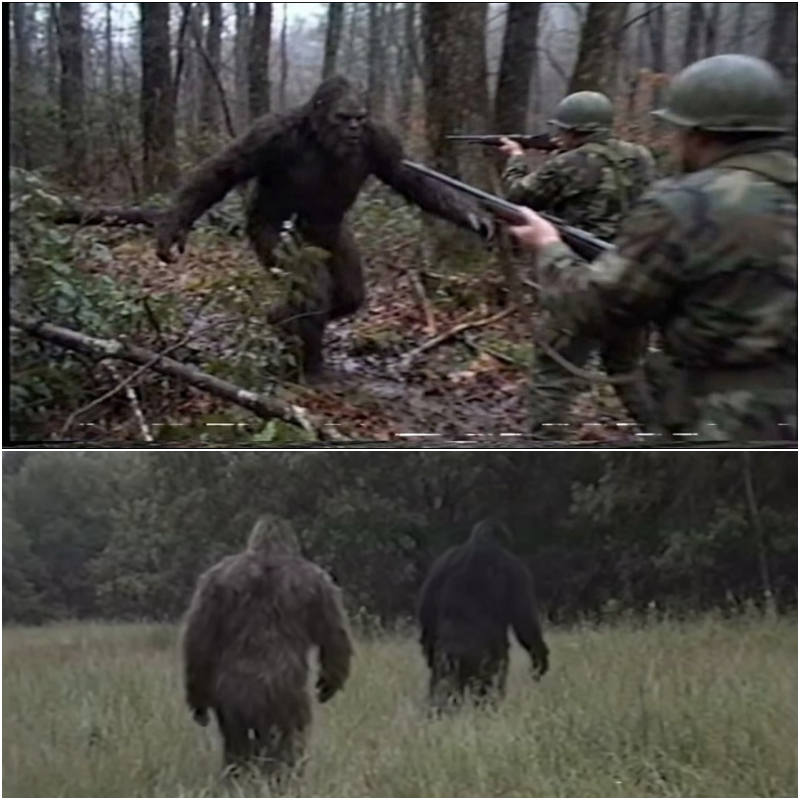
But Victor didn’t answer. I turned just in time to see a massive, hairy arm—thick as a tree trunk—reach out from behind a cedar. It didn’t grab him; it swiped. The force of the blow sent Victor Grant flying twenty feet into a ravine. There was a sickening crunch as he hit the rocks.
“Victor!” Callahan screamed, turning to run back.
“No!” I tackled him. “He’s gone, Robert! Look!”
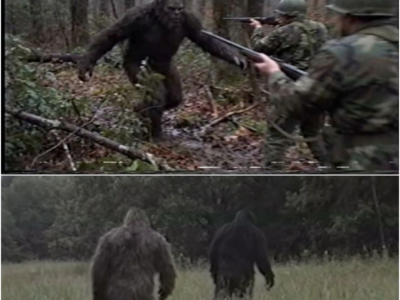
From the shadows, three of the creatures emerged. They didn’t roar like movie monsters. They made a rhythmic, clicking sound with their tongues, like a high-speed code. They moved with a terrifying, fluid grace, staying low to the ground, their massive hands knuckle-walking through the mud.
They weren’t just animals. They were a war party.
They ignored the mercenaries for a moment, focusing on us. One of them, a scarred male with a silver patch on its chest, picked up a stone the size of a bowling ball and hurled it. It whistled through the air, narrowly missing Lucas’s head and shattering a sapling behind him.
“We’re caught in the middle!” Lucas yelled, firing a burst from his carbine into the brush to keep the creatures back. “The mercs are behind us, and these things are in front!”
“The ravine!” I pointed toward the steep drop-off where Victor had fallen. “It’s the only way out of the kill zone! Down! Now!”
We slid down the muddy embankment, the cold mud caking our eyes and mouths. We hit the bottom, a shallow creek bed choked with fallen logs.
That’s where we are now.
Callahan is bleeding out from a stray mercenary round that caught him in the hip during the descent. Lucas is low on ammo, scanning the ridge with his last remaining optic. Above us, I can hear Vance and his team laughing as they move into position. They have the high ground. They have the thermals.
And from the other side of the creek, the clicking has started again.
The water in the puddles is vibrating. Thump. Thump. Thump.
Caldwell was right about one thing: the stakes are high. But he forgot one rule about soldiers. When you back us into a corner, we stop being “entertainment” and start being the nightmare.
I looked at Lucas, then at the bleeding Callahan. I reached into my pack and pulled out the one thing the mercs didn’t know I had—a brick of C4 we’d brought for “clearing debris” on our surveys.
“If we’re going to be the bait,” I whispered, “we might as well be the kind that bites back.”
V: The Silence of the Grave
The transition from a high-stakes tactical retreat to a desperate struggle for survival happened in the heartbeat it took for Vance’s rifle to cycle.
When we dove into the ravine, leaving Victor’s body behind, the world stopped being about money or contracts. It became about the physics of the forest—the way the mud saps your strength and how the darkness plays tricks on a soldier’s mind. Robert Callahan was pale, his tactical shirt soaked through with a dark, spreading stain.
“Boss,” he wheezed, his teeth chattering from the onset of shock. “My arm… I can’t feel my fingers.”
“Save it, Rob,” I whispered, tightening the tourniquet until he winced. “Lucas, what’s the status?”
Lucas was perched on a mossy shelf, his eye glued to his night-vision optic. “They’re coming. Vance, Stokes, and Davis. They’re moving in a wide chevron pattern. They aren’t rushing. They know we’re carrying a casualty. They’re treating this like a Sunday morning stroll through a shooting range.”
But something was wrong. The forest, which should have been alive with the sound of wind and rain, had gone utterly tomb-quiet. The “Baseline Noise” of the Pacific Northwest—the constant drip of water, the rustle of ferns—had been swallowed by a heavy, pressurized silence.
Then the smell returned. It was the scent of a slaughterhouse left to rot in a cedar chest. It was copper and musk, so thick it felt like it was coating my tongue.
Down in the ravine, the green infrared lasers of the mercenaries suddenly stopped their methodical sweeping. They froze, intersecting at a single point near a massive Sitka spruce.
“Hold up,” Vance’s voice crackled over the radio frequency we were monitoring. “I’ve got a massive heat bloom dead ahead. Too big for a human. Davis, Miller, get your thermals on this.”
Through the fog, a shape began to manifest. It didn’t just appear; it seemed to unfold from the shadows of the trees.
VI: The Warden of the Woods
My brain, trained for urban combat and human threats, struggled to scale what I was seeing. The creature stood nearly ten feet tall. Its shoulders were so broad they seemed to block out the very forest behind it. The rain slicked off its matted, dark fur, giving it the appearance of moving obsidian.
It didn’t roar. It didn’t beat its chest. It simply stood there, a mountain of primal muscle, observing the men with the glowing green eyes and the metal sticks. It exuded a terrifying sense of authority.
“Take it down!” Miller’s voice screamed from below.
The suppressed HK417s erupted. The sound was a series of rhythmic thud-thud-thuds. I watched through my binoculars as the high-velocity rounds hit the creature’s chest. They made dull, heavy sounds—like stones being thrown into a wet mattress.
The beast flinched. It took a half-step back, its head snapping to the side as a round grazed its temple. But it didn’t fall. It didn’t even scream. Instead, it moved.
I have seen professional athletes move, and I have seen predators strike, but I have never seen anything that large cover distance that fast. It cleared twenty feet in a single, fluid bound. It hit Miller first. The impact wasn’t a tackle; it was a collision. Miller was sent airborne, his body snapping against a tree trunk with the sound of a dry branch breaking. He was dead before he hit the ferns.
Vance screamed, fumbling for a fresh magazine. The creature turned, grabbed him by the tactical vest, and lifted all 220 pounds of him off the ground with one hand. Vance stabbed frantically with a combat knife, burying the blade in the creature’s forearm. The beast didn’t even flinch. It slammed Vance into the rocky floor of the ravine—once, twice—until the screaming stopped.
Up on the ridge, Lucas and I were carved from stone. We didn’t breathe. We didn’t blink. The massive creature stood over the broken remains of the hunters. Then, slowly, it tilted its head back and looked directly up the slope.
Its eyes—pale, sickly yellow—locked onto our position. It knew we were there. It had known since the first night.
But it didn’t climb. It gave a low, vibrating huff that rattled the rocks beneath my chest, turned its back, and vanished into the timber.
“Why?” Lucas whispered, his voice trembling. “Why did it leave us?”
I looked at the carnage below. “Because we weren’t the ones shooting. They aren’t monsters, Lucas. They’re the bouncers. Caldwell’s guys brought a war to their home. We were just caught in the crossfire.”
VII: The Dinner Bell
We couldn’t stay. Robert was fading, and Caldwell was still out there with his remaining security. But the rules had changed. I realized that the forest was a weapon, and we were finally going to use it.
“Lucas, give me the chem lights and the strobe,” I said. “We’re going to ring the dinner bell.”
We hid Robert in a limestone crevice, camouflaging him with hemlock boughs. Then, we circled the high ridge, moving toward the last known position of Stokes and Davis. They were pushing up the slope, their thermals scanning for our heat signatures.
“Now,” I signaled.
Lucas cracked three high-intensity military-grade chem lights and hurled them down the ravine, straight into the path of the advancing mercenaries. I sparked a road flare and tossed it into a patch of dry brush.
The forest erupted into a strobe-lit nightmare of green and red.
“Movement!” Stokes yelled, his voice tight with panic.
The sniper rifle roared—a massive, unsuppressed .338 Lapua. The sound echoed off the canyon walls like a cannon blast.
The forest answered immediately.
A guttural, chest-shaking roar—the first one we had heard—erupted from three different directions. The giants weren’t stalking anymore. They were charging. Drawn by the lights, the noise, and the scent of the men who had already wounded one of their own, the “Forest People” descended.
We watched from the safety of the rocks as Stokes was dragged into a thicket, his screams cut short by a sickening crunch. Davis tried to run, but a second shadow cut him off, hoisting him into the air like a ragdoll.
The multi-million dollar security team was being systematically erased.
VIII: The Final Invoice
We pushed hard toward the extraction point—a logging clearing four miles north. Halfway there, I found Caldwell’s discarded pack. A waterproof dossier had spilled out into the mud.
I picked it up. It wasn’t a biological survey. It was a “Target Manifest.”
It contained our service records. Our psychological profiles. Even Victor’s medical history. Under the heading “Quarter 3 Entertainment,” I saw my own face staring back at me.
“We weren’t hired,” I whispered to Lucas. “We were curated. He chose us because he thought our ‘will to survive’ would make for a better show for his investors.”
We reached the clearing just as the rhythmic thumping of a helicopter approached. The fog was a wall of gray. In the center of the LZ stood Thomas Caldwell. He was alone, clutching a flare gun, his pristine wool sweater caked in filth. He looked like a man who had finally realized that his money didn’t work in the dark.
“Caldwell!” I screamed, stepping out of the trees with my 1911 leveled at his head.
He spun around, his face a mask of aristocratic terror. “Harper! Thank God! The helicopter—it’s nearly here! I’ll double your pay! Triple it!”
“The contract is over, Thomas,” I said, my finger tightening on the trigger.
But I didn’t have to pull it.
From the trees behind him, four massive silhouettes emerged. They towered over the clearing, their eyes reflecting the approaching helicopter’s searchlight.
The pilot’s voice crackled over Caldwell’s dropped radio: “I’ve got multiple massive heat signatures! Too many! I’m bugging out! I can’t land!”
The helicopter banked hard, its lights disappearing into the mist. Caldwell was left in the silence.
The largest creature—the one with the scar—stepped forward. It didn’t rush. It didn’t roar. It looked at Caldwell, then it looked at me. It saw the gun in my hand, and it saw the dossiers in the mud.
In an act of terrifyingly human judgment, the creature reached down and picked up a jagged boulder. It didn’t throw it like an animal; it aimed.
The impact was instantaneous. The billionaire who wanted to hunt the ultimate prey was gone, crushed into the soil of the mountain he thought he could own.
The giant turned its head one last time. We stood perfectly still. We didn’t raise our rifles. We didn’t move. We gave the forest the respect it had earned.
The creature gave a short, dismissive huff—the sound of a king dismissing a peasant—and melted back into the trees. Its brothers followed.
IX: The Borderlands
Two days later, a SAR team found us. We had carried Robert six miles to a Ranger station.
The official report says it was a “Rogue Grizzly Attack.” The feds came in, cleaned up the camp, and made sure no one talked too loudly. Caldwell’s “associates” didn’t want the world knowing their CEO had died on a psychopathic hunting trip.
But I still have the dossier. And I still have the memory of those amber eyes.
People ask me if I’ll ever go back into the Olympic Peninsula. They ask if I want to “prove” what’s out there.
I tell them no.
We like to think we’re at the top of the food chain because we have paved roads and GPS and high-caliber rifles. But there are places in this country where the light doesn’t reach, where the rules of the city don’t apply.
The Sasquatch aren’t myths, and they aren’t monsters. They are the silent owners of the deep wild. They don’t want our money, and they don’t want our fame. They just want us to stay on our side of the line.
I stay on my side now. Because I know that next time, I might not be the one the forest decides to spare.
And every night, at 3:00 AM, I hear that clicking sound in my dreams, and I wonder if they’re still out there, watching the treeline, waiting for the next man who thinks he’s an apex predator.
👉 Link youtube: https://youtu.be/Hz5Ya3JflOA?si=uiptm-hBN6lfQlKR
News
They Don’t Attack by Accident — Here’s What He Learned After Living Among Bigfoots for 3 Years
They Don’t Attack by Accident — Here’s What He Learned After Living Among Bigfoots for 3 Years The Butcher of the Blue Ridge The mist in the Appalachian “Hells” doesn’t…
He Investigated Bigfoot Attacks — What He Found Was Hidden by the Government | Bigfoot Horror Story
He Investigated Bigfoot Attacks — What He Found Was Hidden by the Government | Bigfoot Horror Story The Boundary at Oak Haven The maps in the Blue Ridge Mountains are…
He Found Bigfoot Footage on His Trail Cam in Alaska 2026, Then Made the Mistake of Going Back
He Found Bigfoot Footage on His Trail Cam in Alaska 2026, Then Made the Mistake of Going Back The wind didn’t howl in the Alaskan interior; it hissed. It was…
This Is What Bigfoot Really Is — And Here Is the Proof | Cliff Barackman
This Is What Bigfoot Really Is — And Here Is the Proof | Cliff Barackman The old-growth timber of the Blue Mountains doesn’t just grow; it looms. Here, in the…
NEW 2026 Bigfoot Footage Has Experts Confused — And It’s Going Viral
NEW 2026 Bigfoot Footage Has Experts Confused — And It’s Going Viral The air in the Pennsylvania Wilds doesn’t just get cold in late October; it gets heavy. It’s a…
The Bigfoot Cover-Up That Was Never Meant to Be Exposed
The Bigfoot Cover-Up That Was Never Meant to Be Exposed The rain in the Cascades doesn’t just fall; it colonizes. It soaks through Gortex, eats its way into leather boots,…
End of content
No more pages to load