Arrogant Managers Laughed At The New Cleaner Until She Fired Them All Three Days Later
Arrogant Managers Laughed At The New Cleaner Until She Fired Them All Three Days Later
The rain began to lash against the glass windows of the COO office, blurring the city lights into jagged streaks of neon. Alice stared at the tablet Jamal had left on her desk. The name Arthur Sterling pulsed on the screen like a digital heartbeat.
Arthur had been at her father’s bedside when the first biopsy came back positive. He had been the one to hold the company together—or so they thought—while Gilbert was in the hospital. He was the man Alice had called Uncle Artie since she was five years old.
But the data didn’t lie. The AI script siphoning funds wasn’t a crude hack; it was an elegant, deep-rooted parasite, woven into the very fabric of Pinnacle’s financial software. Desmond Richards had been a loud, bigoted distraction—a frontline shield that Arthur had likely installed to draw fire while he quietly bled the company dry.
Alice’s phone buzzed again. A second text from Arthur: Don’t keep an old man waiting, Alice. We have so much to celebrate.
Alice looked at Jamal. “How long until he knows we’ve breached the script?”
Jamal’s face was grim in the blue light of the monitors. “The script has a heartbeat monitor. Every time the root directory is accessed, it pings an external server. He probably knew the moment I opened the file.”
“Then he’s not inviting me to dinner to celebrate,” Alice whispered, her mind shifting back into the tactical gear she had used in the janitor’s closet. “He’s inviting me to a negotiation. Or a funeral.”
The Lion’s Den
Alice didn’t call her father. Gilbert was finally sleeping, his body recovering from the grueling chemotherapy. She wouldn’t wake him with the news that his best friend was a thief. Not until she had the kill-shot.
She walked out of the building, her tailored suit crisp, her posture regal. She didn’t take her backpack. She took her leather portfolio, but inside, she had hidden a small, high-gain digital recorder and a direct link to Jamal’s remote station.
The black sedan waiting at the curb was silent. The driver, a man Alice didn’t recognize, opened the door without a word. As she slid into the leather interior, the scent of expensive cologne and old money filled her lungs.
Arthur Sterling was sitting in the back, looking every bit the elder statesman of industry. He smiled, the crinkles around his eyes suggesting a warmth that his bank account refuted.
“Alice, dear. You look exhausted. Cleaning house is a messy business, isn’t it?”
“It’s thorough work, Arthur,” Alice replied, her voice steady. “But sometimes you find a stain that’s soaked all the way through the floorboards.”
Arthur chuckled, a dry, papery sound. “Let’s eat. The Blue Room has the best sea bass in the city. We can talk about the ‘stains’ there.”
The Blue Room Revelation
The restaurant was a fortress of exclusivity, the kind of place where tables were spaced far enough apart that you could plan a coup without being overheard. Arthur ordered a vintage Bordeaux and leaned back, his hands steepled.
“I saw the board records from today,” Arthur said. “Impressive. Truly. Your father always said you had the stomach for the hard stuff. Desmond was a fool, of course. A useful fool, but a fool nonetheless. He was too loud. Too… visible.”
“You put him there,” Alice stated. It wasn’t a question.
“I did,” Arthur admitted freely. “Desmond’s job was to make people look at the surface. If everyone is complaining about the VP’s coffee-spilling and his blatant bias, no one is looking at the ledger. It’s the oldest trick in the book, Alice. Create a fire in the lobby so no one notices the vault is being emptied in the basement.”
“You’ve stolen sixty-two million dollars over five years,” Alice said, her voice dropping to a whisper. “You used my father’s illness as a cover. You forged his name on policy shifts that ruined people’s lives.”
Arthur’s smile didn’t falter. “I didn’t ‘steal’ it, Alice. I reallocated it. Your father’s vision for Pinnacle was becoming… expensive. All these diversity grants, these community outreach programs, the ‘Second Chance’ hiring initiatives. They were eating into the margins. I simply moved the money into a private fund that ensured the board stayed happy and the dividends stayed high.”
“You siphoned it into your own offshore accounts, Arthur. Don’t dress it up as corporate strategy.”
Arthur leaned forward, the candlelight reflecting in his cold, gray eyes. “And what are you going to do? Tell your father? The shock alone might kill him. The doctors said he needs peace. If you go to the authorities, the scandal will tank the stock. Pinnacle will be under federal investigation for a decade. Thousands of people will lose their jobs. Your ‘house cleaning’ will result in the building being demolished.”
He took a slow sip of wine. “Or… we can reach an understanding. You are the COO now. You’re brilliant. You’re capable. I can make sure the board supports every one of your ‘cultural’ reforms. You can have the soul of the company, Alice. Just leave me the keys to the vault. We can be a very powerful team.”
The Janitor’s Counter-Move
Alice felt the weight of the moment. It was the same choice she had seen so many executives make—the compromise of integrity for the sake of stability. She looked at Arthur, the man who had bought her a teddy bear when she was six, and saw a stranger.
“You’re right about one thing, Arthur,” Alice said, opening her portfolio. “My father can’t handle this right now. And a public scandal would be devastating.”
Arthur’s eyes gleamed. “I knew you were a pragmatist.”
“But,” Alice continued, “you’re wrong about who has the leverage.”
She pulled out a physical printout of a document Jamal had found at the very bottom of the encrypted chain. It was an insurance filing from twenty years ago, predating the AI script. It concerned a warehouse fire that had nearly bankrupted Pinnacle in its infancy.
“I spent my first three days mopping the basement of the records department,” Alice said. “Desmond told me to clean the storage rooms because he thought it was a punishment. But those rooms contain the physical backups of the old insurance claims. Files you thought were shredded two decades ago.”
Arthur’s face twitched.
“The fire that started Pinnacle’s first big insurance payout? The one that gave my father the capital to expand? You started it, Arthur. You burned down the original warehouse to get the money. My father never knew. He thought it was an accident. But you’ve been blackmailing the company’s history since day one.”
“That’s ancient history,” Arthur hissed. “No court will take that up.”
“Maybe not,” Alice said. “But the AI script is current. And here’s the thing about Jamal—he’s not just a good CTO. He’s a genius. While you were talking, he’s been following the ‘heartbeat’ of your script. He’s already traced the external server to your private residence. And he’s currently in the process of rerouting the siphoned sixty-two million back into Pinnacle’s general treasury.”
She slid her phone across the table. On the screen was a live feed of Arthur’s personal bank account balances. The numbers were dropping in real-time, millions of dollars vanishing every second.
“You can’t do that!” Arthur gasped, reaching for the phone.
Alice pulled it back. “I already did. By the time we finish this sea bass, your offshore accounts will be empty. The money is going into the Pinnacle Equity Foundation—the very thing you tried to defund. It’s an anonymous ‘charitable donation’ from an undisclosed source. Even the IRS won’t ask questions about a massive influx of cash into a non-profit.”
Arthur was hyperventilating now, his silver-tongued composure shattered. “I’ll ruin you. I’ll tell everyone Gilbert was complicit in the warehouse fire.”
“Go ahead,” Alice said. “I have the recorded testimony from the old foreman who saw you with the gasoline cans. He’s been living in a nursing home you paid for in Arizona. I found his name in the janitor’s records. He was more than happy to talk once I promised him a better facility.”
Alice stood up. “You’re going to resign tonight, Arthur. Health reasons. You’re going to retire to your estate, and you are never going to set foot in Pinnacle Industries again. If you ever speak my father’s name, or try to contact a single board member, the FBI gets the AI script and the arson evidence.”
Arthur sat in the shadows of the Blue Room, a ghost of the titan he had been an hour ago. He looked at the wine, then at Alice. “You really did learn everything from the floor up, didn’t you?”
“The best way to see the dirt is to get on your knees,” Alice said. “Goodnight, Arthur. The car is outside. It’s going to take you home for the last time.”
The New Dawn
The following Monday, the atmosphere at Pinnacle was electric. The announcement of Arthur Sterling’s sudden retirement had shocked the industry, but Alice didn’t give the rumors time to breathe.
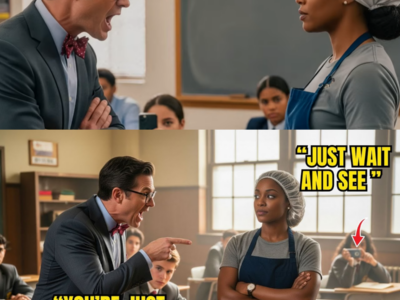
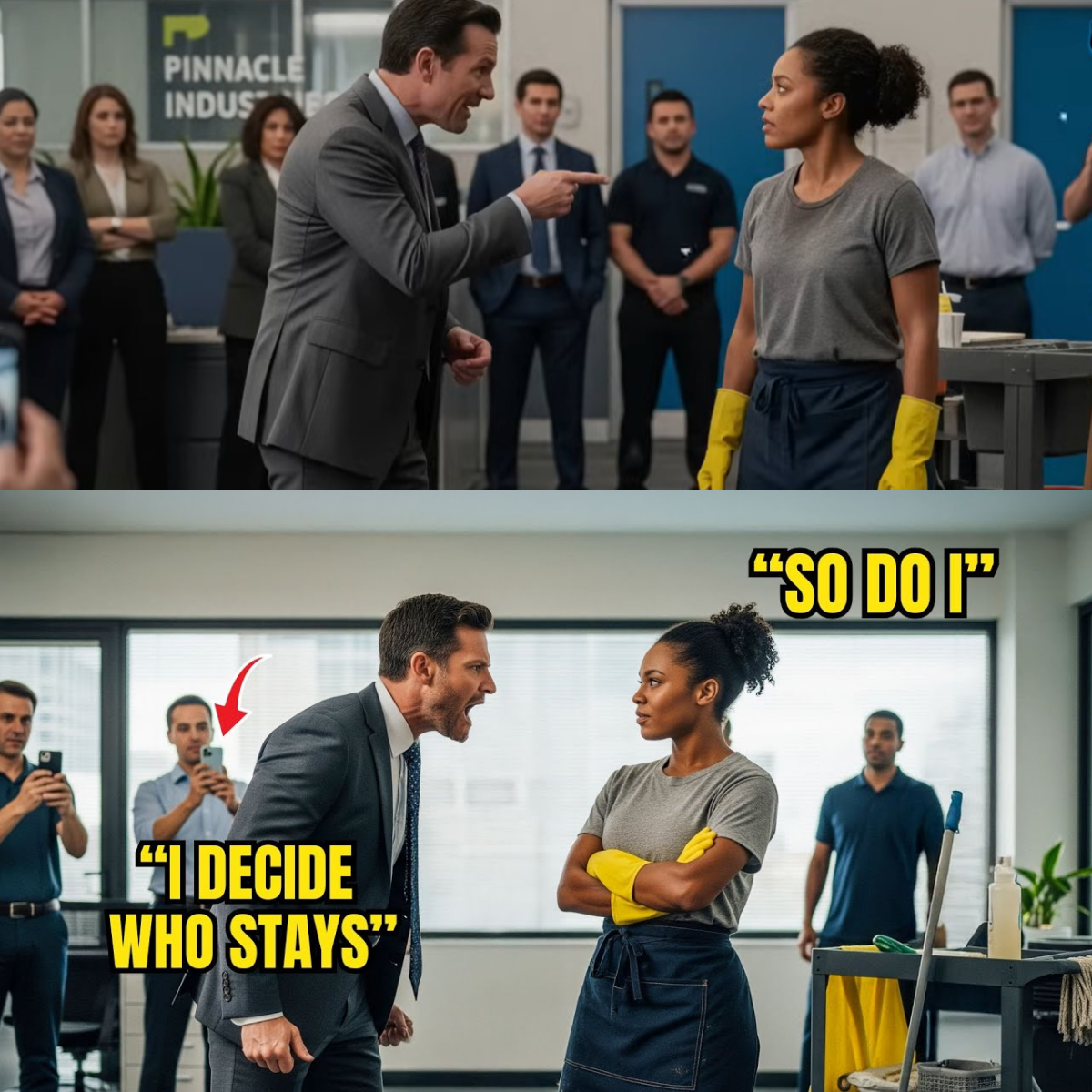
She stood in the lobby, the same marble floor where Desmond had spilled coffee on her shoes just weeks ago. But today, the lobby wasn’t just a pass-through for executives; it was a gathering place.
Alice wasn’t wearing her power suit. She was wearing her blue janitor’s jacket over a simple dress. She stood on a small platform, looking out at the hundreds of employees—the janitors, the IT techs, the junior managers, and the VPs.
“Two weeks ago, I stood here with a mop,” Alice began, her voice carrying without the need for a microphone. “I saw how this company treats the people it thinks are invisible. I saw how arrogance can blind even the most brilliant minds to the talent standing right in front of them.”
She looked at Maria and Jamal, who were standing in the front row.
“Pinnacle is no longer a hierarchy of importance,” Alice continued. “From today, we are a community of contribution. We have recovered sixty million dollars in ‘misallocated’ funds. That money will not go to executive bonuses. It is going into a permanent endowment for employee education, childcare, and a venture fund for any staff member—at any level—who has an idea that can make this company, or this world, better.”
The silence that followed was broken by a single person clapping. Then another. Then a roar of applause that shook the chandeliers.
Gilbert Johnson watched from the balcony, a cane in his hand, a tear of pure pride tracking down his cheek. He had built the company, but his daughter had saved its soul.
The Final Sweep
Late that night, after the celebrations had died down, Alice walked through the quiet halls. She reached the executive supply closet and opened the door.
She took out a mop and a bucket.
She walked to the spot where Desmond had mocked her, where the coffee stain had once been. Even though the floor was spotless, she dunked the mop in the water and began to clean.
“You missed a spot,” a voice joked from the shadows.
Alice turned to see a young man in a custodial uniform. It was Ramon, the new hire with the environmental science degree she had promoted to the operations team.
Alice laughed. “I think I got it this time, Ramon.”
“You did more than that, Ms. Johnson,” Ramon said, stepping into the light. “You changed the way the air feels in here. People are actually breathing.”
“That’s the goal,” Alice said, handing him the mop. “Keep an eye on the corners, Ramon. That’s where the dust likes to hide.”
Alice walked toward the elevator. As the doors began to close, she saw her reflection in the polished brass. She didn’t see the CEO’s daughter or the Wharton MBA. She saw the woman who knew that the most important part of any building isn’t the penthouse—it’s the foundation.
Pinnacle Industries was finally clean.
Epilogue: The Beat Stories Moral
Alice Johnson’s story is a reminder that leadership is not a title; it is a perspective. When we distance ourselves from the “lowest” among us, we lose the ability to lead the “highest.” True power doesn’t come from looking down on others; it comes from having the courage to see the world from their level.
Desmond Richards found out that the person you humiliate today might be the person you have to answer to tomorrow. Arthur Sterling learned that greed is a script that eventually runs out of code.
And Alice? Alice learned that sometimes, the best way to clean house is to start with the people who think they’re too clean to touch the dirt.